Modica
Modica spreads across a deep ravine in south-eastern Sicily, a late-baroque city of monumental staircases, twin cathedrals and chocolate made the old way. Rebuilt with extraordinary confidence after the earthquake of 1693, it forms part of the UNESCO-listed Val di Noto and rewards walkers with some of the finest urban architecture in Europe.
Why visit
Modica is one of the eight south-eastern Sicilian towns inscribed by UNESCO as the Late Baroque Towns of the Val di Noto, praised as the final flowering of Baroque art in Europe. What draws travellers here is architecture on a dramatic scale: churches stacked above the rooftops, stairways that climb entire hillsides, and a cathedral facade that is among the most photographed in Sicily. Yet the city also offers quieter pleasures. Its chocolate, processed at low temperature after a method linked to the Spanish era and traced to Aztec practice, is sold in historic laboratories along the main street. The birthplace of the poet Salvatore Quasimodo, a Nobel laureate, opens a window on twentieth-century Italian literature, and the lanes of the upper town reveal prehistoric cave dwellings in the rock itself. It is a city that balances spectacle and intimacy better than almost any in Sicily.
Character and history
Modica’s story is one of ruin and reinvention. The earthquake of January 1693 devastated south-eastern Sicily, and Modica rose again on or beside its older bones, rebuilt in the exuberant baroque style that gives the Val di Noto its identity. Before that catastrophe the city had been a seat of power: as capital of the County of Modica, one of the great feudal domains of the medieval Mediterranean, it accumulated the wealth that its churches would later express. The city is divided into two souls. Modica Alta climbs the ridge in a tangle of steps and alleys beneath the ruins of the Castle of the Counts, whose clock tower is the emblem of the town; Modica Bassa unrolls along the valley floor around Corso Umberto, where the Church of San Pietro presides over its staircase of apostles. In the rock beneath both are cave dwellings and prehistoric burials, evidence that the ravine sheltered people long before any cathedral.
What to see
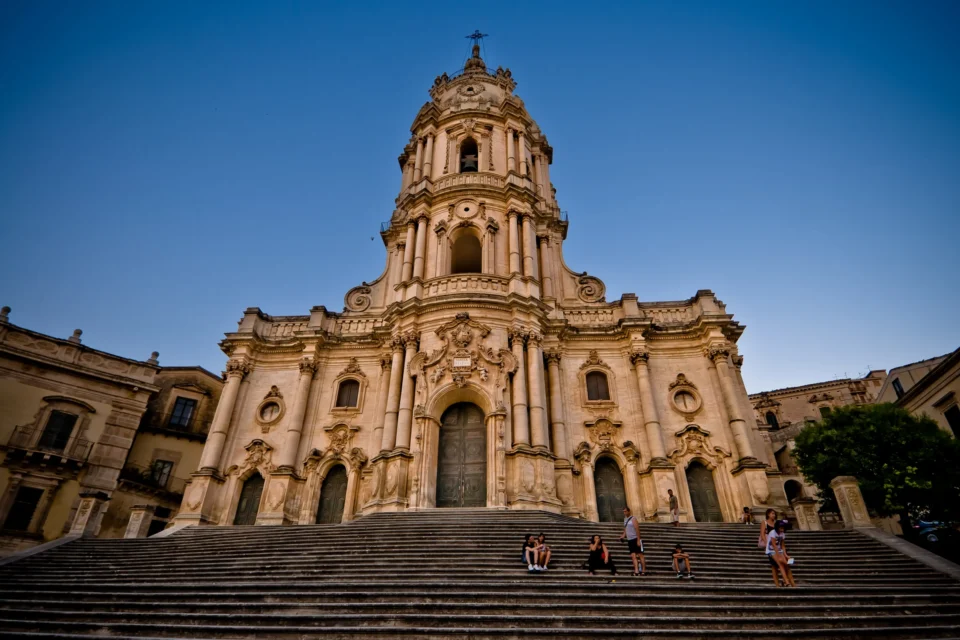
The Duomo di San Giorgio is the city’s masterpiece, raised at the head of a sweeping baroque staircase and crowned by a soaring late-baroque facade attributed to the architect Rosario Gagliardi. Step inside for the luminous nave and the sense of theatre that Sicilian baroque does best. Across town, the Church di San Pietro commands the lower city from its own apostle-flanked staircase, its statues line the balustrade like sentries above Corso Umberto. A short climb into the upper lanes brings you to the Casa Natale Salvatore Quasimodo, the modest house where the poet was born, now a small museum to his life and work. To round out the picture of the city and its territory, the Museum Civico di Modica gathers archaeological and historical collections that reach back to the prehistoric settlement of the ravine. Between monuments, detour into a chocolate laboratory; nearly every street in the lower town has one.
How to experience
See San Giorgio twice: once from below at the foot of the staircase, and once from a terrace higher up the opposite slope, where the whole facade seems to hover over the rooftops. Late afternoon is kindest to walkers; the city is vertical, and steps are the honest price of its views. Taste the chocolate properly, plain, with chilli, or with cinnamon, and ask a laboratory how the low-temperature working keeps the sugar grainy in the old manner. Quasimodo’s birthplace rewards a slow half-hour, especially for readers of his Hermitage poems. If your dates fall near the chocolate festival in early December, expect the town at its busiest and most aromatic. And leave an evening free simply to climb into Modica Alta as the lights come on, when the staircases empty and the domes glow above you.
Practical planning
Modica lies in the province of Siracusa, linked by buses and regional trains from Syracuse, Catania and Ragusa; most visitors arrive by car, which makes the surrounding Val di Noto towns easy to combine. Park below the centre where possible, because the historic core is largely pedestrian and steeply stepped. Comfortable shoes matter more than dress code, though modest dress is expected inside churches. Summer heat can be punishing on the stairways, so schedule climbs for morning or evening. Opening hours for the Quasimodo house, the civic museum and the churches vary through the year, so check locally or on the regional portal visitsicily.info before setting out. Two nights is the sweet spot: one for the monuments, one for the lanes, the chocolate and the view.
Nearby places
The baroque triangle continues at Scicli and Ragusa Ibla, both within a short drive, while the city of Syracuse adds Greek theatre and Ortygia’s old town to the itinerary.
Worth building a day around.
Casa Natale Salvatore Quasimodo
Regione Siciliana — Visit Sicily, in “Modica - Visit Sicily”, identifies Casa Natale Salvatore Quasimodo as a visitor-relevant attraction associated with Modica. Verified source…
Chiesa di San Pietro
Regione Siciliana — Visit Sicily, in “Modica - Visit Sicily”, identifies Chiesa di San Pietro as a visitor-relevant attraction associated with Modica. Verified source…
Duomo di San Giorgio
Regione Siciliana — Visit Sicily, in “Modica - Visit Sicily”, identifies Duomo di San Giorgio as a visitor-relevant attraction associated with Modica. Verified source…
Museo Civico di Modica
Regione Siciliana — Visit Sicily, in “Modica - Visit Sicily”, identifies Museo Civico di Modica as a visitor-relevant attraction associated with Modica. Verified source…
Journeys in Modica.
Demo — Modica Private Highlights Tour
Let a local expert design your Modica day.
Tell us your dates and pace. A travel designer replies within one working day.