Sacile
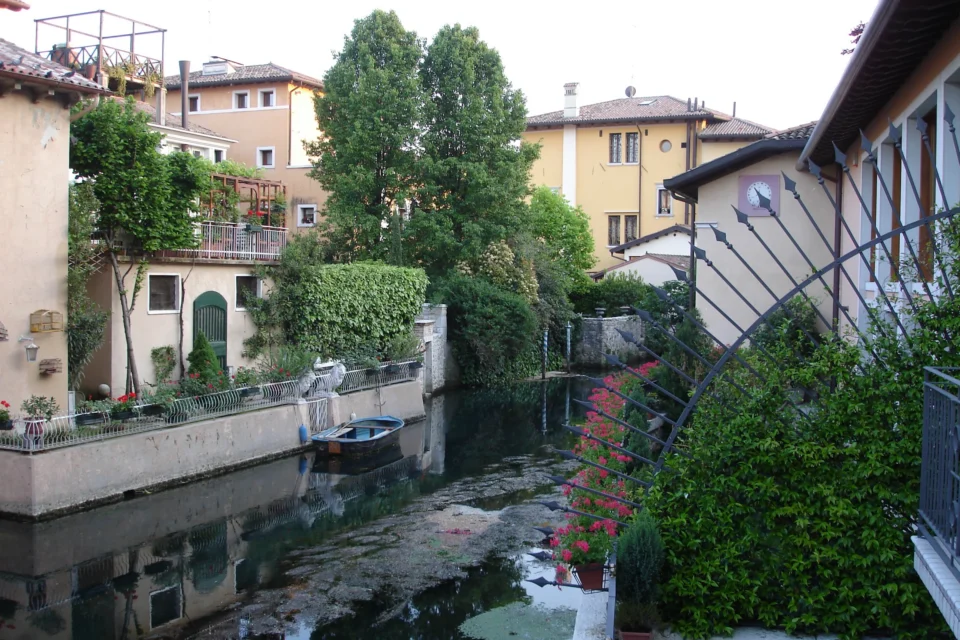
The clear green Livenza splits and folds around Sacile’s old town, and along its banks stand palazzi that earned the place its nickname, the Garden of the Serenissima. A Venetian drawing room of a square, medieval walls and towers, and a river made for slow paddling give this small city an elegance surprising travellers on the Venice–Udine line.
Why visit
Sacile is the kind of town that reorganises an itinerary. Its centre sits on islands in the Livenza, ringed by water and faced with Renaissance and Baroque palazzi whose reflections were celebrated enough to earn the town the name “Giardino della Serenissima” — the Garden of the Republic of Venice. The local tourism portal calls Piazza del Popolo a Venetian-style drawing room, and it is: arcaded, sun-warmed, and opening straight onto the river. Travellers who stop find a compact ensemble of historic palaces, a cathedral with a striking blessing angel on its tower, city walls with surviving towers, and a river that still shapes daily life through kayaking, fishing and guided boat outings. It makes an easy, beautiful pause between Venice and the Friulian hills — or a base for them.
Character and history
The crossing of the Livenza mattered early: after Lombard forces destroyed Oderzo in the seventh century, the river crossing here sat on the road linking Pavia to Cividale, and Paolo Diacono’s history records a clash nearby in the late 600s. The town took shape in the eighth century as a military outpost on an artificial island in the river — a “sacco”, possibly the source of the name. Under the Patriarchs of Aquileia from the eleventh century, it grew into a place where prince-bishops came to hold judgments and festivities, receiving communal statutes in 1190; in November 1366 the Constitutiones Patriae Foriiulii, the great law code of the Patriarchate, were promulgated here. From 1420 Sacile shared Friuli’s fate under the Republic of Venice, and river traffic on the navigable Livenza brought prosperity: noble families lined the banks with palazzi, among them the residence built for Giacomo Ragazzoni in the later 1500s. The Napoleonic wars brought a battle at nearby Camolli in April 1809, and the twentieth century brought bombardments in both world wars, for which the town earned a Bronze Medal of Military Valor. The Livenza, meanwhile, never stopped working — powering mills and metalworks, and giving the centre its two-island geography.
What to see
Anchor your visit on Piazza del Popolo, the arcaded square that steps down to the water, flanked by the Town Hall (Loggia), the historic seat of the municipality. Nearby rises the Cathedral of San Nicolò, whose bell tower carries a sculpted blessing angel hoisted into place by helicopter in 1957. The grandest house is Palazzo Ragazzoni, the sixteenth-century residence of the Ragazzoni family with frescoes attributed to Montemezzano, now hosting the town’s visitor infopoint. In Piazza Duomo itself, the palazzi that give Sacile its nickname line up: Palazzo Carli, home to the Pino Casarini Modern Art Gallery, the neighbouring Palazzo Ovio Gobbi and the storied Palazzo Ettoreo. The fortified past survives in the Walls and Towers of Sacile, whose three surviving towers include the Torre dei Mori. Religious landmarks include the twin Church of San Gregorio and Ospitale San Gregorio, a medieval church with its hospital, and the small Church of Santa Maria della Pietà beside the Ponte della Pietà on the riverbank. Around the town stand quieter devotional buildings: the Temple of San Liberale, the countryside Church of Fossabiuba (Madonna delle Grazie), the Church of San Daniele and the riverside Church of San Giovanni Battista di Livenza.
How to experience
Cross the bridge at dusk first — the mirrored palazzi explain the Garden of the Serenissima faster than any plaque. Then take the river on its own terms: the tourism portal promotes kayaking, canoeing and rafting on the Livenza, plus guided river tours that read the town from the water. Walk the walls-and-towers circuit along the Livenza promenade, visit Palazzo Ragazzoni while picking up maps at the infopoint, and settle into Piazza del Popolo for an aperitivo as the arcades fill. Cyclists can follow the flat river corridors towards the Tagliamento; drivers should pair Sacile with the castles and mosaics of the surrounding province for a full day.
Practical planning
Sacile has its own station on the Venice–Udine railway, and the historic centre lies within a short walk — the town works well without a car. The centre is flat and compact, though the basilica-and-palazzi circuit involves some cobbles. Gallery and church opening hours are limited and vary by season; confirm current arrangements through visitsacile.it, the official tourism portal, or the comune’s site. Spring and autumn suit the river activities best, and summer evenings bring the square to life. Comfortable walking shoes and swim-season courage for a paddle cover most requirements.
Nearby places
Spilimbergo, home of the Friuli Mosaic School and a Romanesque-Gothic cathedral, lies across the plain to the northeast — the natural pairing within the province.
Worth building a day around.
Chiesa di San Gregorio e Ospitale San Gregorio
Portale ufficiale VisitSacile: elenca sia la Chiesa San Gregorio (con cortile usato per eventi) sia l'Ospitale San Gregorio tra le architetture della città. Il…
Chiesetta di Fossabiuba (Madonna delle Grazie)
Elenchata tra le chiese del portale ufficiale VisitSacile. Non determinato.
Chiesetta di San Daniele
Elenchata tra le chiese del portale ufficiale VisitSacile. Non determinato.
Chiesetta di San Giovanni Battista di Livenza
Elenchata tra le chiese del portale ufficiale VisitSacile. Non determinato.
Chiesetta di Santa Maria della Pietà
Elenchata tra le chiese del portale ufficiale VisitSacile; posizione accanto al Ponte della Pietà sul Livenza. Sul percorso fluviale del centro storico.
Duomo di San Nicolò
Il portale ufficiale VisitSacile elenca il Duomo di San Nicolò con campanile tra le chiese visitabili della città; è il duomo cittadino dedicato al…
Galleria d'Arte Moderna Pino Casarini
Pagina ufficiale VisitSacile: la galleria si trova a Palazzo Carli; collezione donata alla parrocchia (68 dipinti, 150 bozzetti per l'Arena di Verona, 800 disegni,…
Mura e Torrioni di Sacile
Pagina ufficiale VisitSacile 'Mura e Torrioni': tre torri superstiti (Torrione del Duomo XII sec., Torrione di San Rocco 1470-1485 con leone di San Marco,…
Palazzo Carli
Elencato tra le architetture del portale ufficiale VisitSacile; la pagina ufficiale della Galleria Casarini dichiara che la galleria 'si trova a Palazzo Carli'. Sede…
Palazzo Comunale (Loggia)
Elencato tra le architetture del portale ufficiale VisitSacile. Esterno/loggia visibile dallo spazio pubblico.
Palazzo Ettoreo
Elencato tra le architetture del portale ufficiale VisitSacile. Non determinato.
Palazzo Ovio Gobbi
Elencato tra le architetture del portale ufficiale VisitSacile, in Piazza Duomo. Non determinato.
Palazzo Ragazzoni
Pagina ufficiale VisitSacile: proprietà comunale dal 1934 (dono Lucia Lacchin), affreschi di Francesco Montemezzano, statue in stucco scuola di Alessandro Vittoria, Salone d'Onore, cappella…
Piazza del Popolo
Elenchata tra le architetture del portale ufficiale VisitSacile come piazza principale della città, 'Giardino della Serenissima', affacciata sul fiume. Spazio pubblico urbano.
Tempio di San Liberale
Elenchato tra le chiese del portale ufficiale VisitSacile. Non determinato.
Torre dei Mori
Elencata tra le architetture del portale ufficiale VisitSacile con pagina dedicata. Non determinato.
Journeys in Sacile.
Demo — Sacile Private Highlights Tour
Let a local expert design your Sacile day.
Tell us your dates and pace. A travel designer replies within one working day.