Matera
Matera, in Basilicata, shelters one of the world’s oldest continuously inhabited urban landscapes: the Sassi, cave quarters cut into a limestone ravine, inscribed by UNESCO in 1993 with the Park of the Rupestrian Churches. European Capital of Culture in 2019 and a Mediterranean capital of culture in 2026, it layers prehistory, frescoes and film sets into a few walkable kilometres.
Why visit
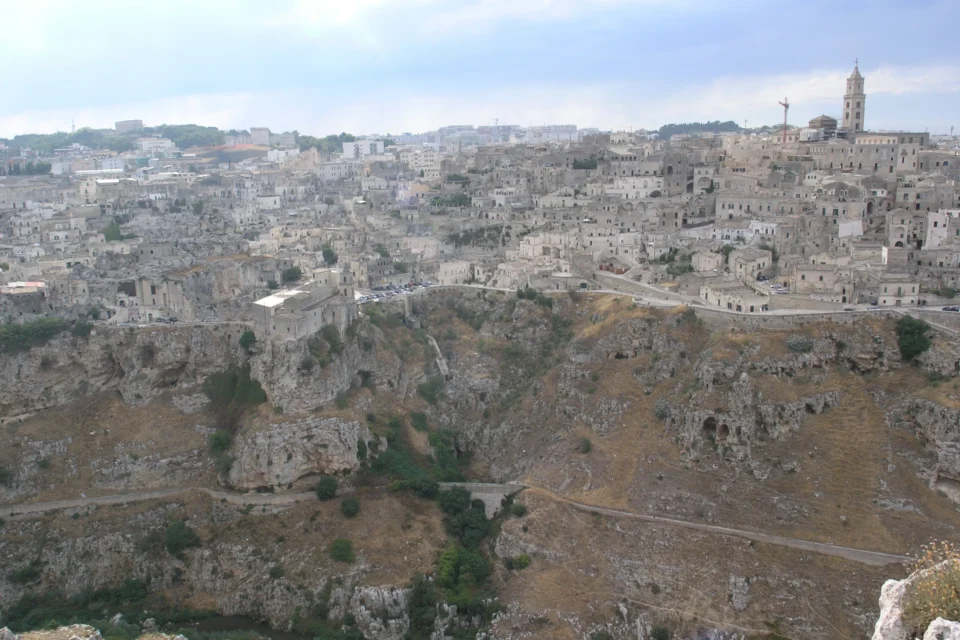
There is nowhere else quite like Matera. The Sassi — districts of dwellings, churches, monasteries and hermitages built into natural caves of the Gravina gorge — were named a UNESCO World Heritage Site in 1993 as an extraordinary testimony of a vanished way of life, and today they have become the city’s living stage: guesthouses in cave homes, restaurants in rock vaults, and the entire ravine glowing gold at dusk. The regional tourism authority counts Matera among the most ancient cities in the world, with settlement traces reaching back to the Palaeolithic. Directors agree: Pasolini’s *Gospel According to St Matthew*, Mel Gibson’s *The Passion of the Christ*, the *Ben-Hur* remake and a James Bond film all shot here. Beyond the spectacle are more than 150 rupestrian churches with Byzantine frescoes, state museums of national standing, and the Murgia plateau opposite, wild and punctuated by cave chapels — a destination that satisfies in a weekend and rewards a week.
Character and history
Matera’s story is one of caves becoming a city, and a city nearly losing its memory. Populations settled the natural grottoes along the gravina from deep prehistory, and over centuries the Sassi grew into dense troglodyte quarters — Sasso Caveoso and Sasso Barisano — crowned by the civita on the ridge between them, where the cathedral was raised in the thirteenth century. By the mid-twentieth century the Sassi had become a byword for poverty; the controversial 1950s resettlement emptied the caves, and for decades the quarters stood half-deserted. The 1993 UNESCO inscription reversed the trajectory, and the 2019 European Capital of Culture year turned restoration into reinvention — a momentum the city carries into its 2026 role as Mediterranean Capital of Culture and Dialogue. The surrounding Park of the Rupestrian Churches protects the rupestrian landscape across the ravine, with over 150 rock churches across city and park bearing Byzantine frescoes; just outside town, the Cripta del Peccato Original is celebrated as the “Sistine Chapel” of rupestrian wall painting. Cinema keeps returning for the same reason painters once did: the light and stone resemble an ancient Near East in the heart of Europe.
What to see
Begin on the high ground of the civita at Matera Cathedral, then work down into the quarters. Vittorio Veneto Square opens onto the Belvedere and the descent into the Sassi. The state collections are major stops: the National Museums of Matera system, whose Ridola seat preserves the city’s prehistoric heritage, and the Palazzo Lanfranchi National Museum opposite the Caveoso, devoted to art of the Lucanian tradition. At San Rocco Museum and Cristo Flagellato Church, the restored former hospital houses the moving fresco cycle of the church of the Cristo Flagellato. Underground, the Ipogeo Materasum opens the hidden, hypogean layer of the city to visitors. Leave time to simply walk: the slopes of the Caveoso, the viewpoints over the Gravina, and the Murgia plateau across the way are all part of the exhibit.
How to experience
Do the Sassi slowly and at two levels: from the Palazzo Lanfranchi belvedere for the panorama, then on foot in the lanes, letting each church and courtyard interrupt you. The regional tourism authority’s Matera pages and the museums’ own sites list current openings and combined tickets — schedules vary seasonally, so check before plotting each day. Add one rupestrian church inside the park for the frescoes, and if visiting between spring and autumn, cross to the Murgia at sunset for the classic view back over the Sassi, when lamps make the ravine look like a presepe. Matera’s kitchens bake incomparable bread from the surrounding grain country and pair it with lucanica sausage and Podolico cheeses; film-location walking tours and photography mornings suit visitors who want the cinematic angle. Two nights is the workable minimum; three lets you add a day for the park’s churches without rushing.
Practical planning
Matera sits in the province of Matera in Basilicata, about an hour’s drive from Bari airport and its motorway links; a rail line connects via the regional FAL network, but most visitors arrive by car or transfer. The historic centre and Sassi are closed to through traffic — park in the designated areas around Piazza Vittorio Veneto or the upper town and continue on foot; luggage on wheels hates cave lanes, so choose accommodation offering porterage. Summer heat on the stone is intense; spring, early summer and autumn are the best visiting windows, and winter has a stark, quiet beauty with far fewer people. Museums, churches and the park’s visitor points keep differing weekly schedules, with possible closing days midweek — the museums’ official site (museonazionaledimatera.it) and basilicataturistica.it are the reliable references for current hours and tickets.
Nearby places
The surrounding province offers excellent pairings: Metaponto and Policoro for Greek archaeology and Ionian beaches, Bernalda for castle-town ease, and Aliano and Craco for badlands and ghost-town drama. In the mountains, Castelmezzano and the Dolomiti Lucane complete a classic Basilicata loop.
Worth building a day around.
Cattedrale di Matera
The operator sells the Cathedral-MATA cultural visitor route. Tourist entry is suspended during Sunday and solemnity worship periods; exemptions and guided-group conditions apply. Not…
Ipogeo Materasum
The operator publishes April-October 2026 opening periods and audio-guided and guided visits. Special visits outside normal hours require prior contact; groups can request arrangements.…
Musei nazionali di Matera
This is a museum system comprising separate sites, not one visitor entrance. Consult the individual site records; current visitor arrangements differ. Not stated on…
Museo Nazionale di Matera - Ex Ospedale San Rocco
San Rocco is an operating museum site with a permanent ethnographic collection and annexed frescoed church. Its visitor page publishes admission and weekly partial…
Museo Nazionale di Matera Palazzo Lanfranchi
The museum publishes visitor opening periods and admission tickets for Palazzo Lanfranchi, with partial weekly closures. Groups should confirm arrangements before visiting. The museum…
Piazza Vittorio Veneto
The official Basilicata Turistica page identifies Piazza Vittorio Veneto as Matera's city centre and a place of meeting and strolling. It is an outdoor…
Journeys in Matera.
Demo — Matera Private Highlights Tour
Let a local expert design your Matera day.
Tell us your dates and pace. A travel designer replies within one working day.