Cortona
Cortona spreads down a steep hillside above the Valdichiana, its Etruscan walls still girding a town of medieval alleys, Renaissance facades and sweeping terraces. One of the great cities of Etruria, it keeps the evidence in its museums: the Tabula Cortonensis, Fra Angelico’s Annunciation, Etruscan tombs in the fields below. Fortresses and a Franciscan hermitage complete the climb.
Why visit
Cortona delivers the complete Tuscan hill-town sequence — Etruscan foundations, medieval streets, Renaissance painting, fortress views — with an energy that few competitors match. The town is compact but vertical, and every ascent is repaid: piazze framed by palaces, a diocesan museum holding first-rank altarpieces, and ramparts looking across the Valdichiana to Lake Trasimeno. Its Etruscan inheritance is unusually legible, from polygonal walls in the streets themselves to the burial mounds in the fields below. Add a strong food and wine culture rooted in Chianina beef and the Cortona vineyards, plus annual festivals of photography and antiques, and the town works equally well as a day trip from Arezzo or a week-long base. Because it sits on the regional rail line, it is one of the rare hill towns you can reach without a car.
Character and history
Cortona — Curtun in the Etruscan tongue — ranked among the major cities of the Etruscan confederation, and roughly two kilometres of fifth-century-BC walls still trace the hill. The medieval commune built its palaces on those foundations; the town hall on Piazza della Repubblica dates to the thirteenth century, and the rival Quarter-based Palio still animates civic life. The Renaissance gave Cortona two of its treasures: the Cathedral of Santa Maria Assunta, begun in its present form in the mid-fifteenth century, and the sanctuary of Santa Maria delle Grazie al Calcinaio, begun in 1480 from designs associated with Francesco di Giorgio Martini. The city’s scholarly pride is the Accademia Etrusca, founded in the eighteenth century to study the town’s ancient past, whose collections anchor the MAEC museum in Palazzo Casali. The Tabula Cortonensis, a bronze tablet bearing one of the longest surviving Etruscan inscriptions, entered that story, while Saint Margaret of Cortona made the summit shrine a pilgrimage goal and Saint Francis established the hermitage of Le Celle in the gorge below town.
What to see
Begin at the top and work down. The Girifalco Fortress, the Medicean work of the sixteenth century, crowns the hill above the Basilica and Shrine of Saint Margaret of Cortona, patron saint of the city. Descend through the Etruscan Walls of Cortona to the Cathedral of Santa Maria Assunta (Cortona Cathedral) and beside it the Diocesan Museum of Cortona, where Fra Angelico’s Annunciation hangs with Signorelli’s Deposition, a Pietro Lorenzetti Maestà and Severini’s Via Crucis cartoons. On Piazza Signorelli, the MAEC – Museum of the Etruscan Academy of Cortona spans the town’s whole past, while in the fields below lie the Sodo Archaeological Area (Melone I and II), with its terraced tumulus, and the Tanella di Pitagora (Etruscan tomb). In the gorge, the Le Celle Franciscan Hermitage preserves the cells of Saint Francis. Between monuments, the Church of San Francesco (Cortona), Piazza della Repubblica (Cortona) and the Cortona Town Hall (Palazzo del Popolo) carry the civic medieval story, and the Shrine of Santa Maria delle Grazie al Calcinaio closes the loop below town.
How to experience
Climb before you stroll: take the long path or road up to the Girifalco early, when the air is clear and the view runs farthest, then let gravity lead you back through the basilica, the piazze and the museums. Reserve the better part of a morning for the Diocesan Museum and the MAEC together — they frame each other, ancient and Renaissance. In late afternoon, walk down to the Calcinaio sanctuary for its luminous interior, or continue to Le Celle for the gorge’s quiet. Food is part of the route: pappardelle with wild boar, chianina beef, and wines of the Cortona road. If your dates allow, come for Cortona On The Move in summer or the Cortonantiquaria fair from August into September, two of the town’s signature cultural events.
Practical planning
Cortona’s rail stations sit in the valley below the hill — Camucia-Cortona on the main Florence–Rome line — with buses climbing to town; drivers will find parking lots at the walls, since the centre is largely pedestrian and steep. Cobbles and continuous gradients make good footwear non-negotiable. Summer is hot and busy, and the festivals lift demand for rooms; spring and October offer milder walking weather. Museum and fortress hours change with the season, and some sites close one day early in the week, so verify current times locally. Allow a full day for the hill and its museums, longer if the Etruscan sites in the surrounding fields are on your list.
Nearby places
The Valdichiana spreads east toward Anghiari and Sansepolcro, towns of frescoed masters and battle history, while north into the Casentino the forests and castle of Poppi make a greener counterpoint. Lake Trasimeno in Umbria lies just over the hill.
Worth building a day around.
Area archeologica del Sodo (Melone I e II)
Sito ufficiale MAEC: due tumuli etruschi arcaici (fine VII-VI sec. a.C.) con altare monumentale; orario estivo congiunto al MAEC; gratuito la prima domenica del…
Basilica e Santuario di Santa Margherita
Basilica dedicata alla patrona (corpo sotto l'altare maggiore), all'estremità del centro storico sotto il Girifalco; documentata da portale turistico locale e Visit Tuscany come…
Chiesa di San Francesco
Chiesa iniziata nel 1247 da frate Elia; conserva l'Annunciazione di Pietro da Cortona e le tombe di frate Elia e Luca Signorelli; documentata da…
Concattedrale di Santa Maria Assunta (Duomo di Cortona)
Orari ufficiali pubblicati dalla Diocesi di Arezzo-Cortona-Sansepolcro: 1/4-31/10 8:00-19:30; 1/11-31/3 8:30-18:30. Visitabile liberamente; gestita insieme al Museo Diocesano (Opera Laboratori). Ingresso a livello; navate…
Eremo francescano "Le Celle"
Sito ufficiale della fraternità cappuccina (lecelledicortona.it) e Visit Tuscany: uno dei primi insediamenti di San Francesco (1211), cella scavata nella roccia, comunità di frati…
Fortezza del Girifalco
Sito ufficiale fortezzadelgirifalco.it con orari 2026 stagionali (es. 31/8-27/9 10:00-19:00; 28/9-1/11 10:00-18:00; weekend invernali). Fortezza costruita nel 1556 da Cosimo I de' Medici, oggi…
MAEC - Museo dell'Accademia Etrusca e della Città di Cortona
Sito ufficiale cortonamaec.org: orario estivo 1/4-31/10 10:00-19:00 (ultimo ingresso 18:30), biglietteria online, tel. +39 0575 630415. Espone le collezioni dell'Accademia Etrusca (1726), reperti etruschi,…
Mura etrusche di Cortona
Segmenti di mura etrusche (IV-III sec. a.C.) che cingono il colle a circa 600 m; documentate dai portali turistici ufficiali di Cortona come elemento…
Museo Diocesano del Capitolo di Cortona
Pagina ufficiale della Diocesi: museo inaugurato nel 1945, aperto tutto i giorni (dall'1 luglio 10:30-13:30 / 14:00-18:30), biglietteria online Opera Laboratori. Conserva l'Annunciazione del…
Palazzo Comunale (Palazzo del Popolo)
Palazzo comunale duecentesco che domina Piazza della Repubblica, simbolo della città sui portali turistici locali; la torre/salita è aperta in orari stabiliti dal Comune…
Piazza della Repubblica
Piazza simbolo della città con la scalinata in pietra serena e la torre dell'orologio del Palazzo Comunale; cuore della visita documentato dai portali turistici…
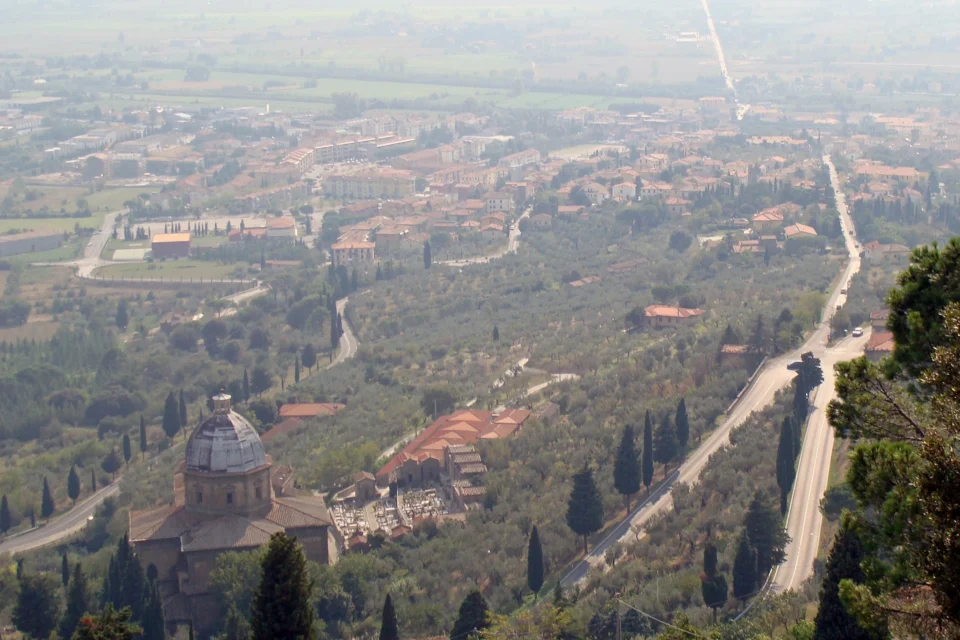
Santuario di Santa Maria delle Grazie al Calcinaio
Santuario rinascimentale (completato 1525, tradizionalmente attribuito a Francesco di Giorgio Martini) documentato da Visit Tuscany; custodisce l'immagine miracolosa della Madonna col Bambino sull'altare maggiore;…
Tanella di Pitagora
Tomba etrusca ellenistica a tholos, raggiungibile lungo il percorso archeologico cittadino segnalato dai portali turistici locali (turiscortona, cortonaweb); visitabile liberamente dall'esterno. Struttura vista dall'esterno;…
Journeys in Cortona.
Demo — Cortona Private Highlights Tour
Let a local expert design your Cortona day.
Tell us your dates and pace. A travel designer replies within one working day.