Bari
Bari, capital of Puglia, is a genuine Adriatic port city rather than a preserved postcard: a tangled medieval old town on a headland between two harbours, a grand nineteenth-century grid along the seafront, and a stratum of Romanesque churches crowned by the Basilica of Saint Nicholas. It is where most journeys through the region begin.
Why visit
Bari plays two roles at once. It is Puglia’s practical gateway, with the region’s main airport, its largest station and ferries across the Adriatic; and it is one of southern Italy’s most atmospheric cities, where laundry swings over alleyways and orecchiette are shaped by hand at street-side tables. Unlike neighbouring resort towns, Bari does not empty out after dinner — it fills up. The old quarter packs a Norman castle, a saint’s basilica and a cathedral into a few pedestrian lanes, while the Murat district adds opera, galleries and a long, breezy promenade. Few Italian cities offer this much texture this close to a major transport hub.
Character and history
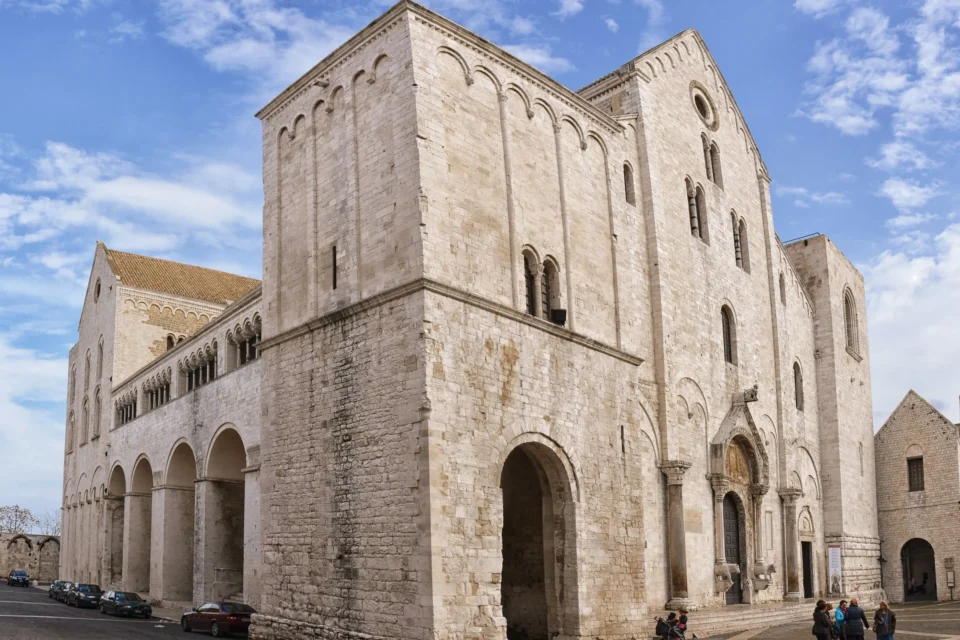
Bari’s geography made it: a low peninsula between two natural harbours on the Adriatic, commanding the sea routes to the Balkans and the eastern Mediterranean. Byzantine governors ruled from here; the Normans took the city in the eleventh century; and in 1087 sailors carried the relics of Saint Nicholas of Myra — the original of Santa Claus — into the harbour, transforming Bari into one of Europe’s great pilgrimage destinations. The Basilica raised to house them became a model of Apulian Romanesque. Under Frederick II the Norman castle by the sea was rebuilt as one of the emperor’s principal strongholds. Modern Bari took shape after 1813, when the orderly Murat district was laid out on a rectangular grid below the old town, bringing theatres, boulevards and the elegant seafront that today frames the whole city.
What to see
Begin in Bari Old Town, the dense medieval quarter wedged between the harbours. Its spiritual heart is the Basilica of Saint Nicholas, built on the former residence of the Byzantine governor to keep the saint’s relics in the crypt below the sanctuary; pilgrims still arrive year-round, and the saint’s feast in May fills the city. A short walk away the Norman-Swabian Castle guards the quarter’s seaward edge: founded under Roger the Norman in 1131, recast by Frederick II, converted into a Renaissance court residence, and now a museum complex whose rooms hold a gipsoteca of plaster casts of Apulian monuments. The nearby Museum of the Exultet Rolls preserves the illustrated parchment scrolls once sung from the cathedral pulpit, among the most precious documents of the medieval Mezzogiorno. For a broader sweep, the Archaeological Museum of Santa Scolastica traces the region from prehistory in a former convent, and the Metropolitan Art Gallery Corrado Giaquinto hangs Apulian and Italian painting in a gallery space on the seafront. In the Murat district, the Petruzzelli Theatre, one of Italy’s great opera houses, anchors the shopping streets.
How to experience
Bari’s pleasures are street-level. Watch (or join) the women rolling orecchiette on the boards outside their doorways in the old town, then eat them with turnip greens or a rich ragù at a family trattoria. Walk the entire seafront from the castle to the port at sunset, when the light turns the nineteenth-century facades gold. Time your visit to catch the evening aperitivo scene that has claimed the lanes around Piazza del Ferrarese and Piazza Mercantile. Book a performance at the Petruzzelli if the season allows, and check the basilica and castle schedules — including evening openings — on their official sites. Bari repays wandering without an itinerary; the old town is only a few streets deep, but endlessly layered.
Practical planning
Bari Karol Wojtyła Airport, eight kilometres northwest of the centre, connects with frequent flights across Europe; an airport shuttle and the regional rail line reach the centre in around twenty minutes. Bari Central Station is the Adriatic main line’s southern pivot, with fast services to Rome and the FAL network inland to Alberobello and Matera. The old town is fully pedestrian — park in the Murat district or use the underground garages near the seafront. The sea breeze moderates the summer heat, but July and August are busy; May, June and September are ideal. Keep normal city vigilance after dark on the old town’s quieter lanes. Ferry timetables and museum hours change seasonally, so confirm on official channels.
Nearby places
Bari is the natural base for Puglia’s southern highlights. Polignano a Mare and Monopoli put the Adriatic’s coves and whitewashed old towns within half an hour; Alberobello and its trulli are an easy train or car trip inland; and Locorotondo, a perfect white ring above the Itria Valley, pairs beautifully with either. Closer still, Bitonto offers a superb Romanesque cathedral without the crowds.
Worth building a day around.
Bari Vecchia (Citta Vecchia)
Comune di Bari tourism section covers Bari Vecchia as the historic old town; basilica and cathedral official sites confirm location within Citta Vecchia.
Basilica di San Nicola
Official basilica site (Dominican Fathers): basilica open to pilgrims and visitors, guided visit reservations and virtual tour available; crypt with relics of St Nicholas.
Castello Normanno-Svevo
Ministero della Cultura - Direzione regionale Musei Puglia: castle open to the public with Gipsoteca (1911 plaster casts) and tower exhibits; first floor accessible…
Museo Archeologico di Santa Scolastica
Official museum site (Citta Metropolitana di Bari): open daily, full ticket EUR 5, housed in the medieval Benedictine monastery of Santa Scolastica with 16th-century…
Museo degli Exultet
ArtEcclesiae portal lists the Museo degli Exultet in the Bari section with hours/tickets shared with the cathedral.
Pinacoteca Metropolitana Corrado Giaquinto
Official gallery site: 4th floor Palazzo della Provincia, open Tue-Sat 9-19, Sun 9-13; works by Giaquinto, Tintoretto, De Nittis, Fattori.
Teatro Petruzzelli
Fondazione Lirico Sinfonica Petruzzelli e Teatri di Bari offers dedicated guided tours of the theatre (visite guidate section).
Journeys in Bari.
Demo — Bari Private Highlights Tour
Let a local expert design your Bari day.
Tell us your dates and pace. A travel designer replies within one working day.