Atri
Atri crowns a hill of terracotta badlands a few kilometres from the Adriatic, a former ducal capital where Renaissance frescoes, a Romanesque cathedral and a working badlands reserve share one hillside. It is an art city that still lives at the pace of its piazzas, orchards and black chickens.
Why visit
Atri is the principal art city of the Teramo hills, an “authentic open-air museum” in the words of the regional tourism authority, its monuments gathered tightly around two connected squares. The draw is twofold. First, the cathedral: one of the most important Romanesque buildings in Abruzzo, built between the late thirteenth and early fourteenth centuries and frescoed in its choir by Andrea De Litio, the greatest Abruzzese painter of the fifteenth century. Second, the landscape: the town overlooks the calanchi — deeply carved clay badlands that the regional portal compares to a lunar terrain — protected since 1995 in a regional nature reserve that doubles as a WWF oasis.
The sea is close enough to combine with a morning of art: from Atri’s belvederes the coastline runs towards Pineto, Silvi and Roseto degli Abruzzi, and the underwater remains of the Roman port of ancient Hadria lie in the protected marine area of the Torre del Cerrano. Food gives the third reason to come — Atri’s liquorice, its raw-milk pecorino, and the Pan Ducale, a sweet whose recipe the regional portal traces to the fourteenth century.
Character and history
Atri’s past is unusually layered for a hill town of eight thousand people. Roman Hadria shipped from a port on the Adriatic whose remains now lie opposite the Cerrano tower, and Roman masonry still surfaces inside the town — the cathedral crypt is, in part, an ancient Roman cistern. The medieval city reached its peak under the Acquaviva dukes, whose palace presides over the main square; their patronage funded the artistic programme that made Atri one of the liveliest centres of fifteenth-century Abruzzo, and their name still attaches to the piazza, to the summer international music festival and to the town’s signature cake.
The ducal age explains the town’s scale: monuments were built for a court, not a village. After unification Atri turned towards the land — its hills are still worked for orchards, vines and grazing — and its identity settled into that particular balance of civic pride and agricultural rhythm you notice in the morning market under the arcade of the palace. The municipality promotes the city today as “civitas vetusta”, the ancient city, and backs that claim with a month-long international festival and a network of restored museums.
What to see
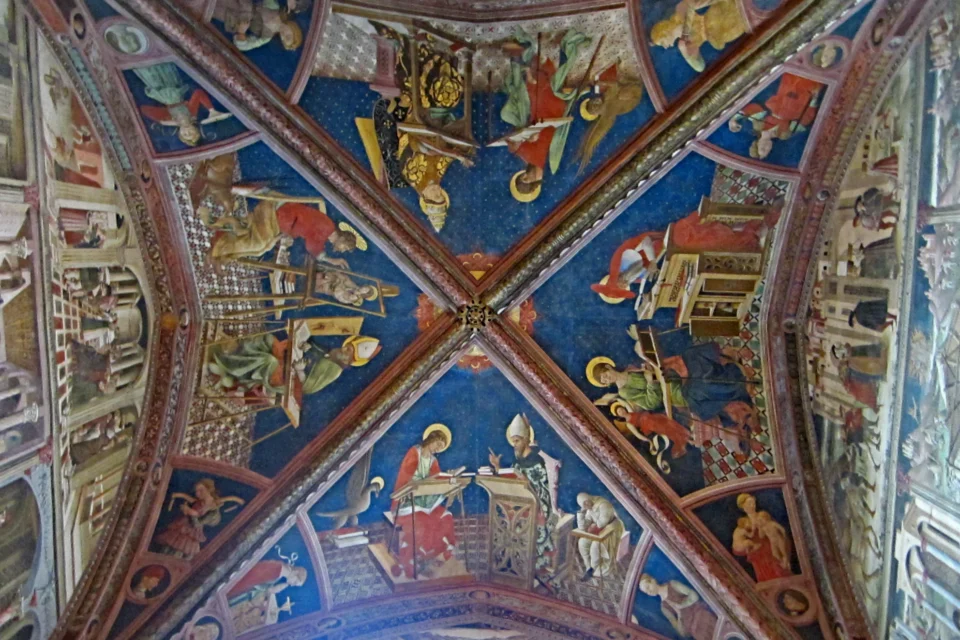
Begin on Piazza Duomo with the Cathedral of Santa Maria Assunta, which the municipality calls one of the finest examples of medieval architecture in Abruzzo. Inside are three naves on pointed arches, three sculpted portals including the “Porta Santa” carved by Rainaldo d’Atri in 1305, and a bell tower dressed in coloured maiolica tiles. The choir frescoes of Andrea De Litio, painted from around 1460, fill the apse with scenes from the Life of the Virgin set in domestic interiors — spinning women, fireplaces, sheep dogs — under a starry vault of Evangelists; look for Saint Reparata holding the model of the city.
Around the cathedral cluster the rest of the ensemble: the Museo Capitolare, founded in 1912 and among Abruzzo’s oldest sacred-art museums, in the two-storey cloister of the former Benedictine monastery; the Capitoline Civic Archaeological Museum with the city’s Roman and pre-Roman material; and the Church of Santa Reparata beside the cathedral. On the same square, the small nineteenth-century Municipal Theatre, inaugurated in 1881 to a design inspired by La Scala, holds the Antonio Di Jorio Museum-Archive dedicated to the locally born composer.
A short walk brings you to the Ducal Palace, built at the end of the fourteenth century over Roman baths and the town hall since 1917, its travertine facade opening onto a Renaissance courtyard of inscriptions and Roman fragments. In the surrounding streets, the Church of San Francesco and the Church of San Nicola mark the historic centre, while the small Ethnographic Museum documents the rural civilisation of the hills. Save the afternoon for the Calanchi di Atri Regional Nature Reserve: several hundred hectares of eroded clay ridges with marked trails and a visitor centre, and some of the best birdwatching in the province.
How to experience
Atri rewards a slow day rather than a tick-list morning. Enter through the historic gates, take the cathedral and De Litio frescoes before the light hardens, then linger over lunch built on local pecorino and a slice of Pan Ducale. In the late afternoon, walk into the reserve when the badlands turn rose and gold — access to the marked trails is free and unrestricted year-round, though the reserve’s managers advise avoiding the hottest summer hours. The town’s summer programme, including the Duchi d’Acquaviva festival, fills the monuments with concerts; monument opening times follow seasonal schedules published by the municipality, so check the civic website, comune.atri.te.it, or the visitor portal, viviatri.it, before setting out.
Practical planning
Atri sits about ten kilometres from the A14 motorway and the Adriatic coast, an easy drive from Pescara airport or a side trip on the coastal rail line; the practical base is a car. Combine the town with a beach afternoon at Pineto or a visit to the Cerrano marine area, and wear proper shoes for the reserve, whose trails climb steep clay slopes. The visitor centre of the WWF oasis lies at Via Colle della Giustizia on the town’s edge.
Nearby places
Campli, another preserved hill town with a celebrated scala santa, lies just inland to the west; the provincial capital Teramo offers Roman and Romanesque monuments half an hour away; and the fortress of Civitella del Tronto crowns the northern edge of the province.
Worth building a day around.
Cattedrale di Santa Maria Assunta
Portale istituzionale del Comune di Atri (sezione Luoghi, categoria Cattedrale) e homepage comunale (galleria 'Cattedrale', 'Museo Capitolare'). Scheda ufficiale comunale: 'uno degli esempi più…
Chiesa di San Francesco
Scheda ufficiale del Comune di Atri (sezione Luoghi, categoria Chiesa). Catalogata tra i luoghi di culto del Comune; orari non pubblicati.
Chiesa di San Nicola
Scheda ufficiale del Comune di Atri (sezione Luoghi, categoria Chiesa). Catalogata tra i luoghi di culto del Comune; orari non pubblicati.
Chiesa di Santa Reparata
Scheda ufficiale del Comune di Atri (sezione Luoghi, categoria Chiesa). Catalogata tra i luoghi di culto del Comune; orari non pubblicati.
Museo Archeologico Civico Capitolare 'De Galitiis - De Albentiis - Tascini'
Scheda ufficiale del Comune di Atri (sezione Luoghi, categoria Museo). Scheda ufficiale comunale; orari non pubblicati online.
Museo Capitolare
Scheda ufficiale del Comune di Atri (sezione Luoghi, categoria Museo); segnalato anche nella homepage comunale. Sito accanto alla Cattedrale; istituito nel 1914, conserva reperti…
Museo Etnografico
Scheda ufficiale del Comune di Atri (sezione Luoghi, categoria Museo). Scheda ufficiale comunale; orari non pubblicati online.
Museo-Archivio 'Antonio Di Jorio'
Scheda ufficiale del Comune di Atri (sezione Luoghi, categoria Museo). Scheda ufficiale comunale; orari non pubblicati online.
Palazzo Ducale (Municipio)
Scheda ufficiale del Comune di Atri (sezione Luoghi, categoria Palazzo: Municipio in Piazza Duchi d'Acquaviva). Sede del Municipio su Piazza Duchi d'Acquaviva, antica residenza…
Riserva Naturale Regionale dei Calanchi di Atri (Oasi WWF)
Scheda ufficiale del Comune di Atri (sezione Luoghi, categoria Parco: 'Riserva Naturale Regionale Oasi WWF Calanchi di Atri, Via Colle della Giustizia'). Area protetta…
Teatro Comunale di Atri
Schede ufficiali del Comune di Atri (sezione Luoghi, categoria Teatro; schede 'Teatro Comunale' e 'Teatro di Atri' con identica descrizione). Inaugurato nel 1881, pianta…
Journeys in Atri.
Demo — Atri Private Highlights Tour
Let a local expert design your Atri day.
Tell us your dates and pace. A travel designer replies within one working day.