Civitella del Tronto
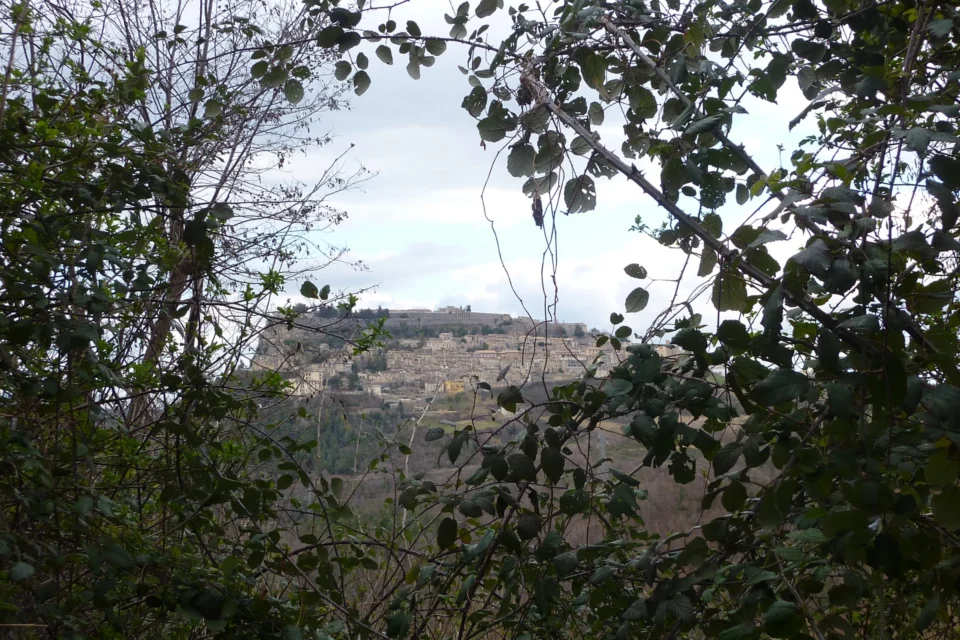
Civitella del Tronto clings to a rocky spur beneath one of the largest fortresses in Europe, guarding the ancient border between the Kingdom of Naples and the Papal States. A medieval borgo of alleys and churches, the jaw-dropping Spanish stronghold above, and Italy’s narrowest street make this northern Abruzzo’s essential hill town.
Why visit
The spectacle alone justifies the climb. The Fortress of Civitella runs more than five hundred metres along its ridge, roughly twenty-five thousand square metres of bastions, ravelins and soldiers’ quarters laid out for Philip II of Spain — among the largest fortifications of Renaissance Europe, and the last Bourbon stronghold to fall in Italy’s unification, surrendering on 20 March 1861. Below it, the borgo threads alleys so tight that one, La Ruetta, is said to be the narrowest street in Italy, past stone portals, painted churches and a Carrara marble monument to the Irish officer who died defending the town for the Bourbons. Add a Benedictine abbey on the hill beyond, the gorges of the Salinello at the valley’s edge, and views that reach from the Gran Sasso to the Adriatic: Civitella is a destination that mixes military history with village charm better than almost anywhere in Abruzzo.
Character and history
A village called Tibidella appears in a notarial deed of 1001, born of the castellamento movement that fortified the Apennine spurs in the ninth and tenth centuries. Because it watched the border between two states, Civitella never stopped being a military place: the Angevins enlarged its stronghold in the late thirteenth century, Alfonso of Aragon strengthened the walls in the fifteenth, and the great redesign attributed in part to Bernardo Buontalenti gave the ridge the round and pentagonal bastions of modern warfare. In 1557 the town withstood a French siege led by the Duke of Guise, earning from Philip II the title “Fedelissima” and tax privileges that are still a point of local pride.
The end came in the Risorgimento. After a four-month siege by Piedmontese troops in 1860–61 — the last organised Bourbon resistance anywhere in Italy — the fortress surrendered on 20 March 1861, days after the kingdom itself had effectively fallen. Napoleon’s army had earlier taken it in 1806 from a garrison led by the Irish major Matteo Wade, honoured since with a marble funerary monument raised by the Bourbons in Largo Rosati. The fortress was restored in the 1970s and is now the most visited monument of the province.
What to see
Give the Fortress of Civitella del Tronto ample time: the walk along the ramparts, the artillery positions, the granaries and chapels, and the outlook over the Salinello and Vibrata valleys. Inside, the Historical Arms Museum, opened in 1988 in the former artillery warehouse, displays Renaissance-to-nineteenth-century weapons and historic maps connected with the battles of 1806 and 1860.
In the borgo, follow the Historic Village of Civitella del Tronto circuit from La Ruetta (narrowest street in Italy) to the Matteo Wade Monument and the Palazzo del Capitano (Captain’s Palace), a fourteenth-century seat of the town’s military governors. Churches punctuate the route: the Collegiate Church of San Lorenzo of the late 1500s, the Church of San Francesco with its baroque interior and fifteenth-century wooden choir, and the frescoed fourteenth-century Church of Santa Maria degli Angeli (della Scopa). Outside the walls stands the Franciscan Convent of Santa Maria dei Lumi, and on the hill above town the Montesanto Abbey, among the earliest Benedictine foundations in Abruzzo, reached on foot through olive terraces.
How to experience
Arrive early, park at the fortress lots, and walk the ramparts before the heat — the full circuit takes an hour or more. Descend on foot into the borgo for lunch on the local pasta known as ceppe, then spend the afternoon in the churches and alleys; guided visits to fortress, borgo and museums can be booked through the fortress’s official site. Drive or walk up to Montesanto Abbey for the best sunset view, and if you have a second day, the Salinello gorges and the golden villages of the Vibrate countryside extend the trip. The feast of patron Sant’Ubaldo on 16 May brings processions and events to the streets.
Practical planning
Civitella del Tronto sits at about 589 metres in the province of Teramo, some twenty minutes from the A14 motorway and the coast at Martinsicuro; the nearest rail link is on the Adriatic line, and a car is by far the easiest approach. The fortress is a ticketed state monument whose seasonal schedule changes through the year — confirm current opening days on fortezzacivitella.it or cultura.gov.it before travelling, as listings have varied recently. Comfortable shoes are essential: the borgo is stairs and cobbles, and the fortress path climbs steadily. Accommodation includes borgo guesthouses and agriturismi in the surrounding hills, with fuller services toward Teramo. Spring and autumn are ideal; the ridge is exposed to wind in winter and hot at midday in August.
Nearby places
Worth building a day around.
Abbazia di Montesanto
Pagina ufficiale Borghi più belli d'Italia. Su un colle sopra il borgo; uno dei primi centri benedettini d'Abruzzo (VI secolo); raggiungibile dal territorio comunale.
Borgo storico di Civitella del Tronto
Pagina ufficiale Borghi più belli d'Italia; percorso 'Fortezza, musei e borgo' sul sito ufficiale della Fortezza. Centro storico medievalmente stratificato con stradine 'rue', feritoie…
Chiesa di San Francesco
Pagina ufficiale Borghi più belli d'Italia. Campanile, rosone, interno barocco e coro ligneo quattrocentesco; orari non pubblicati.
Chiesa di Santa Maria degli Angeli (della Scopa)
Pagina Borghi più belli d'Italia; sito ufficiale della Fortezza (percorso della visita). Chiesa del XIV secolo con affreschi e scultura lignea del Cristo morto;…
Collegiata di San Lorenzo
Pagina ufficiale Borghi più belli d'Italia. A croce latina con facciata a doppia coppia di lesene trabeate e dipinti del Seicento; orari di apertura…
Convento di Santa Maria dei Lumi
Pagina ufficiale Borghi più belli d'Italia. Convento francescano del Trecento fuori le mura, con statua lignea policroma della Madonna del tardo Quattrocento e chiostro.
Fortezza di Civitella del Tronto
Sito ufficiale della Fortezza (fortezzacivitella.it): biglietteria, prezzi, orari, prenotazione online, visite guidate. Aperta al pubblico con orario stagionale (ultimo ingresso 30 minuti prima della…
La Ruetta
Sito ufficiale della Fortezza (percorso della visita) e pagina Borghi più belli d'Italia. Vicolo medievale considerato tra i più stretti d'Italia; tappa del percorso…
Monumento a Matteo Wade
Pagina Borghi più belli d'Italia; sito ufficiale della Fortezza (percorso della visita). Monumento in marmo di Carrara (1929) dedicato al maggiore irlandese che guidò…
Museo NINA
Sito ufficiale museonina.it; sito ufficiale della Fortezza (biglietto unico e biglietteria gruppi al Museo Nina). Gestito dall'Associazione Culturale NINA onlus; incluso nel biglietto unico…
Museo Storico delle Armi
Sito ufficiale della Fortezza e pagina Borghi più belli d'Italia (Museo Storico delle Armi con armi dal Quattrocento alla Prima Guerra Mondiale). Incluso nel…
Palazzo del Capitano
Pagina ufficiale Borghi più belli d'Italia. Edificio del XIV secolo con cornici marcapiano intagliate a soggetto naturalistico e stemma degli Angiò; visibile dall'esterno nel…
Journeys in Civitella del Tronto.
Demo — Civitella del Tronto Private Highlights Tour
Let a local expert design your Civitella del Tronto day.
Tell us your dates and pace. A travel designer replies within one working day.