Arco
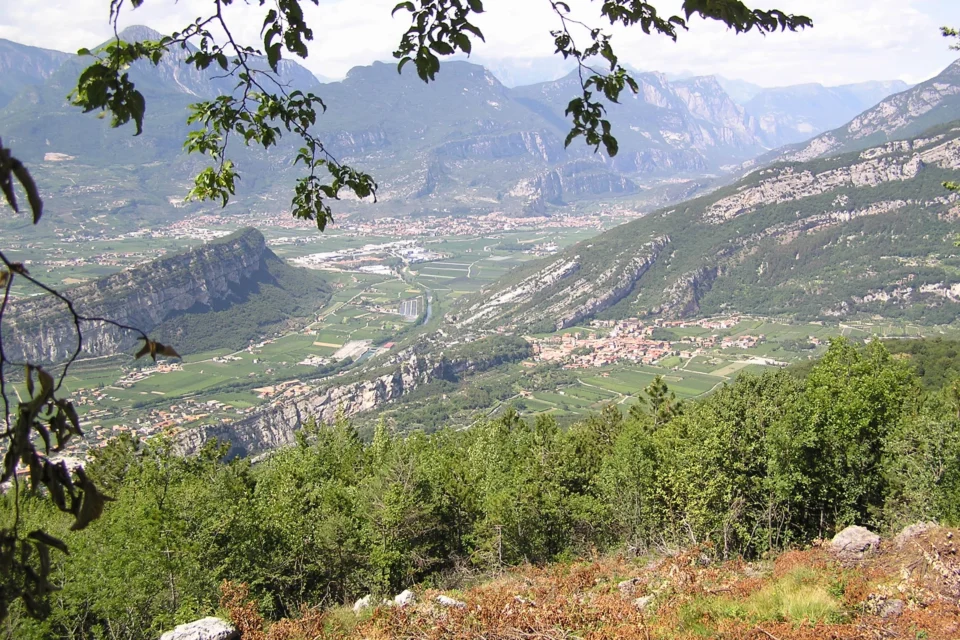
Where the Sarca river leaves the mountains for Lake Garda, Arco keeps a ruined castle on its cliff, palms on its boulevards and climbers on its walls. A Habsburg-era spa town with a mild microclimate, it pioneered European alpinism, and today it is Italy’s climbing capital — a small city of sanctuaries, villas and exotic gardens beneath sheer limestone.
Why visit
Arco feels unlike any other Trentino town because its climate and its history pulled it southwards. Mediterranean vegetation — cypresses, olives, oleanders — grows at the mouth of the Sarca valley, a legacy of the mild air that rises from Lake Garda, and in the nineteenth century that softness made Arco one of the great health resorts of the Austro-Hungarian Empire, drawing sovereigns, invalids and the first mountaineers to its villas and grand hotels. Their legacy is visible everywhere: the casinò, the arcaded streets, the botanical garden on the castle hill, the Lutheran church built for Protestant spa guests. Above it all, on its unforgiving spur, stands the ruined castle, painted by Albrecht Dürer on his Venetian journey and now the emblem of the town. And on the cliffs around it, Arco wrote the history of European rock climbing — a tradition carried on every year when the world’s best competitors meet for the Rock Master. For visitors, this layered identity means that walking, history, botany and sport all happen within a few streets of one another.
Character and history
The counts of Arco held this corner of the Giudicarie from their fortress above the Sarca; the castle, first recorded in the eleventh century and finally slighted in the eighteenth, dominates the town’s whole history from its rock. Below, the settlement grew in a half-moon around the castle mount, its pieve documented from 1144 and its church rebuilt in grand Baroque form in the seventeenth century. The turning point came with the Habsburgs: under Austrian rule after 1814 — and famously as the place where an archduke and, later, the exiled Bourbon court lingered — Arco became a seasonal capital for the Empire’s aristocracy, treated for consumption in its sanatoria and entertained in its casinò and Kurhaus. Mountaineering history was made on the surrounding walls in the pioneering decades of the sport, and the spa era also planted the exotic gardens for which the town is still known. Italian after 1919, marked by the wars and by twentieth-century tourism, Arco has since converted its inheritance into sport: climbing gyms and crags radiate from the town, and international competition climbing made its Italian home here. The Sanctuary of the Madonna delle Grazie at the southern entrance keeps the older devotional face of the community, with ex-votos recording centuries of plague and gratitude.
What to see
The Arco Castle comes first: the climb from the old quarter winds up cobbled lanes and through the Olivaia grove to the ruined halls and tower of the counts, with a near-vertical view over the rooftops to Lake Garda. In town, the Collegiate Church of Santa Maria Assunta on Piazza Tre Novembre is the major monument — an early seventeenth-century rebuilding with a monumental facade, a 59-metre bell tower, the marble Assunta group attributed to Giuseppe Calegari, and Felice Brusasorci’s painting of Saint Michael; the counts d’Arco are buried here, alongside, for a time, the exiled King Francesco II of Bourbon, who died at Arco in 1894. At the southern entrance, the Sanctuary of the Madonna delle Grazie preserves its convent setting and devotional collections, and the little Church of San Giuseppe (San Giuseppe al Ponte) marks the historic entrance to the centre. The Evangelical Lutheran Church of the Santissima Trinita is the spa era’s most curious survival, built for the Protestant patients who flocked to the Habsburg cure. On the hillside towards Laghel, the Arboretum of Arco — created in the late nineteenth century around Archduke Albert of Habsburg’s villa and now affiliated to Trento’s MUSE science museum — grows some 200 species of conifers and warm-climate trees across two free-entry hectares.
How to experience
Climb something. Even if you have never tied a knot, the town’s climbing schools teach on beginner crags within sight of the castle, and the Rock Master’s outdoor stadium makes an atmospheric visit in any season; if you would rather walk, the castle path and the trails towards Laghel and the Sarca greenway deliver the same vertigo more gently. Split your day between the spa-era quarter and the castle hill: arcades and casinò in the morning, arboretum and castle ruins in the cool of the afternoon. The market square and the lakeside road to nearby Torbole connect Arco to the water — cycling the Sarca cycle path to Lake Garda is the classic local outing. In autumn, the olive harvest on the Olivaia terraces and the sagre of the hinterland show the agricultural counterpoint to the resort gloss.
Practical planning
Arco lies a few kilometres north of Riva del Garda and Torbole, about 40 minutes from Trento by road; buses run along the Gardesana and up the Sarca valley, and the town is easily explored on foot once parked. Spring and autumn are ideal — mild, green, and quiet between the climbing and lake seasons — while July and August bring heat, crowds and competition energy. The Rock Master in early autumn fills hotels; book ahead if your dates coincide. Sanctuary, collegiate church and arboretum keep varying schedules — the arboretum’s hours change with the season and the churches close around services — so check locally before setting out. Bring sun protection and swimming gear: the lake is minutes away.
Nearby places
Riva del Garda and the beach town of Torbole continue the lakeside story; Canale di Tenno and Ledro offer mountain-village and upland-lake excursions; Trento anchors the province with its Buonconsiglio castle; and Molveno or Andalo open the Paganella plateau beyond the ridge.
Worth building a day around.
Arboreto di Arco
Listed by MUSE (Museo delle Scienze of Trento) among its 'sedi convenzionate' with description of the archducal park. Historic park on the slope below…
Castello di Arco
Official Garda Trentino page with full schedule and tariffs; dedicated page on Comune di Arco 'Luoghi' section. Reachable only on foot, about 20-minute climb…
Chiesa di San Giuseppe
Parochial church of Arco (part of the parrocchia di Arco), built by will of Count Vinciguerra d'Arco; cross-checked on reference sources; place of worship…
Chiesa Evangelica Luterana della Santissima Trinità
Listed and documented by FAI (Fondo Ambiente Italiano); commissioned by the 'Comité der Evangelischen in Arco'. Historic Lutheran church documenting Arco's Habsburg-era cosmopolitan tourism;…
Collegiata di Santa Maria Assunta
Dedicated page on Comune di Arco website 'Luoghi' section; described as one of the most important monuments of the town. Main church overlooking the…
Santuario della Madonna delle Grazie
Dedicated pages on Comune di Arco and Garda Trentino official portal. Sanctuary in an isolated spot south-west of Arco near the Riva del Garda…
Journeys in Arco.
Demo — Arco Private Highlights Tour
Let a local expert design your Arco day.
Tell us your dates and pace. A travel designer replies within one working day.