Noli
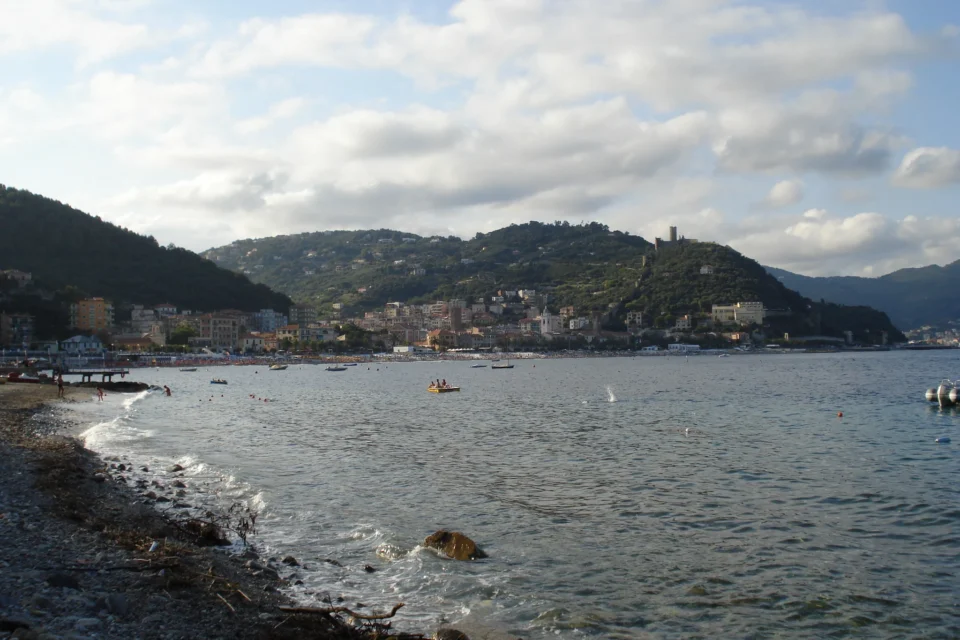
Noli is what remains of one of Italy’s maritime republics — the small, proud “fifth republic” that Dante placed in Paradise and that kept its own laws, fleet and bishops for six centuries. Behind a fine sandy beach, the old town keeps its medieval frame almost intact: red-brick towers, a public loggia and a hilltop castle, worn without effort.
Why visit
Noli answers travellers looking for the Riviera di Ponente’s combination of beach and substance. The town belongs to the select circle of Italy’s maritime republics alongside Venice, Genoa, Pisa and Amalfi, yet it receives a fraction of their traffic. In an afternoon you can climb a twelfth-to-fourteenth-century castle above the roofs, walk a circuit of medieval walls punctuated by round-topped towers, stand in the loggia where the republic’s council met, and finish with a swim from the town beach. Dante cited Noli in the Paradiso as a place of descent — “Vassi in San Leo e discendesi in Noli” — and the phrase still fits: everything here slopes gently downwards, from the castle hill to the towers, to the sea. Add a cultivated events calendar of concerts, book talks and festivals staged in these same monuments, and Noli proves that a historic borgo can live in the present tense.
Character and history
The name descends from Neapolis, “new city”, a Byzantine foundation, and the Romans had already built a shipyard on the Capo Noli promontory before that. In 967 the territory passed to the Savonese branch of the Del Carretto marquises; a free commune emerged in the 1190s, and in 1202 an alliance with Genoa against Savona and the Finale marquisate turned Noli into a maritime republic in its own right. Protected by its powerful ally, the little state flourished through the fourteenth century and outlived every republican neighbour except Genoa, only falling with the republic itself in 1797. The town you see today is that history made physical: the twelfth and thirteenth-century walls with their red towers, the quarter of brick house-towers on green stone bases, the baroque-remodelled cathedral that became the city’s duomo in 1572, and the Del Carretto castle on Monte Ursino, rebuilt by the Genoese in 1522 as the population’s last refuge in case of attack. Noli appears among Italy’s “Borghi più belli d’Italia”, and the classification feels earned rather than promotional.
What to see
Enter the old town through the Walls of Noli with towers and gates: the crenellated Torre del Comune with its swallow-tail merlons, the Torre del Canto, the Torre della Marina and the Torre dello Sperone, together with the Porta di Piazza and Porta Papona gates, form one of the most complete medieval ensembles on the Riviera. In the heart of the borgo, the Concathedral of San Pietro, the city’s duomo since 1572 on much older Romanesque foundations, keeps an inlaid high altar of 1679, a Roman sarcophagus reworked in the fifteenth century and a sixteenth-century polyptych. A few steps away, the Loggia of the Republic, the late-medieval public loggia attached to the town hall, still serves as the town’s open-air parlour for talks and ceremonies. On Via San Francesco, the former conventual Church of San Francesco d’Assisi now hosts cultural events in place of its friars, while the late-seventeenth-century Palazzo Viale-Salvarezza typifies the merchant houses of the old quarter. Finally, walk or drive up to the Monte Ursino Castle for the finest view of roofs, towers and sea, and continue to the Cape Noli Promontory, where sea caves and the ruins of the hilltop fortress close the circuit.
How to experience
Take the walls seriously: few towns this size let you touch so much medieval fabric, and the passage from the gates up towards the castle links every tower in sequence. Visit the cathedral quietly in the morning, then give the beach its due — Noli’s sand is the reward for its history. Time your stay to the town’s calendar if you can: the Festival of Noli in spring fills the loggia and squares with music, and summer evenings bring concerts in Piazza Chiappella and events in the castle. Look out for cappon magro, the elaborate seafood-and-vegetable dish traditionally called the dish of the doges, and the local cicciarello bean celebrated each June.
Practical planning
Noli sits on the Genoa-Ventimiglia coastal railway between Spotorno and Finale Ligure, with the station a short walk from the old town; the A10 motorway serves it from the hill side. Parking is easiest in signed lots near the seafront, from which the borgo is entirely pedestrian. The municipality’s tourism portal, visitnoli.it, lists current opening arrangements for the castle and cathedral and the full events calendar. Late spring and early autumn combine swimmable sea with quieter lanes.
Nearby places
Varigotti and its ochre beach houses lie just along the coast, Finale Ligure and the walled medieval quarter of Finalborgo continue westwards, and Alassio makes an easy onward stop.
Worth building a day around.
Castello di Monte Ursino
Medieval castle above the town; hosts public cultural events (concerts 2026 per visitnoli.it); otherwise used for private events
Chiesa di San Francesco d'Assisi
Former conventual church used as cultural venue (concerts, e.g. Mario Brunello 2026 per visitnoli.it)
Concattedrale di San Pietro
Active parish cathedral in the historic centre; hosted public cultural events per visitnoli.it; cathedral of Noli since 1572
Loggia della Repubblica
14th-15th c. public loggia of the maritime republic; open public space and cultural venue (Libri sotto la Loggia 2026)
Mura di Noli con torri e porte
Medieval walls of the maritime republic running down from Monte Ursino, with 13th-14th c. towers and gates; publicly walkable historic centre
Palazzo Viale-Salvarezza
Late 17th-c. historic palace facade in the main street, listed in the heritage inventory of the borgo
Promontorio di Capo Noli
Scenic promontory west of Noli with panoramic views, coastal caves and remains of the Eremo fortress, reachable on foot
Journeys in Noli.
Demo — Noli Private Highlights Tour
Let a local expert design your Noli day.
Tell us your dates and pace. A travel designer replies within one working day.