Santo Stefano di Sessanio
A stone village at 1,200 metres on the southern edge of the Gran Sasso, Santo Stefano di Sessanio grew rich on high-mountain wool and fell quiet when the trade died. Today its tower-houses, cobbled alleys and Medici landmarks make it one of Abruzzo’s most atmospheric mountain borghi.
Why visit
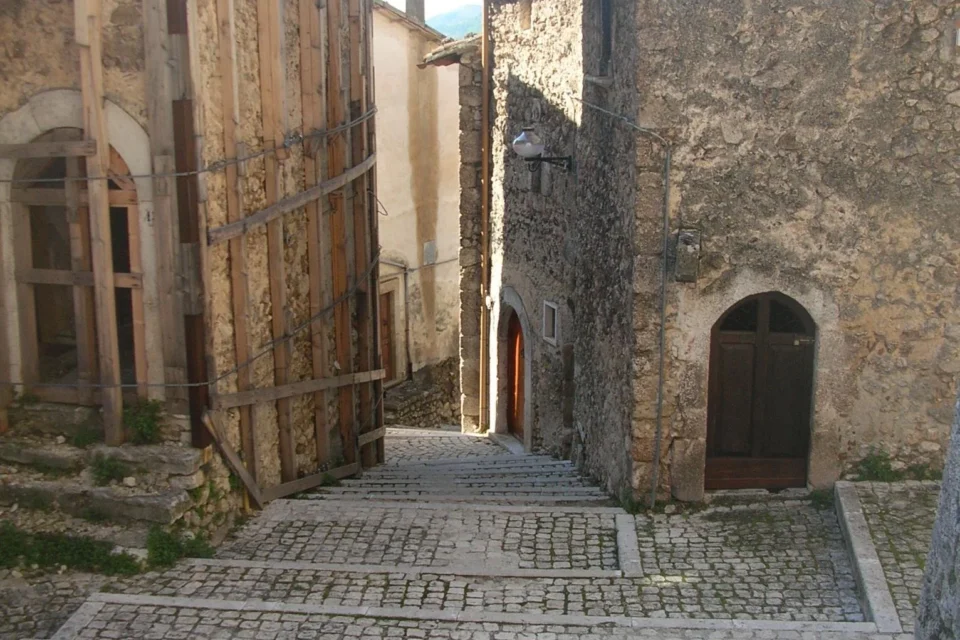
Few places in Abruzzo compress history and landscape so tightly. Santo Stefano di Sessanio stands at the southern gateway of the Gran Sasso and Monti della Laga National Park, looking over the Tirino valley with the high plain of Campo Imperatore above it. The village belongs to the Club of the Most Beautiful Villages of Italy, and its appeal is architectural rather than monumental: whitish limestone houses stacked into towers, alleys worn smooth by mule traffic, and a silence that survives the day visitors. It is also a working food destination — its tiny mountain lentil carries Slow Food recognition — and a natural base for hiking the Gran Sasso’s southern slopes.
Character and history
First recorded in 1239, the settlement belonged from the thirteenth century to the Baronia di Carapelle and passed through several noble families. The most indelible mark was left by the Medici of Florence, whose emblem crowns the Torre Medicea, the tower from which the village’s house-towers and lanes unfold in concentric rings. Under the Signoria of Florence Santo Stefano reached its peak as an outpost of the wool trade: “carfagna” wool, produced here in the mountains, was finished in Tuscany and sold across Europe. When Italian unification and the end of transhumance hollowed out that economy, the village slid into a long decline. Its rebirth came through Daniele Kihlgren’s albergo diffuso concept, which restored uninhabited houses into a scattered hotel while preserving their structure and austere mountain character — a model that has drawn artists and travellers ever since.
What to see
Begin at the Town Gate on Piazza Medicea, which opens into the historic core, then look up: the Medici Tower, the village’s symbol, collapsed in the 2009 earthquake and has since been rebuilt to its old profile. Around it, the Palace of the Captain recalls the Medici administration, and the small Church of the Suffragio faces the square.
The oldest fabric sits just below the summit: the Church of Santo Stefano Protomartire, built between the fourteenth and fifteenth centuries, and the seventeenth-century Church of the Madonna del Lago. A short walk outside the walls brings you to the Church of Santa Maria in Ruvo, one of the most ancient places of worship in the Baronia, a reminder that this valley was sacred ground long before the wool merchants arrived.
How to experience
Arrive in the late afternoon, when coaches leave and the alleys belong again to residents and a handful of guests; spending a night in the albergo diffuso is the definitive way to feel the village’s original domestic scale. Eat lentils: zuppa di lenticchie in one of the village locande is the local classic, and September’s Sagra delle Lenticchie fills the lanes with cooking smoke and long tables. Walkers can set out from the village on Gran Sasso trails, while drivers should consider the short hop to the plateau of Campo Imperatore and the fortress village of Calascio. Bring layers — at this altitude evenings are cool even in summer — and check the regional tourism portal abruzzoturismo.it for current events and trail conditions.
Practical planning
Santo Stefano di Sessanio lies roughly fifty minutes by car from L’Aquila, on the road towards the Tirino valley. Parking sits at the edge of the borgo; the centre is pedestrian and steep, so pack shoes with grip. Accommodation is small-scale — the scattered hotel, locande and a few guesthouses — so book ahead for weekends and the September sagra. For opening times of individual churches, which are irregular, ask at the village or consult the municipal site comune.santostefanodisessanio.aq.it.
Nearby places
The natural companions are Calascio with the Rocca above it, Castel del Monte in the next valley, and Capestrano down towards the Tirino. For a longer mountain day, Campo Imperatore offers the high-plain landscape that defines this corner of the Gran Sasso.
Worth building a day around.
Chiesa del Suffragio (Madonna del Carmine)
Sulla Piazza Medicea, ricordata tra le emergenze architettoniche del borgo nella scheda FAI
Chiesa della Madonna del Lago
Risalente al XVII secolo, citata dalla pagina regionale ufficiale tra i monumenti del borgo; il FAI ricorda inoltre il santuario della Madonna delle Grazie…
Chiesa di Santa Maria in Ruvo
Chiesa madre del borgo, XIII-XIV secolo, stile romanico, vicino alla Porta Medicea; documentata dalla guida ufficiale del Cammino del Gran Sasso
Chiesa di Santo Stefano Protomartire
Edificata tra il XIV e il XV secolo, secondo la pagina regionale ufficiale; il FAI la ricorda come Chiesa di Santo Stefano fuori le…
Palazzo del Capitano
Emergenza architettonica del borgo ricordata nella scheda FAI; prospetto visitabile in spazio pubblico
Porta urbica (Porta Medicea)
Antica porta urbica del borgo murato, ricordata dalla scheda FAI e dalla guida del Cammino del Gran Sasso
Torre Medicea
Simbolo del borgo, emblema della Casata dei Medici; crollata con il sisma del 2009, e' stata di recente ricostruita fedelmente e riportata all'antico splendore…
Journeys in Santo Stefano di Sessanio.
Demo — Santo Stefano di Sessanio Private Highlights Tour
Let a local expert design your Santo Stefano di Sessanio day.
Tell us your dates and pace. A travel designer replies within one working day.