Santa Teresa Gallura
At Sardinia’s northernmost tip, a whitewashed town faces Corsica across the Straits of Bonifacio. Founded by a Savoy king who drew its street plan himself, Santa Teresa Gallura folds a Spanish watchtower, a prize-winning town beach and the granite wilderness of Capo Testa into one of the island’s most scenic corners.
Why visit
Geography gives Santa Teresa Gallura its drama. The town stands on a promontory at the very top of Sardinia, barely eleven miles from the Corsican cliffs of Capo Pertusato, and ferries cross the straits to Bonifacio in season. Its two harbours — Porto Longone with the marina, and the bay of Rena Bianca — frame a centre of low pastel buildings that fills with music and café life each summer.
Beyond town, the coast turns to granite sculpture: coves tucked between wind-carved rocks, twin beaches divided by the dune isthmus of Capo Testa, and the cleft bays of the Valle della Luna. History is present too, from a 16th-century Spanish tower above the main beach to nuragic villages and the rusting works of a Second World War battery. It is a place for swimmers, sailors, walkers and anyone moved by big seascapes.
Character and history
The settlement began as Longosardo, an important Roman port that shipped local granite southward and may correspond to the ancient city of Tibula. An Aragonese castle stood here until Genoese forces sacked it in 1442; it was later demolished on the order of Alfonso V. The modern town is a deliberate creation: on 12 August 1808 King Vittorio Emanuele I of Savoy founded it by decree, personally drew up the town plan and renamed it after his wife, Queen Maria Teresa, granting settlers free land to cultivate. The king’s grid still underlies the centre today.
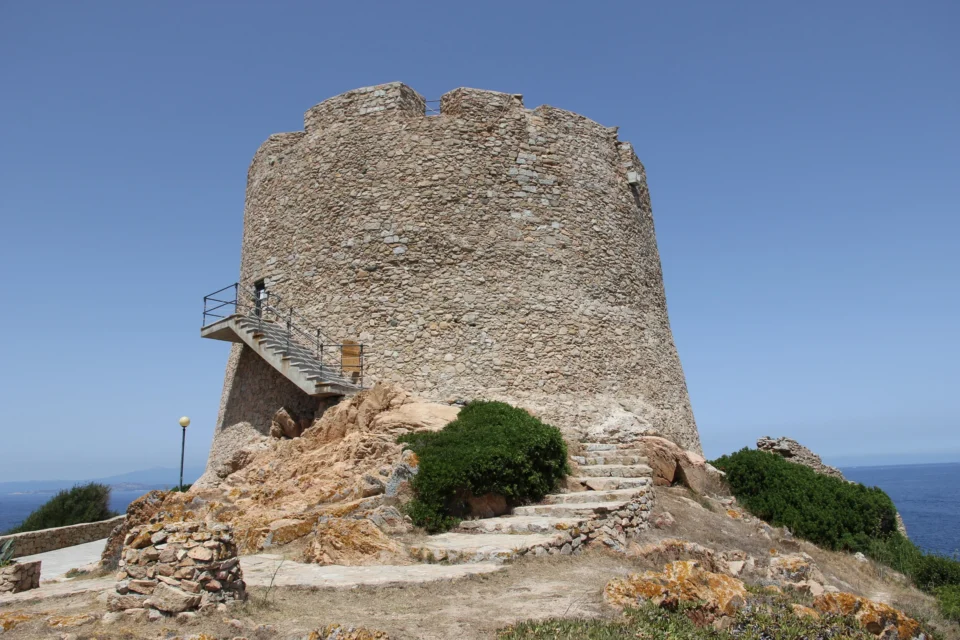
The Spanish period left the town’s emblem, the Torre di Longonsardo, built in the 16th century under Philip II on the town’s most exposed rocky point. On Capo Testa, quarries hollowed the granite that went into Pisa’s cathedral and baptistery and, by tradition, Rome’s Pantheon; a ruined coastal tower and the artillery posts, bunkers and barracks of the wartime Batteria Ferrero add later chapters. A population of about 5,000 residents now hosts tens of thousands of summer visitors, yet the town keeps a village scale.
What to see
Rena Bianca is the town beach, steps from the main square: fine, bright sand shelving into water of layered blues, repeatedly recognised with Bandiera Blu awards. Above it stands the Tower di Longonsardo, its terrace the finest viewpoint over the straits, the Corsican coast and the rooftops below.
A short drive north, Cala Spinosa is a small cove sealed inside limestone-and-granite cliffs, reached on foot and filled with intensely clear water. South along the west coast, Cala Grande – Valle della Luna — the town’s emblem — gathers hidden coves beneath towering granite walls; under moonlight it is unforgettable, and each summer its scenery hosts the Musiche sulle Bocche festival. Nearby Capo Testa itself, joined by an isthmus flanked by the Rena di Ponente and Rena di Levante beaches, guarantees calm water on one side whatever the wind.
How to experience
Structure days around the sea and the light. Swim at Rena Bianca early, walk to the tower before the heat, then drive or hike out to the Valle della Luna for a late afternoon when the granite turns amber. Snorkellers will find rocky reefs at Cala Spinosa and Santa Reparata; divers favour the clear water off the rocky points. Boat excursions run from the marina toward the La Maddalena archipelago and across to Bonifacio — the sea-level view of these coasts rivals the tower’s.
Walkers can follow trails over Capo Testa among the old quarry faces, and visit the nuragic complexes of Lu Brandali and Sa Testa on the edge of town. In summer evenings, the historic centre belongs to strollers: live music, gelaterie and aperitivi around the squares. If you can, time a stay for the shoulder season, when the water is warm, the trails walkable and the village quiet again.
Practical planning
Santa Teresa Gallura is about an hour’s drive from Olbia’s airport and port, on roads that narrow as they climb the northern cape; the last approach offers sweeping views. Book accommodation early for July and August, when the population swells dramatically. Beaches close to town fill fast in high season, so arrive before mid-morning or head for the smaller coves. Ferry schedules to Bonifacio are seasonal and weather-dependent — check with operators before planning a Corsica day trip. Wind is part of life on this coast: the mistral can flatten one sea while ruffling the other, which is exactly what makes the twin beaches of Capo Testa so reliable.
Nearby places
The far north packs destinations close together. Palau is the gateway port to the La Maddalena Archipelago, while the polished marinas of Porto Cervo and the Costa Smeralda lie along the coast to the east. To the west, Castelsardo crowns a headland with a medieval castle, and the nuragic landscapes around Arzachena add prehistory to a touring route.
Worth building a day around.
Cala Grande - Valle della Luna
Regione Sardegna — SardegnaTurismo, in “Cala Grande - Valle della Luna | SardegnaTurismo - Sito ufficiale del turismo della Regione Sardegna”, identifies Cala Grande…
Cala Spinosa
Regione Sardegna — SardegnaTurismo, in “Cala Spinosa | SardegnaTurismo - Sito ufficiale del turismo della Regione Sardegna”, identifies Cala Spinosa as a visitor-relevant attraction…
Rena Bianca
Regione Sardegna — SardegnaTurismo, in “Rena Bianca | SardegnaTurismo - Sito ufficiale del turismo della Regione Sardegna”, identifies Rena Bianca as a visitor-relevant attraction…
Torre di Longonsardo
Regione Sardegna — SardegnaTurismo, in “Torre di Longonsardo | SardegnaTurismo - Sito ufficiale del turismo della Regione Sardegna”, identifies Torre di Longonsardo as a…
Journeys in Santa Teresa Gallura.
Demo — Santa Teresa Gallura Private Highlights Tour
Let a local expert design your Santa Teresa Gallura day.
Tell us your dates and pace. A travel designer replies within one working day.