Santa Severina
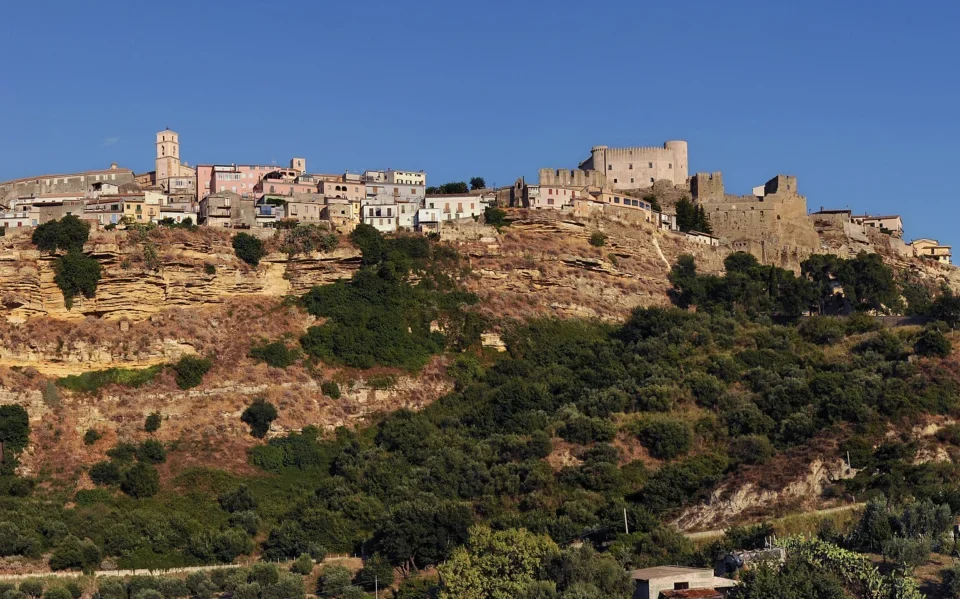
Santa Severina rides a ridge in inland Calabria like what locals call a “ship of stone”, its Norman castle and cathedral clustered around one of the most graceful squares in the south. One of Italy’s most beautiful villages, it layers Byzantine, Arab and Norman history within a few walkable streets, crowned by the region’s rarest building: a Byzantine baptistery.
Why visit
Few Calabrian towns pack so much into so little space. Within a single compact circuit you can climb a four-bastion castle that ranks among the region’s best-preserved fortresses, stand in a tenth-century baptistery where classical columns frame a singular Byzantine space, visit a thirteenth-century cathedral and browse a diocesan museum of sacred art. The town counts among the Borghi più Belli d’Italia, yet the atmosphere is unhurried: Piazza Campo, framed by castle and cathedral, is the kind of square travellers linger in without a plan. Sitting inland in the province of Crotone, Santa Severina also makes a natural cultural counterweight to the coast — the beaches of the Ionian and the castle-by-the-sea of Le Castella are within an easy drive.
Character and history
The town’s silhouette has made it an emblem: from the surrounding valleys the ridge-top settlement reads as a great stone vessel, and the metaphor of a ship that has sailed through centuries of dominations is one locals use with affection. Its ancient name, Siberene, survives in the strata beneath the castle. Santa Severina’s historical claim to fame runs deep — Pope Zachary, who held the papal office from 741, was born here, and the town later passed through Byzantine, Arab and Norman hands, each leaving marks on the borgo’s lanes and ecclesiastical fabric. The Normans fortified the site into the fortress visible today, and the medieval cathedral and baptistery anchored a religious importance that persists in the diocesan institutions around the piazza. The result is a centre where Byzantine artistry and Norman military architecture sit a few steps apart — a condensed history of southern Italy’s layered past.
What to see
The Castle di Santa Severina dominates the town from its four cylindrical bastions and is one of Calabria’s most visited monuments. Inside, the ranges house an archaeological museum, displays of weapons and armour, period costumes and the cells of the old prisons, while the ramparts give sweeping views over the Neto valley towards the Ionian. On the piazza below stands the Cathedral di Santa Anastasia, built between 1274 and 1295 at the wish of Archbishop Ruggero di Stefanuzia and dedicated to the town’s patroness — a sober Gothic-era facade with a bell tower, opening onto a richly layered interior. Beside it, the Battistero di Santa Severina is the town’s most precious oddity: a cross-shaped Byzantine building of the tenth century wrapped around a massive ring of columns, in which — as old descriptions have it — “the classical mingles with the barbaric”. Its exact origins were debated even after early twentieth-century excavations by Paolo Orsi, which only adds to its fascination. The Museum Diocesano di Santa Severina completes the circuit with the diocese’s sacred art, adding context to the cathedral and baptistery.
How to experience
Give Santa Severina a leisurely half-day, ideally in the morning. Start at the castle for the orientation views — understanding the ridge explains the town’s whole history — then work down through the cathedral, the baptistery and the diocesan museum, which are all steps apart around Piazza Campo. Pause in the square for coffee or lunch; this is the place to absorb the town’s rhythms rather than rush on. Late afternoon is the photographer’s hour, when the stone glows and the castle’s bastions throw long shadows. The town hosts cultural events and festivals through the warmer months — timings vary, so check the commune’s or the diocesan museums’ channels before travelling rather than planning around old listings.
Practical planning
Santa Severina lies in the province of Crotone, on a ridge above the Neto river valley roughly equidistant between Crotone and Catanzaro’s province. There is no rail service to the town itself, so visitors arrive by car — the drive from the coast is short and well signed. Streets are stepped in places but the circuit is compact; comfortable shoes are enough. Castle and museum opening days vary by season and close on some weekdays — verify current times through the town’s cultural pages before setting out. Spring and autumn are ideal, combining mild temperatures with clear views from the ramparts; summer visitors should aim for the morning hours.
Nearby places
Down on the Ionian, Le Castella sets the Aragonese castle of Capo Colonna’s coastline in the sea itself, and the provincial capital Crotone holds the National Archaeological Museum with the Pithecusae and Capo Colonna treasures. Inland and to the south-west, the high plateau of the Sila offers forests, lakes and village panoramas within a morning’s drive.
Worth building a day around.
Battistero di Santa Severina
Regione Calabria — Calabria Straordinaria, in “https://calabriastraordinaria.it/storage/files/02_ARTE%20E%20CULTURA_IT_WEB.pdf”, identifies Battistero di Santa Severina as a visitor-relevant attraction associated with Santa Severina. Verified source scope: destination…
Castello di Santa Severina
Regione Calabria — Calabria Straordinaria, in “https://calabriastraordinaria.it/storage/files/02_ARTE%20E%20CULTURA_IT_WEB.pdf”, identifies Castello di Santa Severina as a visitor-relevant attraction associated with Santa Severina. Verified source scope: destination…
Cattedrale di Santa Anastasia
Regione Calabria — Calabria Straordinaria, in “https://calabriastraordinaria.it/storage/files/02_ARTE%20E%20CULTURA_IT_WEB.pdf”, identifies Cattedrale di Santa Anastasia as a visitor-relevant attraction associated with Santa Severina. Verified source scope: destination…
Museo Diocesano di Santa Severina
Regione Calabria — Calabria Straordinaria, in “https://calabriastraordinaria.it/storage/files/02_ARTE%20E%20CULTURA_IT_WEB.pdf”, identifies Museo Diocesano di Santa Severina as a visitor-relevant attraction associated with Santa Severina. Verified source scope:…
Journeys in Santa Severina.
Demo — Santa Severina Private Highlights Tour
Let a local expert design your Santa Severina day.
Tell us your dates and pace. A travel designer replies within one working day.