San Ginesio
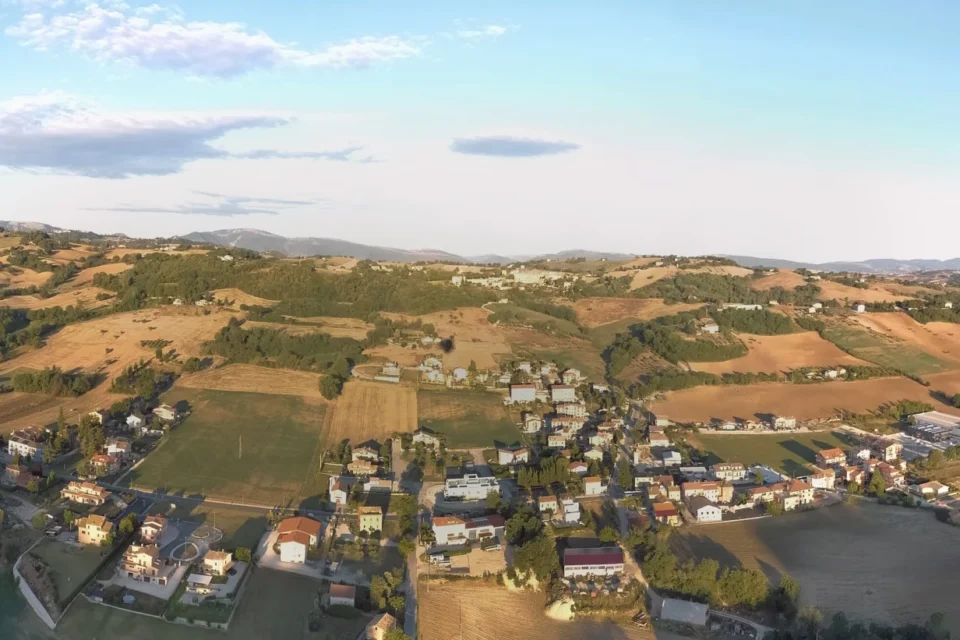
San Ginesio crowns a hill at the edge of the Sibillini mountains, wrapped in a formidable fourteenth-century wall and looking over Apennine country that gave it the name “balcony of the Sibillini”. A medieval borgo of churches, learned families and quiet piazzas, it pairs serious history with mountain air, rebuilt with dignity since the 2016 earthquake.
Why visit
San Ginesio appeals to travellers who want their hill towns complete: walls you can actually walk to, four medieval gates, a pair of Romanesque-Gothic churches, a working theatre, and views that run from the Adriatic to the Gran Sasso on clear days. The town sits at around 690 metres inside the Sibillini range, so the air is cool even in August and the light in October can be extraordinary. It is also a place with an intellectual pedigree out of all proportion to its size — home to the Gentili family, whose son Alberico became one of the founding figures of international law — and it carries the recognition to match: named Best Tourism Village for Italy by UNWTO in 2021, a Bandiera Arancione town, and a member of I Borghi più Belli d’Italia.
Character and history
The site’s story reaches back to the Senone Gauls and Roman times, but San Ginesio enters written history as the castrum Sancti Genesij, first recorded in 995. The name honours a Roman actor and musician martyred under Diocletian — fitting for a town that still fills its theatre each season. Medieval San Ginesio was tough: it repelled an assault by Fermo in 1377, was governed by the Da Varano of Camerino, and passed peacefully to Papal control in the mid-fifteenth century. Its castle walls, begun in 1308 and finished over roughly a century and a half of building, remain the town’s defining feature, punctuated by towers and the four surviving gates — Porta Picena, Offuna, Ascarana and Alvaneto. In the sixteenth century the Inquisition drove the Gentili family into English exile; Alberico taught at Oxford and helped shape the law of nations, and his bronze statue now watches over the main piazza. The earthquakes of 2016–2017 damaged the collegiate church and other landmarks, and restoration continues — a living chapter of the town’s history that visitors witness respectfully.
What to see
Begin at the Castle Walls of San Ginesio and their four surviving Castle Gates, then walk up through the Historic Centre to Piazza Alberico Gentili, where the Collegiate Church of Santa Maria Assunta and the Church of San Francesco face each other in Romanesque-Gothic dignity. The elegant Giacomo Leopardi Municipal Theatre, a nineteenth-century house with its original ceiling and a chandelier still raised by hand-cranked winch, is one of Marche’s loveliest small theatres. Don’t miss the thirteenth-century Pilgrims’ Hospital, once a hostel for travellers on the road to Rome and Tolentino, or the frescoed cloister of the Monumental Complex of Sant’Agostino. The civic Civic Picture Gallery Scipione Gentili and Civic Library hold the town’s artistic and scholarly memory. Out of town, the Benedictine Abbey of the Macchie with its crypt, the Franciscan Sanctuary of San Liberato beneath Monte Ragnolo, the Church of San Michele Arcangelo at Passo San Ginesio, the ruins of Roccacolonnalta, and the Colle Ascarano Panoramic Garden extend the visit into the surrounding hills.
How to experience
Walk the walls at golden hour, when the Sibillini turn violet and the coast shimmers far below. Look for the mura di San Nicola, a stretch tied by local legend to San Nicola da Tolentino. Browse the pinacoteca, then linger over coffee under the loggia facing the piazza; this is a town best understood at walking pace. Hikers can drop into the Sibillini park on marked trails from the sanctuary of San Liberato. Check locally which interiors have reopened since the earthquake — the town’s cultural association and tourism office publish current openings, and visiting a freshly restored church or an exhibition like the artworks returned through the Hoc Opus project is a way of participating in the town’s recovery.
Practical planning
San Ginesio is about half an hour’s drive from Macerata and roughly an hour from the Adriatic motorway; a car is essential for the hamlets, abbey and sanctuary. Park outside the gates and continue on foot — the centre is compact but steep, with cobbled lanes. Summer brings festivals and theatre performances; autumn offers harvest colours and chestnut woods; winter can be cold and luminous. Accommodation ranges from family-run guesthouses to agriturismi in the surrounding countryside. Museums and churches keep changeable, seasonal hours, so confirm times through the official tourism portal sanginesioturismo.it before setting out.
Nearby places
Urbisaglia, with its Roman archaeological park, lies a short drive down the valley, while Sarnano sits at the foot of the mountains along the same road network; within the wider province, Macerata provides the nearest urban anchor and Camerino another university hill town. The same-province list also points to Recanati and Cingoli on the other side of the valley — all within an easy day’s circuit.
Worth building a day around.
Abbazia delle Macchie
Portale turistico comunale: struttura inagibile a causa del sisma 2016; cripta conservata intatta.
Biblioteca Comunale Scipione Gentili
Portale turistico comunale: aperta al pubblico martedì e giovedì esclusi i festivi; 'Struttura parzialmente agibile a causa del Sisma del 2016'.
Castello di Roccacolonnalta
Portale turistico comunale: la rocca è stata riportata alla luce e rimessa in discreto stato; rudere della torre visibile; contatti ufficiali pubblicati.
Centro storico di San Ginesio
Borgo membro ufficiale di I Borghi più Belli d'Italia con Bandiera Arancione TCI; percorribile liberamente a piedi.
Chiesa Collegiata (Santa Maria Assunta)
Portale turistico comunale: 'Struttura ancora inagibile a causa del Sisma del 2016'.
Chiesa di San Francesco
Portale turistico comunale: struttura inagibile a causa del sisma 2016; il convento annesso ospita il Comune.
Chiesa di San Michele Arcangelo al Passo
Portale turistico comunale: una delle poche chiese del comune rimasta agibile dopo il sisma 2016-2017; piazza antistante aperta.
Colle Ascarano
Portale turistico comunale: giardino ombreggiato da tigli sul ballamento delle mura a nord-ovest, raggiungibile all'interno del centro storico.
Complesso dei Santi Tommaso e Barnaba
Portale turistico comunale: 'Struttura parzialmente agibile a causa del Sisma del 2016'; la Confraternita dei Sacconi è tuttora attiva.
Complesso monumentale di Sant'Agostino
Portale turistico comunale: messo in sicurezza nel 2020; riaperto nel 2020 con la mostra 'Hoc Opus - Ritorno alla Bellezza' che espone le opere…
Mura castellane
Cinta muraria di circa 4 km in pietra arenaria visibile e percorribile lungo il perimetro del borgo; valore panoramico documentato dal portale turistico comunale.
Ospedale dei Pellegrini
Portale turistico comunale lo documenta come edificio simbolo del borgo; facciata romanica con loggiato visibile da strada.
Pinacoteca Civica Scipione Gentili
Pagina ufficiale I Borghi più Belli d'Italia documenta la pinacoteca (Ghirlandaio, Folchetti, de Magistris); il portale comunale conferma che la sede antica è inagibile…
Porte castellane
Il portale turistico comunale attesta quattro porte tuttora visibili: Alvaneto, Ascarana, Offune e Picena (detta Nuova).
Santuario di San Liberato
Portale turistico comunale: 'Struttura parzialmente agibile a causa del Sisma del 2016'; ospita i Frati Minori della Provincia Lauretana.
Teatro Comunale Giacomo Leopardi
Portale turistico comunale: 'Struttura ancora inagibile a causa del Sisma del 2016'.
Journeys in San Ginesio.
Demo — San Ginesio Private Highlights Tour
Let a local expert design your San Ginesio day.
Tell us your dates and pace. A travel designer replies within one working day.