San Gimignano
A hilltop market town in Tuscany’s Valdelsa whose surviving family towers still draw one of the most recognisable skylines in Italy. Inscribed on the UNESCO World Heritage List in 1990, San Gimignano rewards more than a photo stop: frescoed churches, a climbable great tower, Vernaccia white wine and quiet lanes at dusk.
Why visit
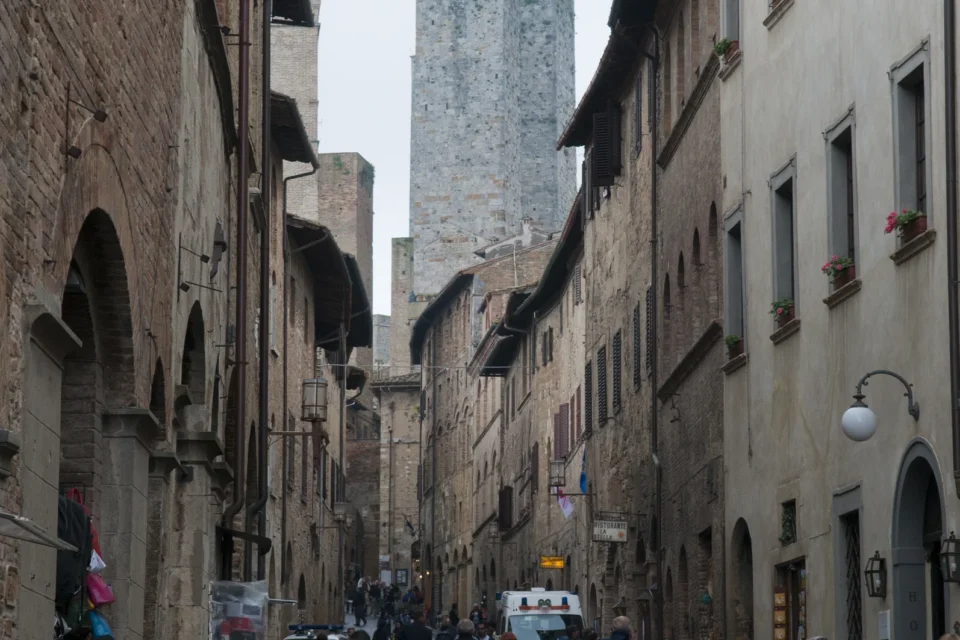
Few towns anywhere announce themselves from such a distance. Rising from a ridge of vineyards and olive terraces between the Elsa and Era valleys, San Gimignano keeps the silhouette of a medieval city almost intact: a tight crown of brick towers above walls, gates and a tangle of stepped alleys. The Historic Centre was inscribed on the UNESCO World Heritage List in 1990, and the reasons are visible in a single walk — a remarkably complete medieval townscape, fresco cycles of the first rank, and the evidence of a civic culture that expressed family ambition in architecture rather than in war.
Visitors who give the town more than an afternoon find layers that day-trippers miss: a civic museum whose walls hold a Maestà painted a few years after Dante stayed in the room below, a collegiate church covered from floor to vault in 14th- and 15th-century narrative frescoes, and a fortress park where the day ends with a glass of Vernaccia as the coaches roll out. The setting on the Via Francigena, the medieval pilgrim road from Canterbury to Rome, gives every lane a sense of passage — this was a town built for travellers long before tourism had a name.
Character and history
San Gimignano grew around two presumed Etruscan-era nuclei and takes its name from Bishop Gimignano, credited in legend with saving the town from Totila’s Huns around 550. Its medieval fortune rested on the Via Francigena, on agriculture — saffron above all — and on the wool and cloth trade. Squeezed between Florence and Siena, the town navigated Guelph and Ghibelline politics through the 13th century, its wealthiest families competing in the fashionable contest of the age: building tower-houses higher than their neighbours.
At the height of that rivalry some seventy towers rose within the walls, the tallest approaching fifty metres; a little more than a dozen survive, which is precisely why the skyline matters. Sumptuary laws and, later, Florentine control after 1353 froze the silhouette in place. The Rocca di Montestaffoli, built by the Florentines in that year to secure the town, now serves not as a garrison but as the town’s public garden and summer open-air cinema. Earthquakes, plague and the 1348 demographic catastrophe dimmed the town’s wealth — and that very decline preserved what prosperity might have demolished.
What to see
The civic heart beats in two adjoining squares. Piazza della Cisterna, a sloping triangle named for its 13th-century octagonal well, remains the town’s living room; steps away, the trapezoidal Piazza del Duomo gathers the sacred and civic monuments under the stern brick face of the Torre Rognosa, one of the town’s tallest towers, admired from below since it is not open to the interior.
The Collegiata Complex (Duomo of San Gimignano) is the artistic centre of gravity: a Romanes-Gothic church whose nave walls carry dramatic Old and New Testament cycles, frescoes by Benozzo Gozzoli and Domenico Ghirlandaio, and the Chapel of Saint Fina, Ghirlandaio’s tender tribute to the town’s patron saint. Across the square, the Palazzo Comunale and Pinacoteca (Civic Museum) preserves the Sala Dante — so called for Dante’s documented 1299 visit — with Lippo Memmi’s Maestà, and a gallery of Sienese and Florentine painting including Filippino Lippi and Pinturicchio. From its courtyard you climb the Torre Grossa (Great Tower), the tallest tower open to visitors, for the classic panorama over rooftops and the hills beyond.
Do not leave out the quieter treasury: the Museum of Sacred Art of San Gimignano, in the chaplains’ former dormitory beside the church. In the former convent of Santa Chiara, the Santa Chiara Complex (Archaeological Museum, Spezieria di Santa Fina and Raffaele De Grada Modern and Contemporary Art Gallery) groups archaeology, an old monastery pharmacy and modern art under one roof. Along the northern side of town, the Church of Saint Augustine holds Benozzo Gozzoli’s fresco cycle on the life of the saint, one of the great paintings of the Florentine Quattrocento; nearby, the deconsecrated Church of San Lorenzo in Ponte keeps traces of medieval frescoes and now serves as an exhibition space. The walk finishes, as most good walks here do, at the Rocca of Montestaffoli, the ruined fortress turned panoramic park.
How to experience
Arrive early or stay late — ideally both. The town empties beautifully after the tour coaches depart, when the stone cools and residents reclaim the squares; evening light on the towers from the fields below is the image you will keep. Walk the perimeter of the walls, follow the Via Francigena markers through the gates, and climb Torre Grossa when visibility is good, looking south to the towers of the Rocca and across to the Crete Senesi on clear days.
Build in slow pleasures. Vernaccia di San Gimignano, the hill’s dry white wine, was among the first Italian wines to receive denomination status, and tasting rooms inside the walls pour it with local pecorino and salumi; the town’s saffron, too, has protected status. Bookshop-and-gelato browsing on Piazza della Cisterna is not a guilty pleasure here, it is the point. If your dates allow, summer brings open-air cinema on the Rocca and a season of concerts and festivals in the squares.
Practical planning
The town stands on its hill above the Raccordo Siena–Firenze–Pisa (raccordo autostradale), with car parks at the gates — vehicles cannot enter the historic centre, so pack for slopes and steps. Regional buses connect San Gimignano with Poggibonsi, which has the nearest rail station on the Florence–Siena line; in season direct buses also link the town with Siena and Florence, and organised excursions run from both cities. Comfortable shoes are non-negotiable: the main street climbs steadily from Porta San Giovanni to the Duomo.
The Civic Museums, Collegiata complex and Santa Chiara sites are operated together, and a combined pass covers several monuments over multiple days; hours vary by season and around religious services, so check current times before setting your itinerary. High season runs from spring to early autumn, with July and August busiest; May, late September and October offer the best balance of weather and calm. A day is enough to see the essentials, but an overnight stay lets you own the town at dawn.
Nearby places
- Siena — the great Gothic rival, an hour or less away by road or bus, for the Campo, the Cathedral and the Palio city’s brick lanes.
- Monteriggioni — a tiny fortified ring of walls and towers crowning its own hill, the perfect half-day pairing for anyone who loves medieval defences.
- Castellina in Chianti — a Chianti Classico town with underground passages and easy access to wineries.
- Radda in Chianti and Gaiole in Chianti — companion villages for a day of wine roads, castles and cypress-lined ridges.
Worth building a day around.
Cappella di Santa Fina
Official Collegiata page documents the Chapel of Santa Fina as part of the visited interior: architecture Giuliano da Maiano, sculpture Benedetto da Maiano, frescoes…
Chiesa di San Lorenzo in Ponte
Listed as a managed venue on the official San Gimignano museums portal with its own visitor page, included in the San Gimignano Pass. Street-level…
Chiesa di Sant'Agostino
Regional tourism portal (visittuscany.com) documents the church at Piazza Sant'Agostino with the 1464 Gozzoli cycle 'Stories of the life of Saint Augustine'; the official…
Complesso della Collegiata (Duomo di San Gimignano)
Official portal page 'Complesso della Collegiata' sells tickets (single EUR 7 full; included in San Gimignano Pass) and publishes hours; interior fresco cycle by…
Complesso di Santa Chiara (Museo Archeologico, Spezieria di Santa Fina e Galleria d'Arte Moderna e Contemporanea Raffaele De Grada)
Official portal page documents the three museums with hours (10:00-19:30 summer / 11:00-17:30 winter, closed 25 Dec) and tickets (EUR 10 full; included in…
Museo d'Arte Sacra di San Gimignano
Official Collegiata complex page describes the museum on Piazza Pecori with panel paintings, sculptures, codices and the Madonna della Rosa by Bartolo di Fredi;…
Palazzo Comunale e Pinacoteca (Museo Civico)
Official museum portal lists Palazzo Comunale, Pinacoteca e Torre Grossa as a managed site with single ticket (EUR 10 full) and San Gimignano Pass…
Piazza del Duomo
Public square framing the Collegiata and the civic palace, documented on official tourism and museum pages. Public pedestrian square.
Piazza della Cisterna
Central public square documented on the official Pro Loco historic-centre pages and municipal tourism material; octagonal travertine well and tower-house facades. Public pedestrian square.
Rocca di Montestaffoli
Pro Loco official portal documents the Rocca as public summer venue ('Cinema in Rocca 2026', 01/06-31/08/2026) and panoramic park; free public access. Uphill path…
Torre Grossa
Official portal sells combined Palazzo Comunale/Pinacoteca/Torre Grossa ticket including the tower climb to the top terrace. Climb by historic staircase only; not wheelchair accessible.
Torre Rognosa
Historic tower on Palazzo del Podestà facing Piazza Duomo, documented on municipal and official tourism sources; interior not open, so the public experience is…
Journeys in San Gimignano.
Demo — San Gimignano Private Highlights Tour
Let a local expert design your San Gimignano day.
Tell us your dates and pace. A travel designer replies within one working day.