Salina
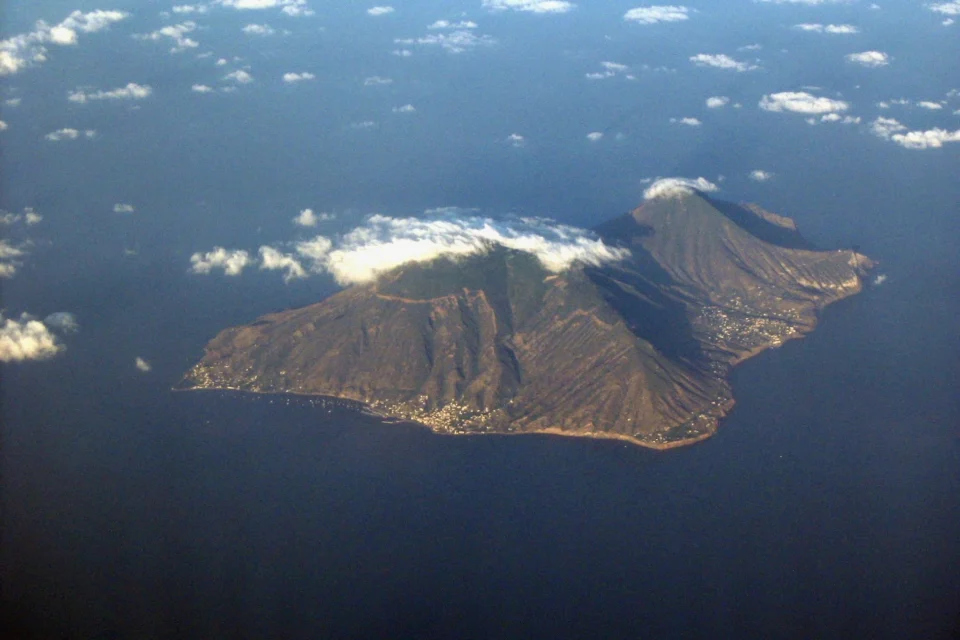
Salina is the green heart of the Aeolian Islands, a pair of sleeping volcanoes draped in vines, caper bushes and chestnut woods off Sicily’s north coast. Quieter than its famous neighbours, it rewards travellers with high-ridge hiking, the collapsed crater of Pollara, and a food culture built on capers and sweet Malvasia wine.
Why visit
Of all the Aeolian islands, Salina is the one people fall for. It is the second largest of the archipelago and by far the greenest, watered by springs that let ferns, poplars and chestnut trees survive where its volcanic siblings bake. Two near-perfect volcano cones rise from the sea, and between them lie terraced gardens, whitewashed villages and roads quiet enough for children to cycle. The island offers genuinely good walking, swimming off dark lava ledges, and trattorie whose cooking — capers in everything, Malvasia in the glass — has real identity rather than resort sameness. If your image of the Aeolians is crowded Stromboli or party-boat Panarea, Salina is the corrective.
Character and history
The Greeks called the island Didyme, “twins”, for its two peaks; the modern name comes from the old salt lagoon at Lingua on its southern shore. Geologically it is the story of six volcanoes, of which the twin summits of Monte Fossa delle Felci and Monte dei Porri are the best preserved, and the most recent eruption, around thirteen thousand years ago, blew out the semi-circular crater of Pollara on the island’s north-west corner, part of which has since slipped beneath the sea. Cultivation shaped the island as much as fire: terraces of capers, vines, olives and figs climb the slopes, and Salina remains the sole production zone of Malvasia delle Lipari, the sweet white wine that Aeolian sailors once traded across the Mediterranean. In 1981 it became the first of the islands to protect its high ground as a nature reserve. Film history touched it too — the 1994 film Il Postino shot key scenes at Pollara — but the island’s essential character is agricultural rather than cinematic.
What to see
Begin with the land itself. Monte Fossa delle Felci, at 962 metres the highest point in the entire archipelago, is the prize of a marked hiking trail that climbs through woods to the summit crater’s rim, with views across to all the islands on clear days. At Pollara, a road ends at the great amphitheatre of the collapsed crater above a pebble cove — walk the path to the old lighthouse point and look down on the offshore rock arch. The port town of Santa Marina Salina is the island’s liveliest centre, its seafront lined with cafes and boat landings. In the saddle between the volcanoes, the Santuario della Madonna del Terzito, built in 1630 at Valdichiesa, remains the island’s religious heart and draws pilgrims each July.
How to experience
Take it at island pace. Hike one volcano, not both, and start early: the trail is exposed near the top. Between walks, hire a boat or join a round-island trip to see Pollara and the sea arch from the water, as the Il Postino crew did. Eat deliberately — a long lunch in a village trattoria, then the island ritual of seasoned bread, pani cunzatu, piled with capers and almonds, followed by mulberry or fig granita in Lingua. Visit a cantina to taste Malvasia where it is grown, and buy capers packed in salt rather than brine. Stay overnight rather than day-tripping: the island after the last hydrofoil belongs to its residents, and that is when Salina is at its best.
Practical planning
Salina is reached by ferry or hydrofoil from Milazzo, with seasonal connections from Messina, Palermo and the other islands; Santa Marina and Rinella are the main ports. The three municipalities — Santa Marina, Malfa and Leni — share a winding road loop best explored by scooter, local bus or hired driver. The volcano trails run within the protected reserve, and access can be limited in high fire-risk weather; check conditions with the reserve authority or the visitsicily.info page for Salina before setting out. May, June and September combine calm seas with flowers or vintage; August is lively and fully booked well ahead.
Nearby places
The other Aeolian islands cluster within easy ferry hops: Lipari, the archipelago’s capital, Vulcano with its sulphur muds, and Stromboli, whose eruption-lit evenings are the Aeolians’ defining spectacle. Quieter siblings Panarea, Filicudi and Alicudi each make a satisfying day trip from Salina’s quays.
Worth building a day around.
Monte Fossa delle Felci
Regione Siciliana — Visit Sicily, in “Salina - Visit Sicily”, identifies Monte Fossa delle Felci as a visitor-relevant attraction associated with Salina. Verified source…
Pollara
Regione Siciliana — Visit Sicily, in “Salina - Visit Sicily”, identifies Pollara as a visitor-relevant attraction associated with Salina. Verified source scope: destination identity;…
Santa Marina Salina
Regione Siciliana — Visit Sicily, in “Salina - Visit Sicily”, identifies Santa Marina Salina as a visitor-relevant attraction associated with Salina. Verified source scope:…
Santuario della Madonna del Terzito
Regione Siciliana — Visit Sicily, in “Salina - Visit Sicily”, identifies Santuario della Madonna del Terzito as a visitor-relevant attraction associated with Salina. Verified…
Journeys in Salina.
Demo — Salina Private Highlights Tour
Let a local expert design your Salina day.
Tell us your dates and pace. A travel designer replies within one working day.