Sabbioneta
Between the Po plain and the hills of the Alto Mantovano, Sabbioneta is a Renaissance ideal city built almost from scratch in a single generation by Duke Vespasiano Gonzaga. Inscribed by UNESCO together with Mantua, it packs a ducal palace, a pioneering theatre, a painted gallery and star-shaped ramparts into a town you can cross on foot in twenty minutes.
Why visit
Sabbioneta answers a question few towns dare to ask: what would a city look like if one enlightened, ambitious man designed it whole? The answer, realized in the second half of the sixteenth century, is a compact grid of handsome streets wrapped in hexagonal walls, with monuments of European rank — a theatre that changed architectural history, a gallery frescoed from end to end, and one of Lombardy’s oldest synagogues. Because everything stands within the ramparts, a day here feels complete: you see the whole Renaissance project, not fragments of it, and you see it without queues.
Character and history
The town grew on a site already inhabited, but its present form is the work of Vespasiano Gonzaga Colonna, the soldier-duke whom his contemporaries flattered as “the Divine.” In a remarkably short span in the later sixteenth century he rebuilt Sabbioneta as his capital, on rational plans of his own devising: straight streets, a defensive perimeter, and a sequence of palaces, churches and squares conceived as a single composition. UNESCO inscribed Mantua and Sabbioneta jointly in 2008 precisely for this pairing — a renewed old city beside a new city built to an ideal plan, two complementary statements of Renaissance urban thinking.
Vespasiano cultivated a deliberately Roman self-image. The theatre’s frescoes link him to the emperor Vespasian and proclaim, on the facade, that mighty Rome itself teaches through its ruins. After the duke’s line faded, the city settled into quiet provincial life, and a new chapter opened with the Jewish community, present from the sixteenth century; under Gonzaga rule and later Este and Austrian administration a ghetto district formed around the synagogue that stands today. That layered identity — ducal, military, Hebrew — gives Sabbioneta a texture rare in a town of its size.
What to see
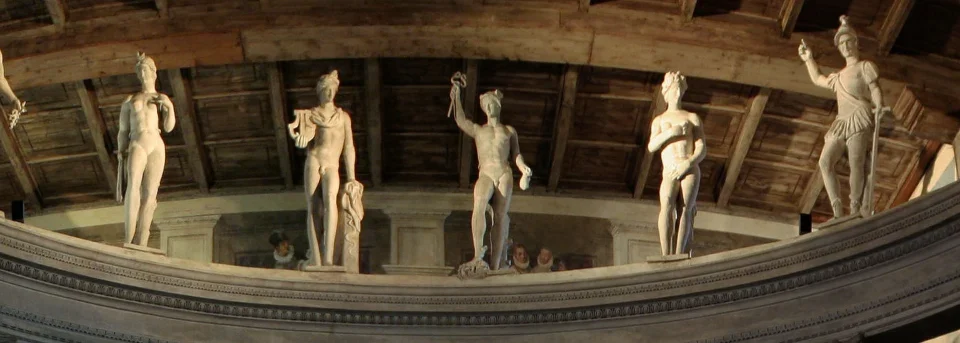
Begin at Piazza d’Armi, the civic heart. The Teatro all’Antica (Ancient Theatre) is the masterpiece: Vincenzo Scamozzi, the Palladio pupil whom Vespasiano met in Venice in 1587, delivered his design the following spring and completed the building by 1590. Its fixed perspective scenery, Corinthian loggia, inverted-hull ceiling and stucco gods make it essential viewing for anyone interested in how the modern theatre was born.
Across the square, the Ducal Palace of Sabbioneta served as the court’s ceremonial seat, while the Palazzo Giardino (Garden Palace) was the duke’s refined retreat beside the horti. Between them runs the Galleria degli Antichi (Gallery of the Ancients), a 96-metre corridor frescoed with views of Rome and lined with ancient sculpture — one of the most atmospheric interiors of the late Renaissance. The octagonal Church of the Beata Vergine Incoronata (Mausoleum of Vespasiano Gonzaga) holds the duke’s tomb, and the Collegiate Church of Santa Maria Assunta in Cielo anchors the other main square.
Do not miss Sabbioneta ebraica: the Synagogue of Sabbioneta in the former ghetto, and the MOISè — Museum of Jewish History and Identity, which threads the ghetto’s lanes into a narrative walk. Walk the Walls of Sabbioneta and the Rocca and pass through the Gates of Sabbioneta to grasp the hexagonal plan from the ramparts. Deeper layers wait in the Museum of the Duchy (Museo del Ducato), the Museum of Sacred Art (Sabbioneta) and the Oratory of San Rocco (Pinacoteca San Luca), while quiet baroque churches in the hamlets of Villa Pasquali, Breda Cisoni, Vigoreto and Ponteterra reward drivers with time to spare.
How to experience
Take the rampart walk first — the circuit of walls gives you the ideal-city plan at a glance and shows the surrounding plain the fortifications were built to command. Then work inward: theatre, gallery, palaces, mausoleum, synagogue. Guided visits, run through the town’s visitor organization, add much on Vespasiano’s symbolism; book the theatre guided slot if you can. Pair Sabbioneta with Mantua, its UNESCO twin, in one trip — the contrast between the two is the lesson. In the evening the town empties of day visitors, and the painted gallery’s silence stays with you over dinner.
Practical planning
Sabbioneta sits in Lombardy’s Mantua province, reachable by car from Mantua, Parma or Cremona; public transport runs by bus from Mantua and Parma but services are infrequent, so a car is the practical choice. The monuments are ticketed individually or by combined pass, with hours and days varying by season — check visitsabbioneta.it, the official tourism portal, before setting out, as some interiors close certain weekdays. The historic centre is compact and flat, ideal on foot; parking lies just outside the walls. Spring and autumn are ideal; August heat makes the rampart walk a morning activity.
Nearby places
No other destinations are currently listed for this province, but the obvious companions lie within easy reach: Mantua, the UNESCO twin city to the east; Parma and its food culture to the south; Cremona and its violin-making tradition to the northwest; and the small Po-side towns of Guastalla and Sabbioneta’s own rural hamlets in between. Plan these as plain driving excursions and treat Sabbioneta as the fixed centre.
Worth building a day around.
Chiesa collegiata di Santa Maria Assunta in Cielo
Pagina ufficiale 'Gli edifici religiosi': commissionata da Vespasiano nel 1562, consacrata dal 1582; principale luogo di culto della città. Chiesa collegiata aperta al culto;…
Chiesa della Beata Vergine Incoronata (Mausoleo di Vespasiano Gonzaga)
Portale ufficiale: chiesa ottagonale 1586-1588, mausoleo di Vespasiano Gonzaga con sepolcro e statua bronzea di Leone Leoni; listino prezzi ufficiale. Intero €8,00; inclusa nel…
Chiesa di San Giorgio Martire in Breda Cisoni
Pagina ufficiale: chiesa tardobarocca (1747-1764) con organo del 1769 funzionante. unknown
Chiesa di San Girolamo in Ponteterra
Pagina ufficiale: facciata innalzata nel 1685; sezione museale 'La camera picta dé Confratelli'. unknown
Chiesa di Sant'Antonio Abate in Villa Pasquali
Pagina ufficiale: opera barocca (1765-1784) di Antonio Luigi Galli Bibiena con doppie volte traforate uniche. unknown
Colonna con statua di Minerva
Pagina ufficiale dedicata: monumento a elementi sovrapposti su tre gradini. Monumento urbano in spazio pubblico.
Galleria degli Antichi (Corridor Grande)
Portale ufficiale con pagina dedicata e listino prezzi ufficiale per il binomio Palazzo Giardino + Galleria degli Antichi. Visita congiunta con Palazzo Giardino: intero…
MOISè — Museo dell'Identità Storica ed Ebraica
Portale turistico ufficiale: il museo accompagna la sinagoga nella narrazione di 'Sabbioneta ebraica' con visite guidate al ghetto. Visite guidate al ghetto ebraico con…
Mura di Sabbioneta e la Rocca
Pagina ufficiale: le mura sono 'l'elemento essenziale dell'assetto urbano' della città ideale; perimetro liberamente esperibile. Passeggiata esterna libera lungo la cinta; elementi interni/scavi con…
Museo del Ducato
Listino ufficiale Visit Sabbioneta (pagina contatti) che pone il Museo del Ducato tra i sei monumenti a pagamento della città. Intero €8,00; incluso nel…
Museo di Arte Sacra
Pagina dedicata del portale ufficiale: allestito nelle stanze della canonica a fine anni Ottanta. unknown
Oratorio di San Rocco (Pinacoteca San Luca)
Pagina ufficiale 'Gli edifici religiosi': ospita la sezione museale Pinacoteca San Luca; luogo della perduta sepoltura di Diana Cardona. unknown
Palazzo Ducale di Sabbioneta
Portale ufficiale Visit Sabbioneta con pagina dedicata (il più antico edificio di Vespasiano Gonzaga) e listino prezzi ufficiale. Intero €10,00; incluso nel Biglietto Unico…
Palazzo Giardino
Portale ufficiale con pagina dedicata ('Il Casino', villa di delizie di Vespasiano) e listino prezzi ufficiale. Visita congiunta con Galleria degli Antichi: intero €10,00;…
Porte di Sabbioneta
Pagina ufficiale: porte della prima cinta muraria, completate nel 1567. Monumenti esterni lungo la cinta muraria, liberamente visibili.
Santuario della Beata Vergine delle Grazie di Vigoreto
Pagina ufficiale: santuario cinquecentesco costruito sul luogo di un'apparizione mariana del 1543. unknown
Sinagoga di Sabbioneta
Portale ufficiale con pagina dedicata alla comunità ebraica insediatasi dalla seconda metà del Cinquecento e alla sinagoga (costruita 1824); listino prezzi ufficiale. Intero €8,00;…
Teatro all'Antica
Portale turistico ufficiale Visit Sabbioneta con pagina dedicata e listino prezzi ufficiale (teatro progettato da Vincenzo Scamozzi, 1588-1590, uno dei primi teatri coperti indipendenti…
Journeys in Sabbioneta.
Demo — Sabbioneta Private Highlights Tour
Let a local expert design your Sabbioneta day.
Tell us your dates and pace. A travel designer replies within one working day.