Palinuro
At the southern reaches of the Cilento coast, where the land pushes boldly into the Tyrrhenian Sea, Palinuro gathers wide sandy beaches on one side of its promontory and cliffs, coves and sea caves on the other. Named for Aeneas’s helmsman, this seaside quarter of Centola pairs beach-holiday ease with dramatic coastal scenery.
Why visit
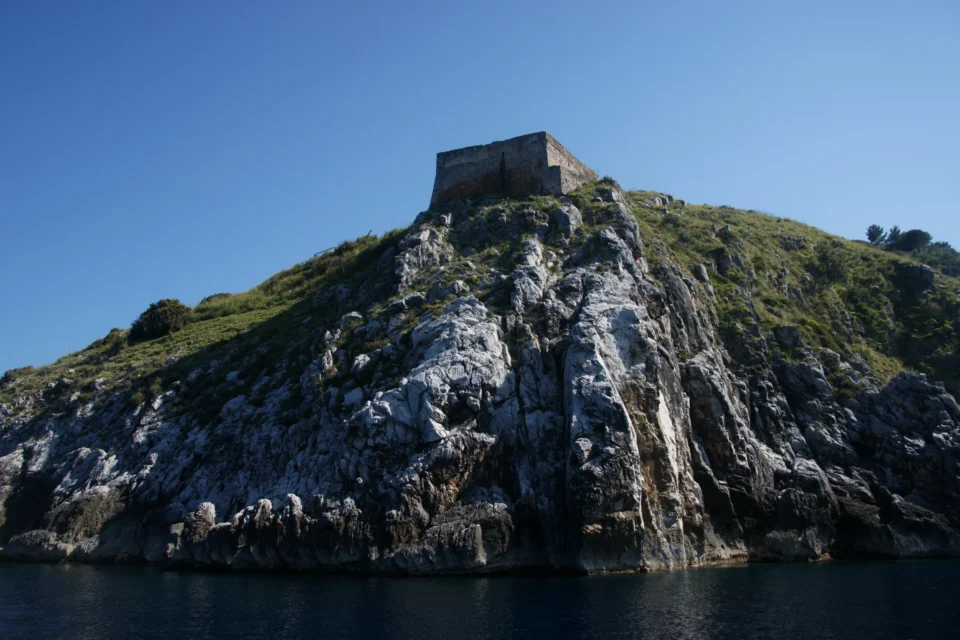
Palinuro answers a simple question: what if a Greek-island coastline had grown up along an Italian shoreline? The promontory of Capo Palinuro is the reason to come. Boat trips from the little port thread into marine caves whose waters glow electric blue, rock walls flush with reds and a grotto streaked with pale formations; on land, a great natural arch of stone frames the sea at Ficocella. The beaches — long, sandy and repeatedly awarded for water quality — are among the finest in the national park that surrounds the town. Underwater, depths plunge dramatically within a short distance of the cape, making these some of the most interesting dive sites on the Tyrrhenian. It is a place that suits families and swimmers as much as hikers, divers and mythology-minded travellers.
Character and history
The name carries an epic weight. Palinurus, helmsman of Aeneas, fell into the sea — betrayed by Sleep, Virgil tells us — while steering the Trojan fleet by night toward Italy, and the cape that bears him anchors the closing books of the Aeneid. Whatever one makes of the legend, the headland’s strategic position meant the coast was frequented and settled from remote antiquity; tombs and finds scattered across the promontory attest to centuries of occupation long before the modern resort took shape. Palinuro itself grew from a small fishing and farming community into the principal seaside frazione of Centola, and it now sits inside the Cilento, Vallo di Diano and Alburni National Park, a territory whose coastline is also recognised as a UNESCO World Heritage cultural landscape. Today it is livelier than its neighbour Marina di Camerota — more evening life, more summer energy — though it remains far calmer than the resorts of the Amalfi Coast to the north.
What to see
The headline attraction is on the water. The Sea Caves of Capo Palinuro are reached by boat from the port, where excursion fleets run regular circuit trips. The best known is the Grotta Azzurra, whose flooded chamber blazes with reflected light on sunny days; the Grotta del Sangue takes its name from the deep red tones the water can assume, and the Grotta dei Monaci is named for rock shapes resembling hooded monks. Which caves are enterable depends on sea conditions, so treat each trip as its own weather-dependent event.
On the coast below the Ficocella district, the Palinuro Natural Arch — a rock arch carved by the sea — has become the area’s signature photograph, and the small beach beneath it is a favourite with snorkellers. The arch and this stretch of coast have even served as backdrops for classic adventure films.
For a cultural counterpoint, the Antiquarium of Palinuro at Ficocella displays archaeological material recovered from the promontory, evidence of the cape’s ancient importance; it is a small museum, quickly and rewardingly visited.
How to experience
Take a boat first. The cave circuit from the port is the essential Palinuro experience, and a private or small-group rubber-boat excursion reaches coves such as the Baia del Buondormire that larger vessels cannot enter. Snorkel the Ficocella arch, walk the paths across the promontory at golden hour, and let the days organize themselves around the beach. Divers come for the deep water offshore and the cave dives; beginners can arrange courses at local dive centres. In the evenings, the waterfront and the old village streets fill with the unpretentious ritual of aperitivo and grilled fish. September, when the sea is warm and the crowds thin, may be the finest month of all.
Practical planning
Palinuro lies roughly 80–100 kilometres south of Salerno, depending on the route, within the Cilento national park. The nearest rail station is Pisciotta-Palinuro, a few kilometres away, with connections toward Naples and Salerno; buses and taxis cover the final stretch. Drivers should allow time on the coast road and park at the port for boat excursions. The season runs broadly from late spring through October; July and August are busy and best for booking everything well ahead, while June and September offer the same sea with more calm. Boat trips, cave access and dive conditions are all weather-dependent — check locally on the day. Blue Flag water-quality recognition has been a recurring feature of the town’s beaches. Ask at the local tourist office or the municipal site (comune.centola.sa.it) for current schedules and event programmes.
Nearby places
Along the same Cilento shoreline, Marina di Camerota lies just to the south with its own coves and caves, while Acciaroli and Castellabate sit to the north — the first famous for its blue-water beaches, the second for its medieval borgo above the sea. Inland and slightly further afield, Padula rewards a day trip with its vast Certosa.
Worth building a day around.
Antiquarium di Palinuro
Antiquarium page on palinuro.it, the tourism portal linked from the Comune di Centola homepage, gives address, seasonal hours and phone; exhibits finds recovered in…
Arco Naturale di Palinuro
Described as the symbol of Palinuro with easy access on the official-linked local tourism portal palinuro.it ('cosa vedere'). Symbol of Palinuro on the shoreline;…
Grotte marine di Capo Palinuro
Local tourism portal palinuro.it (linked from the Comune di Centola homepage) names the caves of Capo Palinuro (Grotta Azzurra, Grotta d'Argento, Grotta delle Ossa,…
Journeys in Palinuro.
Demo — Palinuro Private Highlights Tour
Let a local expert design your Palinuro day.
Tell us your dates and pace. A travel designer replies within one working day.