Paestum
Some places you visit; Paestum you walk into. On a flat stretch of the Sele plain near the Tyrrhenian coast, three Greek temples have stood for roughly two and a half thousand years amid the quiet streets, walls and sanctuaries of the city colonists called Poseidonia — complete, serene, and uncrowded relative to its importance.
Why visit
Paestum offers something increasingly rare in Italy: monuments of the first rank with room to breathe. The three Doric temples rank among the best preserved anywhere in the Greek world, and unlike the Acropolis or Pompeii, you can often stand before them with only the wind in the grass for company. The on-site museum holds the Tomb of the Diver, whose painted slab of a swimmer plunging into blue water is celebrated as the only complete surviving example of Greek figure painting of its era. Add the Roman forum, early Christian basilica and miles of city walls, and you have a full day — or two — of dense, atmospheric sightseeing, with the beaches of the Cilento coast a short drive away.
Character and history
Greek settlers, traditionally linked to Sybaris, founded Poseidonia around 600 BC on a plain watered by the Sele river, naming it for Poseidon. They laid the city out on a grid, with great sanctuaries at its northern and southern edges, and over the next century and a half raised the temples that still define the site. Around 400 BC the indigenous Lucanians took control, renaming the city Paistos; Greek cult and language mingled with Oscan for generations. Rome absorbed Paestum in 273 BC, making it a loyal Latin colony — it stayed faithful even during Hannibal’s invasion — and adding a forum, baths and an amphitheatre. From late antiquity onward, malaria and a slowly waterlogging plain emptied the city; by the early Middle Ages only the temple of Athena, reused as a church, kept a flicker of life. Forgotten for centuries, Paestum was rediscovered in the 18th century as the Grand Tour generation began excavating Pompeii and Herculaneum. Piranesi’s etchings of the temples spread their fame across Europe and helped shape the Greek Revival.
What to see
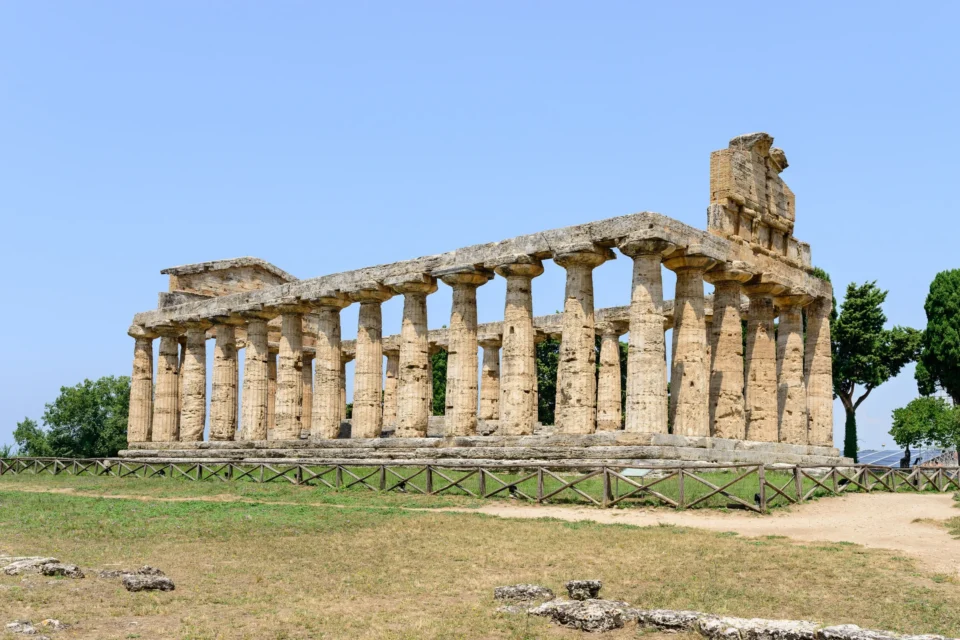
The heart of any visit is the Archaeological Area of Paestum, which sprawls across the ancient city. The Temple of Hera, known as the Basilica, is the oldest, begun around 560 BC and unusually wide, with nine columns across each short end. The Temple of Athena, on a low rise, mixes Doric and Ionic elements around 500 BC. The grandest is the so-called Temple of Neptune, completed around 460 BC, its fluted columns supporting much of the original entablature; its true dedication is debated, which tells you how much there is still to learn here. Between them lie the circular ekklesiasterion, the heroon symbolically honouring the city’s founder, and the Roman forum and baths.
The National Archaeological Museum of Paestum, beside the site, displays the Tomb of the Diver, metopes carried from the sanctuary at the mouth of the Sele, painted Lucanian tombs, and bronzes from the heroon.
Within the ruins, the Paleochristian Basilica of the Santissima Annunziata testifies to the Christian community that persisted as the ancient city faded. The City Walls of Paestum form a nearly complete circuit of Greek and Lucanian masonry with gates and towers — a pleasant walk in themselves. Two outlying sanctuaries reward those with time: the Santa Venera Archaeological Area, an extra-urban sanctuary of Aphrodite beyond the Capodifiume stream, and the Heraion on the Sele Archaeological Area and Museum near the river mouth, where metopes from the great temple of Hera are shown on the spot where they were found.
How to experience
Take it slowly. The temples change character through the day: pale and crystalline in the early morning, honey-coloured by late afternoon. Walk the full length of the walled city rather than only the temple zone; the quieter stretches reveal the scale of a Greek colonial capital. Renting an audio guide or joining a licensed guide brings the dedications and debates to life. After the museum, linger in the modern village for a lunch of mozzarella di bufala — this is one of its heartlands — then consider the coast. Cyclists can ride quiet roads between the ruins, the station and the sea. Tickets and the combined pass covering Paestum and Velia are available online; check the park’s official site (parchipaestumvelia.cultura.gov.it) for current hours and prices before you go.
Practical planning
Paestum sits in the municipality of Capaccio Paestum, south of Salerno, and is reachable by train on the Naples–Reggio Calabria line; the station is a short walk from the site. Drivers should follow the SS18 and use the signed parking near the entrance on Via Magna Grecia. Most of the terrain is flat and easy, but the site is exposed — bring a hat and water in summer, when midday heat is serious. The archaeological area and museum generally open daily, with the last entries before closing, though schedules shift for holidays and special events, so confirm on the park website. A combined ticket covering Paestum, the museum and Velia suits a two-day itinerary along this coast. Spring and autumn offer the best balance of light, temperature and calm.
Nearby places
The Amalfi Coast lies north along the same province: Amalfi, Positano, Ravello and Praiano make natural pairings with Paestum for a Salerno-based trip. Closer to hand, the protected landscapes of Cilento begin just to the south, with Vietri sul Mare, the ceramic town at Salerno’s edge, on the way.
Worth building a day around.
Area archeologica di Paestum
Official MiC park institute page and ticket page: open daily 8:30-19:30, last entry 18:30, no mandatory booking; combined ticket covers area + museum +…
Area archeologica di Santa Venera
Official institute page dedicated to the area: sanctuary remains 'si possono ancora ammirare' and the site belongs to the state park institute; no published…
Area archeologica e Museo dell'Heraion sul Sele
Official institute page dedicated to 'Area Archeologica e Museo dell'Heraion sul Sele'; the park's public communications state visits to the Heraion are by reservation…
Basilica paleocristiana della Santissima Annunziata
Official park page for the Area archeologica states the medieval church 'costruito attorno alla Basilica paleocristiana della SS. Annunziata' and that the area also…
Cinta muraria di Paestum
Official institute page dedicated to the Cinta Muraria: circuit of almost 5 km with 4 main gates (Porta Aurea, Porta Sirena, Porta Giustizia, Porta…
Museo archeologico nazionale di Paestum
Official institute page: museum open since 1952, fully renewed layout from October 2023; ticket page: open daily 8:30-19:30, museum last entry 19:00, closed first…
Journeys in Paestum.
Demo — Paestum Private Highlights Tour
Let a local expert design your Paestum day.
Tell us your dates and pace. A travel designer replies within one working day.