Padula
In the green trough of the Vallo di Diano, Padula grew up beside the Certosa di San Lorenzo, a Carthusian universe of cloisters, spiral staircases and gilded chapels that UNESCO inscribed in 1998. Around it lies a small stone town of paleo-Christian baptisteries, hilltop archaeology and surprising museums.
Why visit
Padula is the justification for a detour into deepest Campania. The Certosa di San Lorenzo, begun in 1306 by Tommaso Sanseverino, count of Marsico, is described by the Ministry of Culture as the most vast monastic complex in southern Italy and one of Europe’s most significant — over fifty thousand square metres of Chartreuse order, baroque chapels and monumental stairs, protected together with the Cilento and Vallo di Diano National Park on the UNESCO World Heritage list. The town around it is no footnote: a paleo-Christian baptistery counted among the oldest in the West, the remains of the ancient hilltown of Cosilinum, a house museum honouring the legendary New York detective Joe Petrosino, and a multimedia civic museum that threads the whole Vallo di Diano story together. Come for half a day, stay two — the scale of the charterhouse alone demands it.
Character and history
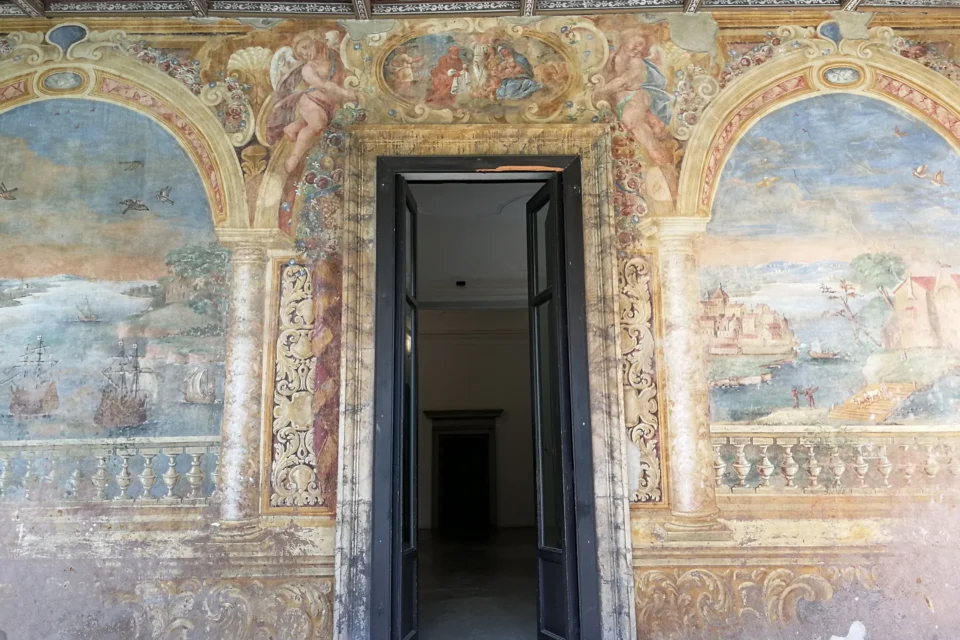
The hill above town was already a refuge in the ninth century, when locals retreated there against Saracen raids, and a monastery of Saint Nicola stood on its crest by 1086. The organised village took shape when Tommaso II Sanseverino settled here at the end of the thirteenth century; in 1306 his family founded the Carthusian house below, on the site of an earlier grange. For five hundred years the monks built, refined and prospered: the original fourteenth-century church survives in its portal of 1374 and cross vaults, while the Counter-Reformation brought transformation — gilded seventeenth-century stuccoes by the lay brother Francesco Cataldi, eighteenth-century frescoes, the late-Mannerist facade finished in 1723, and the great cloister of 1583, nearly fifteen thousand square metres among the largest in Europe, spanned by Barba’s celebrated elliptical double staircase of 1642’s decade. French confiscation ended monastic life in 1807; the building was declared a national monument in 1882 and major restoration began only in 1982. The hilltop keeps older memories — the ancient Lucanian-Roman town of Cosilinum with its necropolis crowns the Civita hill — while the borgo remembers Joe Petrosino, born here in 1860 before becoming New York’s most famous crime-fighter.
What to see
The Certosa di San Lorenzo is the essential visit and easily fills hours: the church and refectory with Alessio D’Elia’s 1749 Wedding at Cana, the monks’ cells (several now holding contemporary art from the triennial “Le Opere e i Giorni” project), the spiral stone stair of thirty-eight monolithic steps up to the library, and above all the great cloister with its 1640 fountain. Inside the complex, the Archaeological Museum of Western Lucania displays the valley’s ancient heritage. In the borgo below, the Palaeo-Christian Baptistery of San Giovanni in Fonte — traditionally commissioned by Pope Marcellus I — stands among the oldest in the Western world; the hill of the Civita preserves the Cosilinum Archaeological Area; and the town’s museum system rounds out the picture with the Joe Petrosino House Museum, the Padula Multimedia Civic Museum in the modern Palazzo Brando, the genealogical Museum of Surnames and the Didactic Museum of Padula Stone, honouring the local stonemasons’ craft.
How to experience
Dedicate the morning to the Certosa, walking it slowly — the sequence of cloister, staircase, church and cells is a designed experience, not a collection of rooms. In the afternoon climb through the borgo to the baptistery and continue up to Cosilinum for the view over the whole Vallo di Diano. Food matters here: the valley’s padulesi cooking is hearty and traditional, and on 10 August the town famously cooks a thousand-egg omelette in memory of a feast held for Charles V. If genealogy runs in your family — as it does for many Italian-American visitors — the Museum of Surnames and the civic museum’s archives make Padula a meaningful stop on a roots journey. The local tourism site offers guided visits, audio guides and workshops; booking ahead simplifies the Certosa visit in high season.
Practical planning
Padula lies about a hundred kilometres southeast of Salerno in the Vallo di Diano, reached by the A2 motorway at the Padula-Buonabitacolo exit or by train to nearby Sala Consilina followed by a short ride. The Certosa’s visit hours and tickets are published by the Ministry of Culture — check before travelling, as closing days shift seasonally. Wear comfortable shoes for the borgo’s slopes and the Civita climb. Combine the town with the Cilento coast (about an hour west) or with the park’s villages; spring and autumn are the most comfortable seasons.
Nearby places
- Marina di Camerota — the Cilento coast’s southern beach town, within an hour’s drive west.
- Palinuro — the famous cape and grotto coast at the Cilento’s southern tip.
- Acciaroli — the polished little fishing port on the Cilento’s western shore.
- Castellabate — the medieval borgo and seaside quarter of the northern Cilento.
Worth building a day around.
Area archeologica di Cosilinum
Official padula.eu borgo page describes the ruins of Civita (ancient Cosilinum) with a visible wall stretch and the Via Popilia; necropolis finds held in…
Battistero paleocristiano di San Giovanni in Fonte
Official padula.eu museum-system ticket page lists the baptistery among the ticketed sites ('aperto su prenotazione'); described as one of the oldest baptisteries in the…
Casa Museo di Joe Petrosino
Official padula.eu museum system and integrated ticket list the house museum with published seasonal hours; unique house museum in Italy dedicated to a law-enforcement…
Certosa di San Lorenzo
Reservation is optional for ordinary admission. Group visits to the Museo dei Ricordi require a request at least one week in advance. The library…
Museo Archeologico della Lucania Occidentale
Official padula.eu borgo page states necropolis finds are 'kept in the Archaeological Museum of Western Lucania inside the Certosa di San Lorenzo'; the Certosa…
Museo Civico Multimediale
Official padula.eu museum system page and integrated 'Certosa e Padula' ticket ('aperto su prenotazione'). Housed in Palazzo Brando (opened 2014, design Fabrizio Mangoni); interactive…
Museo del Cognome
Presented as a visitable museum on the official padula.eu borgo page of the Padula museum system. Ground floor of an 18th-century house in the…
Museo Didattico della Pietra di Padula
Listed as a visitable museum on the official padula.eu borgo page. Dedicated to the centuries-old tradition of Padula master stonemasons and sculptors and the…
Journeys in Padula.
Demo — Padula Private Highlights Tour
Let a local expert design your Padula day.
Tell us your dates and pace. A travel designer replies within one working day.