Orvieto
Orvieto rises on a sheer plateau of volcanic tuff above the Paglia valley, one of the most dramatic positions of any Italian hill town. A leading Etruscan metropolis, a papal refuge and a free commune in turn, it packs a great Gothic cathedral, a honeycomb of underground caves, Etruscan necropoleis and Renaissance engineering into a compact, walkable upper town.
Why visit
Few cities of this size offer so much within so small an area. The plateau known as La Rupe rises from the valley of the Paglia, a tributary of the Tiber, and everything of consequence sits on top of it: the cathedral and its museums, the civic towers and palaces, the warren of streets opening onto terraces of vineyard and clay. You can walk from the funicular to the far end of town in half an hour, yet each corner repays an hour.
Orvieto suits three kinds of traveller at once. Art lovers come for the cathedral’s sculpted facade and the apocalyptic frescoes of its San Brizio chapel. Curious travellers descend instead of ascend — into the Etruscan quarries beneath the streets, down the spiral staircases of Saint Patrick’s Well, through the cave dwellings of Pozzo della Cava. And anyone who enjoys slow Italian urban life will find café terraces, ceramic workshops and a worthy food scene strung along Corso Cavour and the lanes around Piazza della Repubblica.
Character and history
The city occupies the site of Velzna, one of the great Etruscan cities and home of the Fanum Voltumnae, the sanctuary where the Etruscan league met. Rome destroyed and absorbed it in 264 BC, and the medieval name Urbs Vetus — “old city” — preserves the memory of that deep past within the modern Orvieto. After the collapse of empire the shattered population retreated to the cliff, which was easier to defend than the valley below.
The free commune, recognized from the twelfth century, peaked in the thirteenth and fourteenth, when work began on the cathedral and the civic palaces that still define the townscape. Papal influence returned decisively under Cardinal Albornoz, whose fortress of 1364 still guards Piazza Cahen; the city passed formally to the Papal States in 1499 and stayed there until unification. In 1527, fleeing the Sack of Rome, Pope Clement VII took refuge here and commissioned the great well that still bears Saint Patrick’s name. Orvieto sought UNESCO World Heritage listing in 2006, and its claim to exceptional universal value rests on exactly this layering: Etruscan, medieval, papal and Renaissance in one small place.
What to see
Begin at the cathedral. The Orvieto Cathedral (Santa Maria Assunta), begun in 1290 under Pope Nicholas IV, carries one of Italy’s great facades, striped and gabled and crowded with reliefs; inside, the Chapel of San Brizio was started by Fra Angelico in 1447 and completed by Luca Signorelli between 1499 and 1504 with a thunderous vision of the Last Days, while the Chapel of the Corporale guards the relic of the Bolsena miracle. The Museum of the Duomo Works (MODO) and the Emilio Greco Museum, both in the Papal Palaces, extend the visit, and the Underground of the Duomo reveals some 800 square metres of tunnels beneath the transept where the cathedral workshop worked for centuries.
Civic Orvieto clusters around Corso Cavour: climb the 47-metre Torre del Moro for rooftop views, admire the Palazzo dei Sette, then cross to Piazza della Repubblica for the Palazzo del Popolo and the Palazzo Comunale (Town Hall). At the cliff’s edge stands the Rocca Albornoziana, now gardens inside papal walls, beside Saint Patrick’s Well, Sangallo’s 62-metre shaft with two helical staircases wide enough for mule loads passing in opposite directions.
The underground city deserves its own afternoon: Orvieto Underground leads through Etruscan caves and quarries, and Pozzo della Cava combines a 36-metre well with medieval kilns and, in 2023, joined UNESCO’s Global Network of Water Museums. For Etruscan Orvieto, the Claudio Faina Museum and the National Archaeological Museum of Orvieto face the cathedral; below the cliff lie the Crocifisso del Tufo Necropolis, the Cannicella Necropolis, the Etruscan Belvedere Temple and the frescoed Golini Tombs (Hescanas Tomb). Among the churches, Sant’Andrea, San Giovenale, San Domenico, with Arnolfo di Cambio’s cardinal de Braye monument, San Francesco and San Lorenzo de’ Arari each reward a short stop.
How to experience
Give Orvieto two nights if you can: one day for the cathedral complex and civic centre, one for the underground and the Etruscan sites. Time a visit to the Duomo for late afternoon, when the facade catches low sun from the piazza’s cafés. Book the San Brizio chapel and underground visits in advance in high season. Food is part of the experience — Umbrian classics, the white and rosy Orvieto wines from the hillside vineyards, and ceramics in the traditional green-and-dark patterns make lasting souvenirs. Umbria Jazz Winter brings clubs and squares alive around the New Year, a good moment to see the city at its most convivial.
Practical planning
Orvieto sits on the main Rome–Florence rail line, about an hour from Rome; from the station a funicular climbs to the historic centre, and escalators and lifts continue into the old town, so luggage wheels are manageable. Cars must remain in the valley car parks. The cliff-top town is compact and walkable, though cobbled; comfortable shoes matter. Combine tickets for the Duomo complex save time and money, and the official cathedral app offers an audioguide. Check seasonal hours for the wells and underground sites before you go, as they vary and some close on weekdays out of season.
Nearby places
Orvieto anchors the south-western corner of Umbria, within easy reach of the Tiber valley and Lake Corbara, and well placed for exploring the rest of the region by rail or road. The vineyard roads around the cliff make an easy half-day loop, while the routes north towards Todi and the centre of Umbria thread castles and monasteries through quiet valley country.
Worth building a day around.
Cappella di San Brizio
The official Duomo site presents the chapel with the Beato Angelico-Signorelli fresco cycle. unknown
Chiesa di San Domenico
Described by the official regional tourism portal with the original apse, the Aquinas cathedra and the De Braye mausoleum. unknown
Chiesa di San Francesco
Described by the official regional tourism portal with its c. 1240 origins and municipal library in the convent. unknown
Chiesa di San Giovenale
Described by the official regional tourism portal as built in 1004 over an Etruscan temple and paleochristian building. unknown
Chiesa di San Lorenzo de' Arari
Described by the official regional tourism portal as built c. year 1000 over an Etruscan altar. unknown
Chiesa di Sant'Andrea
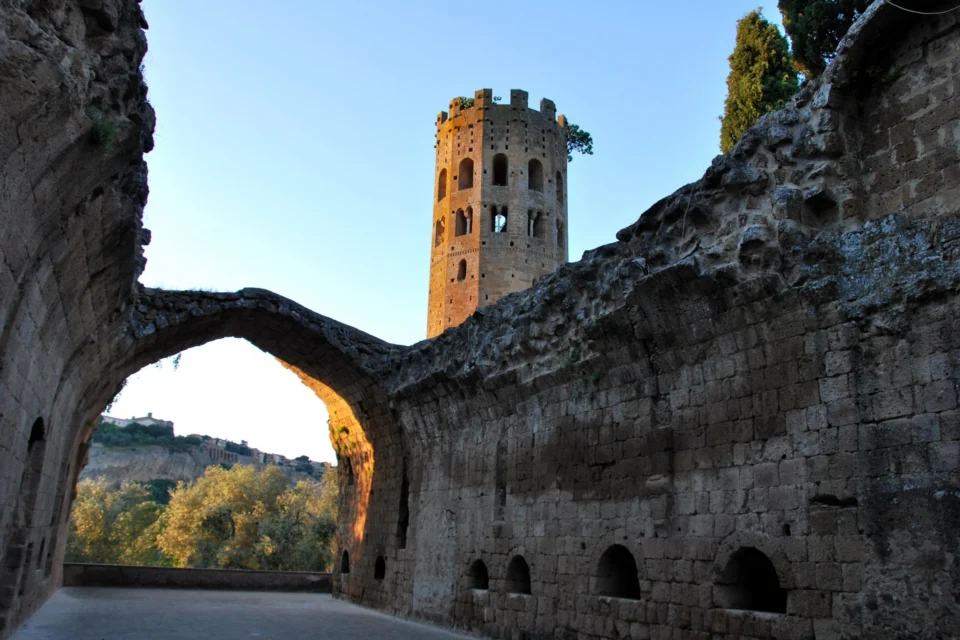
Described by the official regional tourism portal with its 12-sided bell tower and stratified museum area. unknown
Duomo di Santa Maria Assunta in Cielo
Official Duomo site publishes visitor components, ticket types (EUR 8 Duomo ticket incl. Museo Emilio Greco and Sotterranei) and combined options. unknown
Museo Archeologico Nazionale di Orvieto
Described by the official regional tourism portal as holding Belvedere temple remains and Volsinii materials in Palazzo Vescovile. unknown
Museo Claudio Faina
Official Fondazione site presents the museum and the Piazza del Duomo museum quarter. unknown
Museo dell'Opera del Duomo (MODO)
Official Duomo site includes free access to MODO with the Duomo ticket; the museum is named among the visitor components. unknown
Museo Emilio Greco
Official Duomo site lists Museo Emilio Greco in Palazzo Soliano among the components included in the EUR 8 Duomo ticket. unknown
Necropoli della Cannicella
Described by the official regional tourism portal with its female-deity sanctuary. unknown
Necropoli di Crocifisso del Tufo
Described by the official regional tourism portal as a necropolis of monumental family tombs with inscriptions. unknown
Orvieto Underground (Citta Sotterranea)
Official site publishes guided tours (daily 11:00, 12:15, 16:00, 17:15, c. 1 hour) departing from Piazza Duomo 23 with phone/email booking. unknown
Palazzi Papali
The official Duomo site lists the Palazzi Papali complex hosting MODO and Museo Emilio Greco. unknown
Palazzo Comunale
Described by the official regional tourism portal with its seven round arches. unknown
Palazzo dei Sette
Described by the official regional tourism portal as today hosting exhibitions. unknown
Palazzo del Popolo
Described by the official regional tourism portal; the municipal site maintains a dedicated Palazzo del Popolo page (congress venue). unknown
Pozzo della Cava
Official site publishes identity, address, tickets (EUR 5/3.50), combos and free audioguides; UNESCO Water Museums Network member since 2023. unknown
Pozzo di San Patrizio
Described by the official regional tourism portal as a 62 m well of 1527 commissioned by Clement VII; ticketing confirmed by the Pozzo della…
Rocca Albornoziana
Described by the official regional tourism portal as a quadrilateral fortress converted to public gardens. unknown
Sotterranei del Duomo
Official Duomo site describes the Sotterranei as an included component of the Duomo ticket. unknown
Tempio Etrusco del Belvedere
The official regional tourism portal records the Belvedere temple remains among Orvieto's archaeological heritage. unknown
Tombe Golini (Tomba degli Hescanas)
Described by the official regional tourism portal among Orvieto's frescoed Etruscan burial chambers. unknown
Torre del Moro
Described by the official regional tourism portal as 47 m tall at the centre of the four quarters. unknown
Journeys in Orvieto.
Demo — Orvieto Private Highlights Tour
Let a local expert design your Orvieto day.
Tell us your dates and pace. A travel designer replies within one working day.