Nus
Nus pairs a quiet vineyard village on the Dora Baltea with the starry heights of the Saint-Barthélemy plateau, where an astronomical observatory shares a ledge with a Bronze Age hillfort. Ruined medieval castles, the legendary seat of Pontius Pilate and Europe’s highest sanctuary trace a line from prehistory to present-day astronomy.
Why visit
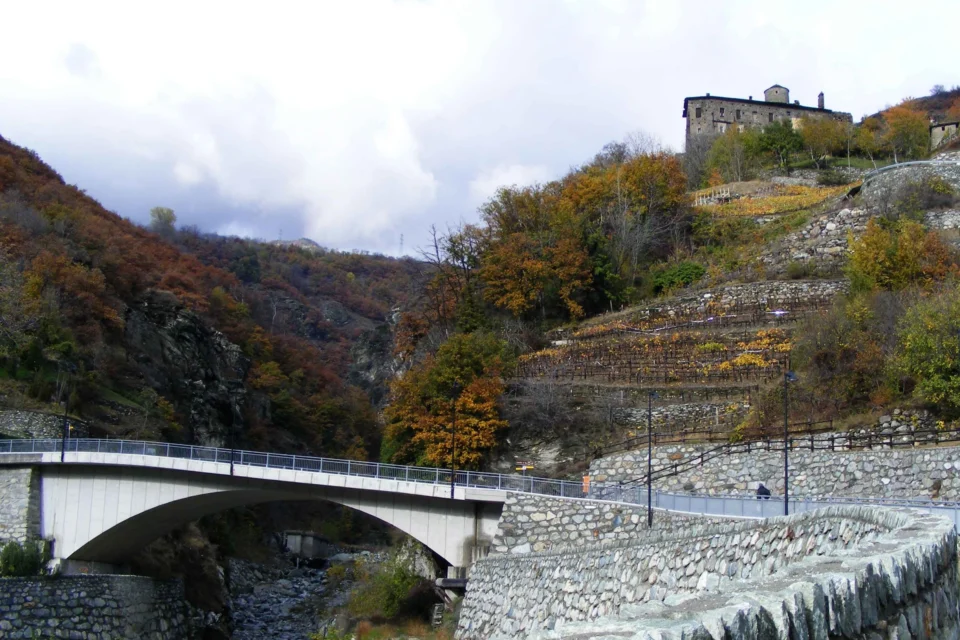
Nus rewards travellers who like their Alps layered. On the valley floor, amid vineyards producing the local Torrette wines, stand two medieval castles — one abandoned in favour of a stronger stronghold, one wrapped in a legend of Pontius Pilate resting on his journey toward exile. Up the Saint-Barthélemy valley, the landscape changes character entirely: at Lignan, a naturally fortified hilltop settled in the late Bronze Age keeps watch beside a modern astronomical observatory and planetarium, one of the few places where you can contemplate prehistoric hill-dwellers by day and exoplanets by night. Higher still, at 2,656 metres, the sanctuary of Our Lady of the Snows at Cuney — described as the highest sanctuary in Europe — crowns the pastures in a solitude broken only by the feast-day procession each August. This combination of archaeology, astronomy and living faith, all within one small municipality between Fénis and the city of Aosta, makes Nus a destination for the curious rather than the checklist traveller, with Châtillon and Saint-Vincent below for a longer lower-valley itinerary.
Character and history
Nus’s recorded story begins with the medieval lords who built the first castle in the village centre in the twelfth or thirteenth century; after a fire they moved to the stronger castle on the hill near Plane, leaving the old ruin to legend. The most picturesque of the legends attached itself to the lowly one: that Pontius Pilate, travelling toward exile in Gaul after condemning Christ, stopped here to rest, lending the ruin the name of Pilate’s Castle. Above the valley, the Saint-Barthélemy plateau preserves a far older chapter: the site of Lignan, an isolated rock height at 1,546 metres above the valley, is a textbook example of the naturally fortified settlements to which alpine communities moved in the late Bronze and early Iron Age, roughly between 1200 and 900 BC, when the first Celtic pressures from central Europe made the valley floors feel unsafe. The plateau kept its sacred vocation across the millennia — the pastures of Cuney drew worshippers to a blessed spring from at least the seventeenth century, when a chapel was consecrated in 1659, and the modern era added a scientific dimension with the regional astronomical observatory, which chose Lignan for its dark skies, complemented by a public planetarium. Few valleys of similar size can trace habitation from protohistory to research astronomy on a single path.
What to see
The archaeological anchor is the Lignan Protohistoric Settlement Site, the naturally fortified height at 1,546 metres overlooking the Saint-Barthélemy valley, occupied in the late Bronze and early Iron Age — the regional heritage authority presents it as the classic instance of hilltop relocation in the pre-Roman Alps. Beside it, science took over the same sky: the Aosta Valley Astronomical Observatory at Lignan conducts public research programmes and opens to guided visits, while the nearby Lignan Planetarium stages digital sky shows that make the plateau a destination for families and stargazers alike.
Down in the village, the two castles frame the medieval memory: the Castle of Nus above the hamlet of Plane, the lords’ stronger residence after the fire, and the evocative ruins of Pilate’s Castle in the village centre, restored and visitable in the warm months, its staircase climbing to the turrets. The sacred geography culminates at the Our Lady of the Snows Sanctuary at Cuney: a chapel commissioned in 1656 and consecrated in 1659, rebuilt in 1861, hung with eighteenth- and nineteenth-century ex-votos and an 1825 altarpiece by the Valdostan painter Curta, and still the goal of the patronal pilgrimage on 5 August, when the processional cross is dipped in the blessed spring.
How to experience
Plan the day as a climb through time. Morning on the valley floor: the ruins of Pilate’s Castle, the lanes of the village and, if time allows, the exterior of the castle at Plane. Early afternoon, drive the Saint-Barthélemy road as it climbs through chestnut woods to Lignan — narrow, lovely and unhurried — and visit the observatory or planetarium according to the scheduled programme; book guided visits ahead in summer. Late afternoon, continue to the trailhead for Cuney if you mean to walk to the sanctuary, or simply savour the plateau’s views back over the Dora Baltea. Stargazers should stay for nightfall: the plateau’s dark skies are the reason the observatory exists, and even unaided viewing rewards patience. Wine lovers can round the day in the vineyards below, where the Torrette blend belongs to the Valle d’Aosta’s oldest red tradition. In winter the plateau becomes quiet snow country; verify road conditions before attempting it.
Practical planning
Nus sits directly on the SR26 and the A5 motorway between Aosta and Châtillon, making it one of the easiest side-valley excursions in the region; regional buses serve the valley floor, while the Saint-Barthélemy plateau requires a car or seasonal shuttle. The castle ruins are visited on foot from the village; winter visits to some sites are arranged through the municipality, so check ahead in the cold months. The observatory and planetarium operate on fixed public-visit schedules rather than open-door access — confirm times on the observatory’s site before planning an evening. The Cuney sanctuary opens with the high season and celebrates its principal feast on 5 August; the walk up is moderate but entirely exposed, so set out early with sun protection and water. Lodging is scarce in the village itself; consider bases in Aosta, Fénis or Saint-Vincent.
Nearby places
- Fénis — neighbouring village with the emblematic Challant castle and craftsmanship museum.
- Aosta — regional capital, twenty minutes downstream, with the archaeological museum.
- Châtillon — castle and thermal town at the lower valley’s edge.
- Saint-Vincent — historic spa resort of the central valley.
- Gran Paradiso National Park — protected massif within reach for a day trip.
Worth building a day around.
Castello di Nus
The official LoveVDA page identifies Castello di Nus above Nus near Frazione Plane and explicitly states that it is privately owned and not visitable.…
Castello di Pilato
The official LoveVDA page identifies Castello di Pilato in the centre of Nus. The restored surviving ruins are visitable via a stairway to the…
Osservatorio Astronomico della Valle d'Aosta
Official OAVdA (Fondazione Clément Fillietroz) site publishes booking pages and schedules; listed among regional museums on LoveVDA. Visits only with booked guided tours (night…
Planetario di Lignan
Official OAVdA booking page for planetarium shows; venue presented on the regional tourism portal. Planetarium shows on booking (typically Saturday 16:00 and 18:00); ticket…
Santuario Madonna delle Nevi a Cuney
The official LoveVDA page identifies the sanctuary at Cuney in the municipality of Nus, at 2,656 m. It publishes seasonal religious opening dates (last…
Sito protostorico di Lignan
Listed as an archaeological site of Regione Autonoma Valle d'Aosta with trail access from Lignan; presented to visitors on the regional tourism portal LoveVDA.…
Journeys in Nus.
Demo — Nus Private Highlights Tour
Let a local expert design your Nus day.
Tell us your dates and pace. A travel designer replies within one working day.