Nesso
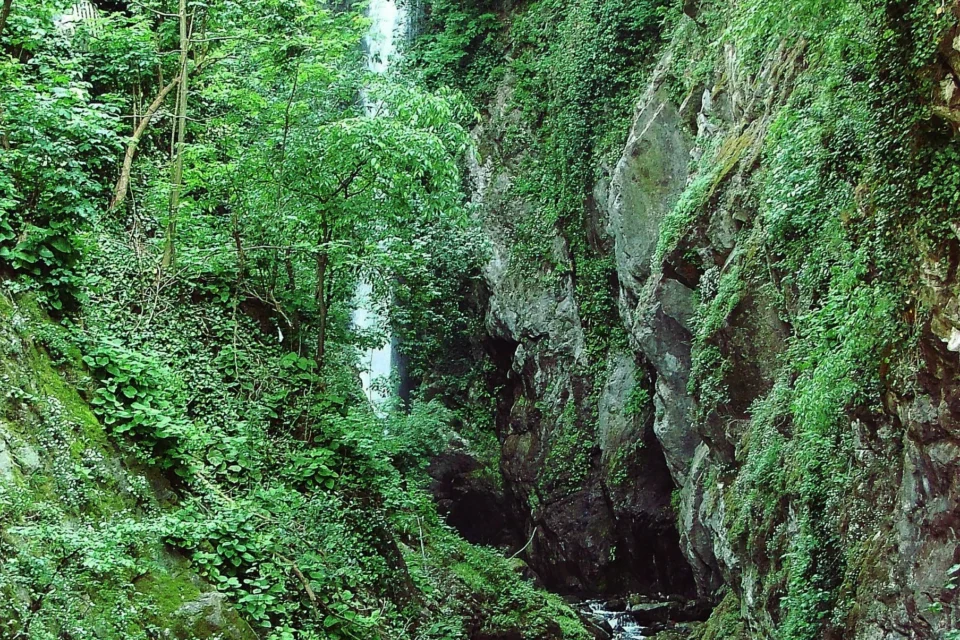
Nesso hangs on the wooded slopes of the Larian Triangle, where two mountain streams meet and plunge through a narrow gorge straight into Lake Como. A hump-backed Romanesque bridge, hamlets stacked above the water and paths climbing towards the upland pastures make this small parish one of the lake’s most photogenic and least package-driven corners.
Why visit
Nesso is for travellers who like their lake scenery with a pulse of wildness. The famous gorge delivers drama in miniature: a double waterfall squeezing through rock beneath an arched stone bridge, best heard before it is seen. Beyond the photo, though, there is a real village — stone stairways instead of lakeside promenades, a parish church that was once the mother church of the whole pieve, and hamlets like Careno where laundry still dries above the landing stage. You come for a couple of hours and stay half a day; the trails that thread the shore and climb to the piano above reward anyone with proper shoes.
Character and history
Water wrote Nesso’s past. The name is usually traced to a Celtic root for mooring, and the site has been lived on since prehistoric times — the area holds Neolithic finds — before falling within the Roman orbit. The torrents Nosè and Tuf, which join in the gorge, powered mills, paper works, silk workshops, forges and oil presses for centuries, and the sound of falling water is the town’s oldest industry still audible. A plaque by the falls quotes Leonardo da Vinci, who studied the torrent plunging through the great fissure of the mountain; painters and writers of the Grand Tour, Cesare Cantù among them, drew the same view of the Ponte della Civera. The parish church of Saints Peter and Paul served as the former mother church of the medieval pieve, and the upland hamlet of Vico keeps the church of Santa Maria, documented before 1184. Careno, strung along the shore road to the south, grew around its own landing and medieval churches. Later centuries belonged to the fishing, milling and silk economies typical of the eastern shore.
What to see
The Orrido di Nesso gorge and waterfall is the essential stop: the torrents Nosè and Tuf converge and drop through the cleft, visible from the lakeside road and best experienced by descending the long stone stairway that leads down beside the flow. A short walk away, the Romanesque Ponte della Civera arches between the hamlets of Coatesa and Riva del Castello, flanked by old houses — arguably the village’s single most beautiful view. In the main settlement, the Church of Saints Peter and Paul occupies the hillside above the harbour, its position reflecting its ancient status as the pieve’s mother church. Down at the water in Careno, the Church of San Martino at Careno sits above the little port, a small Romanesque building in a setting of lake-facing houses, while the Church of the Assumption at Careno stands on the shore road. Between church visits, follow the lanes towards Piazza Castello and the remains of the medieval castle quarter for views over the rooflines to the opposite shore.
How to experience
Arrive by boat if you can: the mid-lake ferries stop at Nesso’s landing, and the approach from the water shows exactly why the village grips the slope so tightly. Walk the gorge stairway early or late, when the stone is quiet and the light enters the cleft sideways. Then pick a trail: the old mule tracks link Nesso with Careno, Veleso and Zelbio above, and the historic shore path — the Roman-era Regina road — threads the hamlets along the water. Swimmers use the flat rocks near the gorge mouth in summer; the July Nesso Rock Race, a run-and-swim event from the Ponte Civera towards Careno, gives an idea of local energy. Eat simply: lake fish dishes such as missoltini and risotto with perch appear on the menus of the village’s small trattorie in season.
Practical planning
Nesso sits on the SP583 shore road about midway between Como and Bellagio, with buses on the Como–Bellagio line and frequent passenger ferries calling at the landing in season; parking at the roadside is very limited, so the boat or bus is the calmer option. The gorge stairway is steep, damp and closed in bad weather — sensible footwear matters, and the site can be shut after storms, so check locally. The hamlet churches are generally open daylight hours but not always staffed; the parish and the comune’s tourism pages list arrangements. Spring and autumn suit walkers best; in high summer the gorge is refreshingly cool while the shore bakes. There is no bank or large supermarket in the village — plan for cash and provisions.
Nearby places
Nesso’s neighbours are the small shore villages of the eastern branch of the lake and, across the water, the great names of the mid-lake ferry triangle.
Worth building a day around.
Chiesa dei Santi Pietro e Paolo
Scheda Lombardia Beni Culturali (CO250-00284, costruzione 1632); parrocchia censita da Diocesi di Como e SIUSA; affreschi di Carlo Innocenzo Carloni. A pochi metri dal…
Chiesa della Beata Vergine Assunta (Careno)
Parrocchia censita ufficialmente dalla Diocesi di Como; edificio di origine medievale con affreschi del XVI secolo. Lungo l'antica strada Regina, sul lago a Careno…
Chiesa di San Martino (Careno)
Esempio di architettura romanica documentato dal portale turistico d'area myLakeComo; contesto parrocchiale di Careno (Diocesi di Como). Sopra il porticciolo di Careno, raggiungibile a…
Orrido di Nesso
Gola formata dai torrenti Tuf e Nosè con cascata ~200 m che divide il borgo; citata da Leonardo; vista pubblica documentata da più fonti…
Ponte della Civera
Antico ponte (tradizione di origine romana) che unisce Coatesa e Riva del Castello sopra l'orrido; esperienza pubblica libera documentata dalle fonti turistiche d'area. Raggiungibile…
Journeys in Nesso.
Demo — Nesso Private Highlights Tour
Let a local expert design your Nesso day.
Tell us your dates and pace. A travel designer replies within one working day.