Muggia
The last town on Italy’s Adriatic coast before Slovenia, Muggia keeps a Venetian soul this side of the border: pastel houses around a campiello-like square, calli instead of streets, a Gothic duomo and a carnival with deep roots. A hilltop basilica, Bronze Age earthworks and a seaside cycle path complete a town that feels like Istria held in miniature.
Why visit
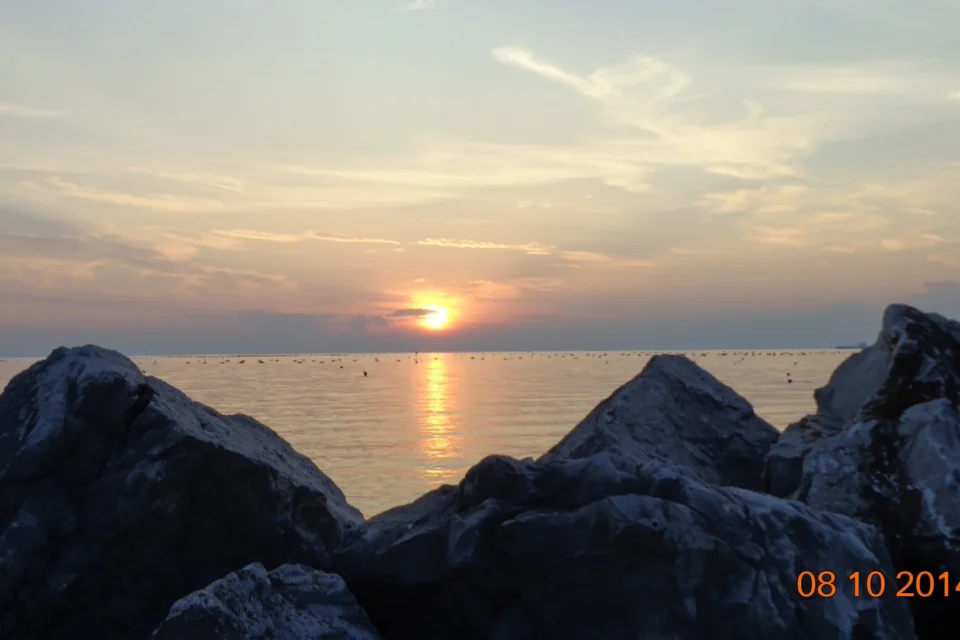
Muggia offers the grammar of Venice — campielli, calli, winged lions on facades — on a small, liveable scale, a ferry ride from Trieste. The regional tourism authority describes it as the only Istrian town that remained to Italy, and that mixed inheritance shows everywhere: white Istrian stone in the houses, an Istrian-inflected kitchen, a dialect with Venetian vowels. Travellers come for the harbourside strolls and stay for the layers — a Romanesque basilica on the hill above town, an archaeological park of medieval remains, Bronze Age hillforts on the karst, and a carnival museum documenting one of the region’s oldest mask traditions. It is the kind of place that rewards a slow loop: square, harbour, castle hill, basilica, then sunset over the gulf.
Character and history
Settlement here is ancient: the hillfort of Elleri on the karst above town attests Bronze Age communities, and a village called Borgolauro existed before the year 1000. In 931 the Italian kings Hugh and Lothair donated the town to the Patriarch of Aquileia; a proper municipality formed in the thirteenth century, when the cathedral and town hall were first raised. In 1420 Muggia passed to the Republic of Venice by act of dedication and stayed Venetian until 1797, serving as a fortress of Venice’s Istrian holdings facing Habsburg-linked Trieste across the gulf. That rivalry wrote the skyline: the town walls with their gates and towers, the castle above the harbour built between 1375 and 1399, and palaces carrying the Lions of St. Mark and the names of Venetian podestà. Venetian rule also left the language of the streets — calli, campielli — and the carnival, whose Carneval de Muja survives with Istrian inflections and a parade through the main square each winter.
What to see
Begin at Piazza Marconi, a Venetian-style square closed on one side by the Town Hall (palazzo del Municipio), rebuilt after a 1930 fire, and open on the other to the Mandracchio harbour of Muggia, the old fortified basin now filled with fishing and pleasure boats. Overlooking it all stands the Castle of Muggia, the fourteenth-century fortress that anchored the walls. The Cathedral of Saints John and Paul (Duomo di Muggia) is Romanesque in origin, reclad in the mid-fifteenth century as a fine Venetian Gothic facade with a rose window of the Virgin and Child. On the hill above town, the Basilica of Santa Maria Assunta (Muggia Vecchia) keeps Byzantine-style frescoes inside an early medieval shell, surrounded by the Muggia Vecchia Archaeological Park. Back in the lanes you meet the La Portizza (Gate of Levante) with its winged lion relief, the Torre Loredan, the Porta San Rocco (sea gate), a Venetian house (calle Oberdan) and the Casa a Gheffo (via Verdi). Museums cover the rest: the Muggia Civic Archaeological Museum, the Ugo Carà Museum of Modern Art devoted to the Muggia-born sculptor, the Museum of the Muggia Carnival, and the Gothic Church of San Francesco (Muggia) near the Church of the Crucifix (Muggia). The Giuseppe Verdi Municipal Theatre, a Liberty-style house of 1923, faces the Giardini Europa gardens beside the Biblioteca Guglia (civic library). Above the karst, the Elleri Hillfort (Castelliere di Elleri) marks Bronze Age ground, and the Parenzana (Muggia section) follows the old railway line towards Istria on foot or by bike.
How to experience
Cross from Trieste by the seasonal ferry if you can — the approach across the gulf sets the Venetian scene before you land. Walk the square-to-harbour circuit first, then climb to Muggia Vecchia for the frescoes and the view over the Gulf of Trieste. Time a visit to February if carnival fascinates you: the floats are built by hand through the year and the parade fills the square. Cyclists should ride the Parenzana stretch towards the border, an easy gravel line with Istria at the end of it. Finish, as locals do, with an aperitivo at the Mandracchio watching the boats.
Practical planning
Muggia lies a few kilometres south of Trieste, linked by frequent buses and, in season, by ferry; the Slovenia border is minutes away for onward exploring. The old town is flat along the waterfront and steep up to the basilica, so bring sure feet for the climb. Museum opening days vary through the week and season — confirm current arrangements via the comune’s site and turismofvg.it, and check visiting conditions for the castle and archaeological park before setting out. Summer brings bathing on the town’s short beaches and at the nearby marinas; spring and autumn are ideal for the karst paths.
Nearby places
Trieste is the natural twin city across the gulf, while Duino and Sistiana, with their castles, bays and the Rilke coastline, sit along the shore to the northwest.
Worth building a day around.
Basilica di Santa Maria Assunta
Official Muggia culture portal presents the Romanesque basilica on the Muggia Vecchia hill with Byzantine-style frescoes, within the archaeological park area. Regular opening hours…
Biblioteca Guglia
Visitor arrangements are not consistently published. Check the official source before travelling.
Casa a Gheffo
Visitor arrangements are not consistently published. Check the official source before travelling.
Casa Veneta
Visitor arrangements are not consistently published. Check the official source before travelling.
Castelliere di Elleri
Official Muggia culture portal documents the Bronze Age (c. 1660 BC) hillfort of Elleri with its necropolis as an archaeological site and the start…
Castello di Muggia
Turismo FVG documents guided tours of the castle (approx. 45 minutes, EUR 15) offered on special occasions such as the Carnevale muggesano, bookable via…
Chiesa del Crocefisso
Official Muggia culture portal documents the church built 1372-1374 (formerly della Visitazione) as a Marian place of worship and family tomb in the historic…
Chiesa di San Francesco
Official Muggia culture portal documents the Franciscan church rebuilt in 1411 in Franciscan Gothic style, holding works including a Madonna della cintura and a…
Civico Museo Archeologico di Muggia
Scopri FVG documents the civic archaeological museum in Calle Oberdan (tel. 040 3360340) housing finds from the castelliere and Muggia Vecchia. Current opening hours…
Duomo dei Santi Giovanni e Paolo
Turismo FVG official page documents the cathedral as a visitable site in Muggia historic centre; Romanesque plan consecrated 1263, Venetian Gothic-Renaissance facade, frescoes and…
Giardini Europa
Visitor arrangements are not consistently published. Check the official source before travelling.
La Portizza (Porta di Levante)
Official Muggia culture portal documents La Portizza as the ancient access gate to the borgo with the winged lion of St Mark, among the…
Mandracchio di Muggia
Official Muggia culture portal describes the Mandracchio as the old fortified harbour of Muggia, today used by fishing and leisure boats, on the seafront…
Museo d'Arte Moderna Ugo Carà
Official museum website (museougocara.eu) documents the museum at Via Roma 9 with a permanent collection of over 100 works by Muggia-born sculptor Ugo Carà,…
Museo del Carnevale Muggesano
Official Muggia culture portal lists the Museo del Carnevale Muggesano among the town's museums, documenting the centuries-old Muggia Carnival tradition. Hours/ticketing not published in…
Palazzo del Municipio
Visitor arrangements are not consistently published. Check the official source before travelling.
Parco Archeologico di Muggia Vecchia
Scopri FVG (regional institutional portal) documents the Parco Archeologico di Muggia Vecchia as a visitable archaeological park; finds are kept in the Civico Museo…
Parenzana (tratto di Muggia)
Official Muggia culture portal lists the Parenzana, the former Trieste-Parenzo narrow-gauge railway converted into a historic route, among the experienceable routes at Muggia. Flat…
Piazza Marconi
Official Muggia culture portal describes Piazza Marconi as the heart of the town, a Venetian campiello with stone paving, seat of the Municipio, and…
Porta San Rocco
Visitor arrangements are not consistently published. Check the official source before travelling.
Teatro Comunale Giuseppe Verdi
Official Muggia culture portal documents the Art Nouveau municipal theatre of 1923, an active venue of the town's cultural programme (muggiacultura.eu lists events and…
Torre Loredan
Official Muggia culture portal documents Torre Loredan on the salita alla Torre, the climb leading to the castle, as part of the medieval townscape.…
Journeys in Muggia.
Demo — Muggia Private Highlights Tour
Let a local expert design your Muggia day.
Tell us your dates and pace. A travel designer replies within one working day.