Montesarchio
Under the green massif of Monte Taburno, Montesarchio guards the Valle Caudina from a hilltop fortress that began Lombard and ended Bourbon. This was Samnite Caudium, an unlucky name for the Roman army that surrendered nearby, and today its castle holds one of southern Italy’s most compelling archaeological museums — and a krater famously called the most beautiful in the world.
Why visit
Montesarchio is the kind of town that rewards a detour from the Naples–Benevento axis. The climb to its castle and tower gives you the whole Valle Caudina at a glance, with the Taburno massif filling the horizon; inside the fortress, the National Archaeological Museum of the Sannio Caudino assembles grave goods from three ancient centres of the valley, including Attic red-figure vases and the celebrated Assteas krater of the Abduction of Europa, repatriated from the Getty Museum in 2007. The historic centre adds a twelfth-century abbey, Franciscan cloisters and an eighteenth-century church in the style of Vanvitelli — all within a compact walk. With its position among the “Borghi più belli d’Italia” association of beautiful towns, and a location eighteen kilometres southwest of Benevento, it makes an easy half-day or full-day excursion with genuine substance rather than scenery alone.
Character and history
This was Caudium, capital of the Samnite Caudini, first recorded in 321 BC when the Samnite general Gaius Pontius camped here before trapping and humiliating a Roman army at the Caudine Forks nearby. On the Appian Way between Capua and Beneventum, the town later received a colony of veterans, and its necropoleis — excavated and now displayed in the castle museum — show vigorous trade with the Greek coast and the Etruscan-Campanian world. After the fall of Rome, a Lombard noble named Arcolo fortified the refuge in the seventh century; the tower on the hilltop dates from this era, and the castle was rebuilt after Norman destruction and again in the fifteenth century, its outer walls surviving from Aragonese times. Feudal lordship passed through the D’Aquino, Della Leonessa, Caracciolo, Carafa and D’Avalos families until feudalism ended in 1806. The Bourbons turned the fortress into a jail: under Ferdinand, the tower held Risorgimento prisoners such as Carlo Poerio, and after the Second World War the complex housed an orphan institute until the late 1980s before its museum life began.
What to see
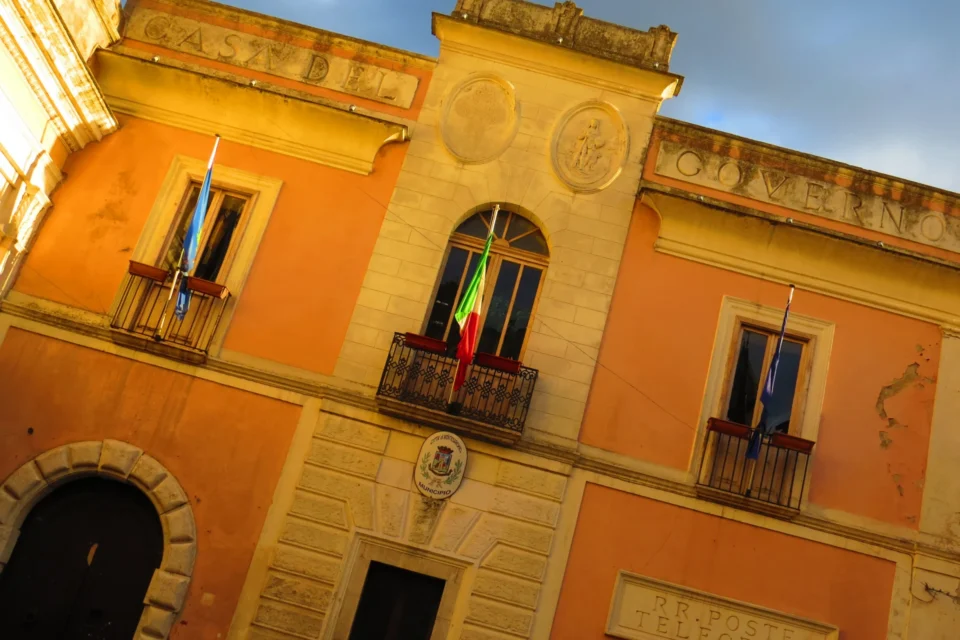
The fortress complex on Via Castello holds three sights in one. The Castle of Montesarchio preserves Lombard and Norman origins within Aragonese walls; the Tower of Montesarchio, the town’s emblem, is climbable by reservation and offers the definitive panorama of the valley; and inside, the National Archaeological Museum of the Sannio Caudino displays necropolis finds from Caudium, Saticula and Telesia, crowned by the Assteas krater from Paestum — a fourth-century BC red-figure masterpiece showing the Abduction of Europa, recovered from the Getty and now shown in the former prison cells amid immersive projections that animate the painted myths. Down in the town, the twelfth-century Abbey of San Nicola anchors the historic centre, while the Church and convent of Santa Maria delle Grazie keeps its Franciscan cloister, and the Church of San Giovanni Battista closes the eastern side of the main piazza beside the Vanvitelli-style Church of San Francesco, whose former convent now serves as the town hall.
How to experience
Do the museum first — its vases teach you to read the valley, so the views from the tower afterwards mean more. Reserve the tower visit by phone as required. Then walk down through the historic centre for the abbey and the piazza, and settle at a café to watch ordinary Sannio life, which proceeds at an unhurried rural pace. The surrounding Taburno hills are agricultural rather than touristed, and a country lunch in the valley pairs naturally with the museum visit. Bring the museum’s hours into your plan rather than assuming a midday pause — it keeps longer hours than most small-town sites.
Practical planning
Montesarchio sits on the Benevento–Naples rail line, about eighteen kilometres from Benevento; the station is below town, with a steady climb to the historic centre — drive up to Via Castello if walking is difficult. The castle-museum is generally open Tuesday to Sunday with morning-to-evening hours and modest tickets, but verify current times and tower access through the Ministry of Culture page or by phone before travelling. Combine with Sant’Agata de’ Goti, a short drive across the valley, and Benevento itself. Spring and autumn are ideal; summer afternoons on the exposed hilltop are hot.
Nearby places
- Sant’Agata de’ Goti — the tufa-edge town whose necropolis finds are displayed in Montesarchio’s museum.
- Benevento — the Samnite and Lombard capital with Trajan’s arch, a short ride northeast.
Worth building a day around.
Abbazia di San Nicola
Access confirmed via access_source_id (see referenced source). Hilltop sites and historic churches; accessibility varies, castle by stairways.
Castello di Montesarchio
Reservation is optional for ordinary castle and museum admission, but the tower must be booked separately. Groups are advised to contact the museum before…
Chiesa di San Francesco
Access confirmed via access_source_id (see referenced source). Hilltop sites and historic churches; accessibility varies, castle by stairways.
Chiesa di San Giovanni Battista (dell'Annunziata)
Access confirmed via access_source_id (see referenced source). Hilltop sites and historic churches; accessibility varies, castle by stairways.
Chiesa e convento di Santa Maria delle Grazie
Access confirmed via access_source_id (see referenced source). Hilltop sites and historic churches; accessibility varies, castle by stairways.
Museo Archeologico Nazionale del Sannio Caudino
Reservation is optional for ordinary museum admission. Groups are advised to contact the museum; the separate tower visit requires reservation.
Torre di Montesarchio
The tower is visitable by prior reservation. Contact the museum on +39 0824 834570 to arrange access.
Journeys in Montesarchio.
Demo — Montesarchio Private Highlights Tour
Let a local expert design your Montesarchio day.
Tell us your dates and pace. A travel designer replies within one working day.