Montepulciano
A Renaissance hill town rising above the Valdichiana, Montepulciano stacks noble palaces along one cresting street to a perfect main square — then pours you a glass of Vino Nobile from the cellars beneath them. Sangallo’s temples, crenellated towers, underground wine cathedrals and cypress-lined views make it Tuscany’s most complete hill-town experience.
Why visit
Some towns have a great square; Montepulciano is one. The main street climbs in a single disciplined line to Piazza Grande, where the cathedral, the town palace and the noble facades compose so harmoniously that film crews keep returning. The Tuscan regional tourism portal ranks the town among the Valdichiana’s essential destinations, and visitors quickly see why: architecture by Michelozzo and Antonio da Sangallo, a views-and-vineyard panorama from the ramparts, and a wine — Vino Nobile di Montepulciano — considered among Italy’s most prestigious reds, aged in the very cellars under your feet. Yet the town resists theme-park gloss. Offices, schools and markets carry on around the monuments; the barrels ride through the streets each August in the Bravìo delle Botti; and the surrounding countryside of the Valdichiana Senese unfolds in unbroken waves of vine and olive. It is Tuscany at its most composed, and still unmistakably alive.
Character and history
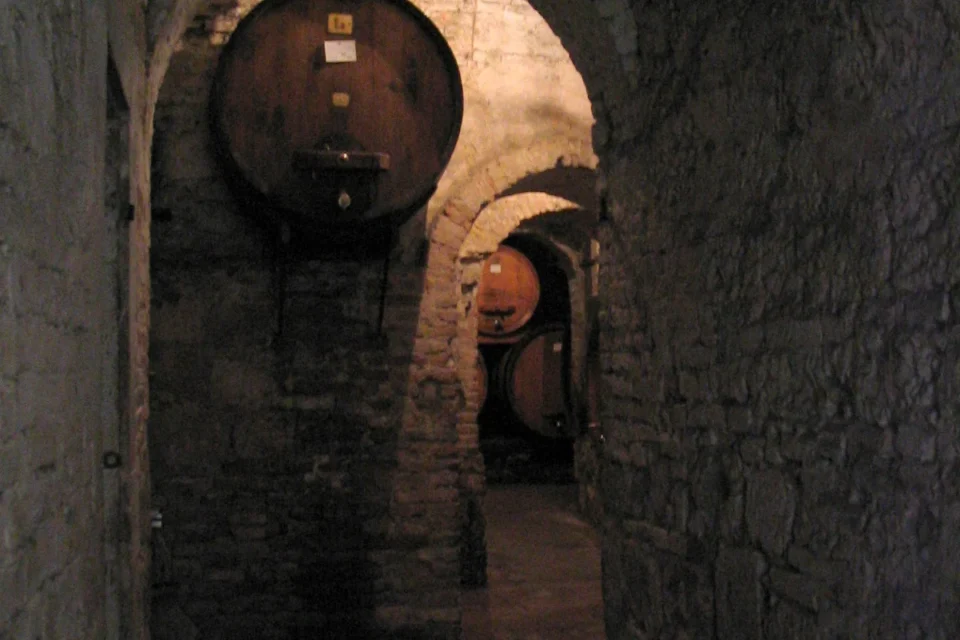
Montepulciano’s identity was shaped by rivalry. Perched on the frontier between the spheres of Florence and Siena, the town fortified itself, aligned at different moments with each power, and its medieval defences — remodelled by Sangallo when Siena held it, later absorbed into the Medici state — became the Fortress of Montepulciano (Medici Fortress) whose park and bastions crown the ridge today. Prosperity bought elegance: the sixteenth century filled the main street with palaces by the era’s leading architects, and Sangallo the Elder built outside the walls his masterpiece, the Temple of San Biagio, a Greek-cross Renaissance church of pale travertine begun in the early sixteenth century and ranked among the finest of its kind in Tuscany — a building whose central design, Tuscan sources note, drew the attention of Michelangelo. Wine ran through it all: the noble families dug vaulted cellars deep into the tuff, and from them grew the Vino Nobile tradition that now carries the town’s name onto wine lists worldwide.
What to see
Every visit moves through Piazza Grande: the Cathedral of Santa Maria Assunta with its unfinished facade and works by Taddeo di Bartolo and Andrea della Robbia; the Palazzo Comunale and Tower, whose crenellated lookout repeats the palette of Florence’s Signoria over the Valdichiana and Val d’Orcia; and the Well of the Griffins and Lions, Sangallo’s ceremonial centrepiece. Along the climb, the Church of Sant’Agostino shows Michelozzo’s Gothic-Renaissance facade, the Civic Museum of Montepulciano (Palazzo Neri Orselli) gathers paintings and Etruscan finds, and the Torre di Pulcinella (Pulcinella Tower) strikes the hours with its mechanical figure. Below town stands the Temple of San Biagio; above it, the Fortress of Montepulciano (Medici Fortress) holds exhibitions and a public garden. Wine lovers descend into the De’ Ricci Historic Cellars – Cathedral of Wine and the Contucci Historic Cellars, and walkers end on the Passeggiata Poliziana, the panoramic circuit along the walls.
How to experience
Taste the town before you tour it: arrange a cellar visit in the late afternoon, when the underground vaults are at their most atmospheric and the Vino Nobile can lead directly into dinner. Walk the main street slowly, morning and evening — the light changes the facades entirely — and climb both the town tower and the fortress for competing panoramas. Time a visit for August to see the Bravìo delle Botti, when barrel-men race uphill between the contrade, or for the quieter harvest weeks of late September, when the smell of crushed grapes drifts over the walls. With a car, add the Lake Montepulciano Nature Reserve for birdlife and the hill roads towards Pienza and Montalcino; the Church of Santa Maria dei Servi and the Church of San Francesco Montepulciano reward those who linger beyond the headline sights. Dine on pici with ragù and pecorino di Pienza, and let the tasting rooms settle the argument about Vino Nobile versus its Brunello neighbour.
Practical planning
Montepulciano stands about 600 metres up in the Sienese Valdichiana, roughly an hour by car from Florence or Siena; drivers should park at the lots below the walls and walk up, since the historic centre is largely restricted. Buses connect with the Valdichiana valley and Siena, but a car serves the surrounding wine roads best. Spring and autumn bring the best walking weather and the clearest views; August is lively with the Bravìo but busy, while winter is quiet, cold and atmospheric. Accommodation spans agriturismi in the vineyards below to palazzo rooms in town — book early for the harvest. Visits to San Biagio, the cellars and the museums follow seasonal timetables; check hours before planning a tight schedule, and note tastings are usually by reservation. Comfortable shoes are non-negotiable: the main street is steep from either end. Two nights let you cover the monuments, two cellars and a countryside loop at ease.
Nearby places
Pienza and its ideal-Renaissance streetscape lie a short drive west, with Montalcino and Brunello country beyond. Bagno Vignoni and San Quirico d’Orcia line the way into the Val d’Orcia, while the Crete Senesi and Colle di Val d’Elsa extend the Sienese horizon to the north.
Worth building a day around.
Cantine Contucci (cantina storica di Palazzo Contucci)
Official Contucci family site documents the cellars (dating to the 13th century, part of the inner walls) and visits. Free visits of the historic…
Cantine De' Ricci - Cattedrale del Vino
Official site cantinadericci.it presents the historic cellars and guided experiences; Consorzio Vino Nobile documents the location inside Palazzo Ricci. Guided tours of the monumental…
Cattedrale di Santa Maria Assunta
Visit Tuscany dedicates an entry to the Duomo on Piazza Grande with its artworks. Open for worship; houses Taddeo di Bartolo's Assumption triptych, Michelozzo's…
Chiesa di San Francesco
Pro Loco covers the historic centre including the San Francesco convent area; local documentation records the auditorium use. One of the oldest churches of…
Chiesa di Sant'Agostino
Visit Tuscany entry on Sant'Agostino (begun 1285, facade by Michelozzo); Torre di Pulcinella stands on the church per italia.it. Historic church with frescoes and…
Chiesa di Santa Maria dei Servi
Pro Loco Montepulciano historic-centre page describes Santa Maria dei Servi. Gothic-Tuscan church with artistic portal at the end of the tree-lined avenue; worship access,…
Fortezza di Montepulciano (Fortezza Medicea)
Visit Tuscany describes the Fortezza Medicea (Sienese origin 1261, rebuilt by Antonio da Sangallo the Elder) today used as exhibition spaces. Fortification at the…
Museo Civico di Montepulciano (Palazzo Neri Orselli)
Visit Tuscany entry on the Museo Civico; Pro Loco lists Museo Civico among town institutions. Housed in the 14th-century Palazzo Neri Orselli near Piazza…
Palazzo Comunale e Torre
Visit Tuscany describes the tower climb open to visitors; Pro Loco lists Palazzo Comunale among monuments. Travertine Gothic facade on Piazza Grande; internal staircase…
Passeggiata poliziana
Visit Tuscany lists the Passeggiata poliziana among the town's experiences. Free ~200 m public walkway under the old walls with panoramic views over Valdichiana…
Piazza Grande
Regional tourism portal Visit Tuscany presents Piazza Grande as the town's central square; Pro Loco covers the historic centre. Free public square framed by…
Pozzo dei Grifi e dei Leoni
Visit Tuscany describes the well in Piazza Grande designed by Antonio da Sangallo. Freely visible in the centre of Piazza Grande.
Riserva Naturale Lago di Montepulciano
Visit Tuscany lists the Riserva Naturale del lago di Montepulciano among the town's destinations. Regional nature reserve a few km from town, managed with…
Tempio di San Biagio
Official site tempiosanbiagio.it publishes full visiting schedule, ticket and contact details. Ticketed visits (full EUR 5 with free multilingual audio guide) managed by Opera…
Torre di Pulcinella
italia.it (national tourism board) page dedicated to the tower with address and description. Exterior clock-tower feature on the church of Sant'Agostino; the wooden Pulcinella…
Journeys in Montepulciano.
Demo — Montepulciano Private Highlights Tour
Let a local expert design your Montepulciano day.
Tell us your dates and pace. A travel designer replies within one working day.