Montefalco
Called the railing of Umbria for its balcony over the Clitunno, Topino, and Tiber valleys, Montefalco pours its energy into two vintages: Benozzo Gozzoli’s Renaissance frescoes of Saint Francis and the Sagrantino wine grown on the hills all around. A ring of thirteenth-century walls, quiet churches, and cellar doors makes the town a compact, rewarding high point.
Why visit
Montefalco earns its nickname — the “ringhiera dell’Umbria,” the balcony-railing of the region — honestly: from its hilltop the gaze runs across the Clitunno, Topino, and Tiber valleys in a full sweep. Within the thirteenth-century walls lies one of Italy’s great small art surprises: the church and convent of San Francesco, built between 1335 and 1338, whose walls carry Benozzo Gozzoli’s fresco cycle of the Life of Saint Francis, painted in 1450–52 and counted among the most important Renaissance cycles preserved anywhere, beside an Annunciation fresco by Perugino. The same complex houses the civic picture gallery and, in its old cellars, the story of the wine that made the town famous. Because Montefalco anchors the Sagrantino route — the DOCG hills shared with Bevagna, Gualdo Cattaneo, Giano dell’Umbria, and Castel Ritaldi — a visit naturally doubles as a wine pilgrimage, with the Sagrantino Museum and the National Sweet Wines Centre deepening the theme. Add quiet Romanesque and Gothic churches, a well-kept medieval square, and vineyard roads in every direction, and the town delivers a full day of art and agriculture in equal measure.
Character and history
Montefalco’s position shaped its fate. An important Roman municipality on the road linking Spoleto and Perugia, it flourished as a free commune from the eleventh century and took sides — usually with the Papacy — against the Ghibelline Trinci lords of nearby Foligno, suffering roughly half a century of domination before Francesco Sforza’s intervention liberated it in 1424. That liberation opened a rebirth of arts and economy in the fifteenth century, precisely the moment when Gozzoli’s brush transformed the Franciscan church into a jewel box. The town’s defences still speak of its contested past: thirteenth-century walls, restored in part by the sculptor-architect Lorenzo Maitani of Orvieto fame, and the Gate of Frederick II, recalling the emperor’s own century. Formal recognition came late — city status from Pope Pius IX in 1848 — but by then Montefalco’s true monument was already in the vineyards: Sagrantino, the deeply tannic native grape, documented for centuries in religious and domestic use, whose dry expression conquered the world and whose passito tradition the National Sweet Wines Centre, founded in 1991, keeps alive.
What to see
Begin at the Saint Francis Museum Complex, the artistic heart of the town: the church built between 1335 and 1338, Gozzoli’s Storie di san Francesco of 1452, chapel decorations by Jacopo Vincioli, Giovanni di Corraduccio, and Ascensidonio Spacca, Perugino’s Annunciation fresco of 1503 on the counter-facade, and a picture gallery of the Umbrian school in the former convent rooms — with the crypt holding archaeological finds and the old cellars open to visitors.
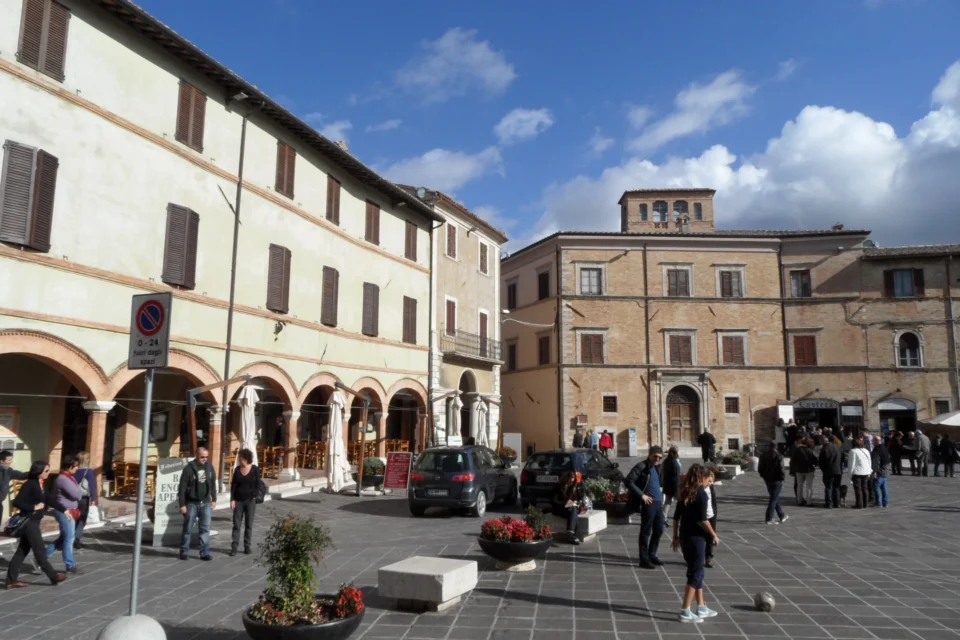
Wine continues at the Sagrantino Museum, which traces the native grape and its culture, and at the National Sweet Wines Centre (Palazzo Santi Gentili) on the main square. The civic face of town is Piazza del Comune with its aristocratic palaces and the Town Hall with Bell Tower, whose thirteenth-century core was later given a loggia and bell tower.
The religious itinerary includes the Gothic, thirteenth-century Church of Sant’Agostino with frescoes by the Lorenzetti circle and the Caporali, the Church and Convent of Santa Chiara, the Renaissance Church of Santa Illuminata, the Romanesque Church of San Bartolomeo (Montefalco), the medieval Church of Santa Maria de Platea, and the fifteenth-century Convent of San Fortunato on the vineyard road. The 13th-century Walls of Montefalco and the Gate of Frederick II complete the ring.
How to experience
Split the day between art and wine. Walk the walls circuit first for the valley views that explain the town’s nickname, then enter the San Francesco complex while the light is soft and study Gozzoli’s narrative frames in order. In the afternoon, commit to the Sagrantino: taste at cellar doors along the Strada del Sagrantino, visit the Sagrantino Museum for the grape’s history, and let the National Sweet Wines Centre introduce the passito style in which the grape began. Time the calendar if you can — harvest-season events in autumn fill the town with music and tastings — but any weekday visit rewards with quiet lanes and open kitchens. Cyclists and drivers alike can loop through the vineyards toward Bevagna below, and walkers will find the church of San Fortunato and the Santa Illuminata road ideal short rambles among rows of vines with the Apennines behind.
Practical planning
Montefalco sits east of the Foligno–Spoleto corridor in the Perugia province, reached by car via the SS248 or by rail to Foligno or Trevi with a bus or taxi connection up the hill. The borgo is compact and walkable, with car parks just outside the walls; the climb on foot is short but steady. The museum complex observes weekly closing and seasonal hours, and cellar-door visits usually require appointment — arrange tastings in advance, especially at harvest. The town is best visited from late spring through October; summer evenings on the balcony of Umbria are famously mild, while the autumn vintage brings the richest experiences and the busiest weekends. Allow a full day, or half a day if paired with Bevagna.
Nearby places
The wine-road neighbours come first: /destination/bevagna/ below the hill, with /destination/spello/, /destination/foligno/, and /destination/spoleto/ framing the valley. Assisi’s basilicas are close at /destination/assisi/, and the provincial capital at /destination/perugia/. Westward lie the lake lands of /destination/lake-trasimeno/ with /destination/panicale/, /destination/castiglione-del-lago/, and /destination/passignano-sul-trasimeno/, while the wider tour reaches /destination/gubbio/, /destination/todi/, and /destination/deruta/.
Worth building a day around.
Centro Nazionale Vini Passiti (Palazzo Santi Gentili)
Il portale regionale Umbria Turismo indica il palazzo Santi Gentili (XV secolo) come sede del Centro Nazionale Vini Passiti, fondato nel 1991. Accesso non…
Chiesa di San Bartolomeo
Chiesa romanica citata dal portale regionale Umbria Turismo tra i luoghi di Montefalco. Orari non pubblicati dalle fonti consultate.
Chiesa di Sant'Agostino
Chiesa duecentesca descritta dal portale regionale Umbria Turismo con affreschi di Ambrogio Lorenzetti e Bartolomeo Caporali. Aperta alla visita.
Chiesa di Santa Illuminata
Chiesa del XVI secolo citata dal portale regionale Umbria Turismo con nicchie laterali affrescate da Francesco Melanzio. Orari non pubblicati dalle fonti consultate.
Chiesa di Santa Maria de Platea
Uno degli edifici più antichi della città, sede delle prime assemblee pubbliche del comune, secondo il portale regionale Umbria Turismo. Orari non pubblicati dalle…
Chiesa e convento di Santa Chiara
Chiesa e convento descritti dal portale regionale Umbria Turismo con dipinti della scuola umbra del XIV secolo. Aperta alla visita.
Cinta muraria duecentesca di Montefalco
Mura del XIII secolo restaurate nel XIV per opera di Lorenzo Maitani, ancora ben conservate, secondo il portale regionale Umbria Turismo. Percorribili lungo il…
Complesso museale di San Francesco
Il sito ufficiale del Museo di Montefalco (gestione Montefalco Arte e Cultura) pubblica biglietti, orari e acquisto online; il portale regionale Umbria Turismo descrive…
Convento di San Fortunato
Convento del XV secolo affrescato da Benozzo Gozzoli e Tiberio d'Assisi, secondo il portale regionale Umbria Turismo. Orari non pubblicati dalle fonti consultate.
Museo del Sagrantino
Il portale regionale Umbria Turismo indica il Museo del Sagrantino, aperto nell'aprile 2024 all'interno del complesso museale di San Francesco. Modalità di accesso non…
Palazzo Comunale con Torre Campanaria
Palazzo del 1270 con loggia aggiunta e torre campanaria settecentesca con fastigio, secondo il portale regionale Umbria Turismo. Sede municipale attiva; torre visibile dall'esterno.
Piazza del Comune
Piazza con palazzi nobiliari (Pambuffetti, Senili, Santi-Gentili, Langeli, De Cuppis o Camilli) descritta dal portale regionale Umbria Turismo. Spazio pubblico.
Porta di Federico II
Porta del 1244 legata a Federico II, citata dal portale regionale Umbria Turismo. Monumento urbano, visibile dall'esterno.
Journeys in Montefalco.
Demo — Montefalco Private Highlights Tour
Let a local expert design your Montefalco day.
Tell us your dates and pace. A travel designer replies within one working day.