Monte Sant’Angelo
Monte Sant’Angelo holds one of Europe’s oldest pilgrimage destinations: the cave sanctuary of the Archangel Michael, first Western shrine of the angel and a UNESCO World Heritage site of the Longobards. Around it spreads a hardy mountain town of Longobard crypts, a Norman-Swabian castle and white house-shaped lanes, on the high spine of the Gargano.
Why visit
This is not a seaside detour but a place with weight. Pilgrims have climbed to this cave for some fifteen hundred years — popes among them — following a cult that stretched from Rome to Santiago and Jerusalem. The town above the shrine keeps its early-medieval layers close to the surface: Longobard inscriptions, an eighth-century baptistery, a fortress over the rooftops. Come for the history, stay for the mountain air and the long views over the Gulf of Manfredonia.
Character and history
Tradition counts three apparitions of the Archangel on Mount Gargano — of the bull in 490, of victory in 492, of dedication in 493 — after which the bishop of Siponto consecrated the cave to angelic worship; the sanctuary is reckoned the first Western shrine of St Michael. The Lombards embraced it as their national sanctuary after their conversion, and their dukes of Benevento left inscriptions in the crypts below. On 25 June 2011 those Longobard remains joined UNESCO’s World Heritage list as part of the serial site “The Longobards in Italy. Places of Power (568-774 AD)”. The medieval pilgrimage business made the town: knights and crusaders climbed here on the road to the Holy Land, engraving marks in the stone, and the route formed part of the great “Homo, Angelus, Deus” itinerary binding Rome, Compostela, the Gargano and Jerusalem. The abbey of Santa Maria di Pulsano on the mountain’s southern slope tells a parallel story — founded in the sixth century, destroyed by Saracen raids and rebuilt at the start of the 1100s by San Giovanni da Matera, with hermitages scattered through its valley. The town itself grew around the shrine’s trade: white low-built houses of the Junno district lining the walls, and above them the castle, layered Norman, Swabian and Aragonese, where Frederick II kept his empress.
What to see
The Basilica Sanctuary of San Michele Arcangelo is the reason to come: descend the long staircase to the Porta del Toro, pass bronze doors cast in Constantinople in 1076, and enter the cave church with its rocky vault and marble archangel. The Longobard Crypts beneath hold some two hundred early-medieval inscriptions, and the sanctuary’s Devotional Museum and Lapidary Museum gather ex-votos, gilt icons and carved stones. Above the old town, the Norman-Swabian-Aragonese Castle guards the summit, while the nearby Baptistery of San Giovanni in Tumba (Tomba di Rotari) — an eighth-century hypogeum — and the Church of San Pietro of its San Pietro Monumental Complex form the finest Longobard architecture in the south. Wander the Junno district, stop at the Abbey Church of Santa Maria Maggiore, and end at the Abbey of Santa Maria di Pulsano with the Pulsano Hermitages scattered through the valley below.
How to experience
Come as pilgrims do — on foot if you can. The long climb from the plain to the shrine mirrors centuries of arrivals, and the town’s pilgrim infrastructure, from guesthouses to the sanctuary’s own services, makes it easy. Time a visit for late September or May, when feast days bring processions without peak crowds; the sanctuary is a working church, so dress and behave accordingly. Drive or hike out to Pulsano for the valley of hermitages at golden hour — the silence there explains the site better than any plaque. The town’s museums suit a slow afternoon; the castle terrace suits the end of day.
Practical planning
Monte Sant’Angelo sits on the Gargano’s high ridge, reached by road from Manfredonia or from the north through the forest country; buses link toward Foggia, but a car serves best. Summers are cooler than the coast, winters sharp — pack layers even in August. The sanctuary keeps long visiting hours with reduced winter service, and the castle and museums vary seasonally; check santuariosanmichele.it and the municipal site, montesantangelo.it, before travelling. One night is enough for many; two allows Pulsano and the castle unhurried.
Nearby places
The promontory continues north and east: Vieste with its cliff-top old town and long beaches, and Peschici, a whitewashed perch above the northern coast, both within an easy drive along the Gargano’s forest roads.
Worth building a day around.
Abbazia di Santa Maria di Pulsano
Official monastic community site: Sunday Mass 11:00, Lectio Divina open to lay people, hospitality for pilgrims, contact 0884 561047; municipal portal lists the Pulsano…
Basilica Santuario di San Michele Arcangelo
Regional tourism portal: free entry, visitable cave, Tomba dei Rotari and museum; municipal UNESCO category page confirms inscription 25 June 2011; sanctuary official site…
Battistero di San Giovanni in Tumba (Tomba di Rotari)
Municipal monuments page: known as Tomba di Rotari due to a misread inscription; visits 9:30-13:00 and 14:30-19:00; regional tourism portal lists the Tomba dei…
Castello Normanno Svevo Aragonese
Municipal castle page: daily 10:00-13:00 / 14:30-19:00, ticket 2 euro, tel. 0884 565444; municipal property since 1907; balcony over the Gargano and the Gulf…
Chiesa Abbaziale di Santa Maria Maggiore
Municipal monuments page: considered by some the cathedral, traditionally attributed to the patronage of Leone (abbot of the Cassinesi monks); routine hours not published…
Chiesa dell'Incoronata
Municipal monuments page: small evocative church guarding the city in the Sant'Oronzo valley just outside the ancient town; access hours not published (unknown).
Chiesa della Madonna della Libera
Municipal monuments page: near the basilica's upper atrium, built in 1879 by enlarging an older structure; hours not published (unknown).
Chiesa della Santissima Trinità
Municipal monuments page: complex built against the walls running from the Castle down through Junno to the Coppa district; hours not published (unknown).
Chiesa di San Giuseppe (già Santissima Annunziata)
Municipal monuments page: church near the old walls by the Porta del Lago, originally dedicated to the Annunziata; hours not published (unknown).
Chiesa di San Niccolò
Municipal monuments page: Capuchin convent along the ancient walls near the Castle, built from 1595; visiting arrangements not published (unknown).
Chiesa di San Pietro
Municipal monuments page: rebuilt in the 11th century, later collapsed; visits 9:30-13:00 and 14:30-19:00.
Chiesa di Sant'Antonio Abate
Municipal monuments page: small church outside the walls along a pilgrim route to the Sacra Grotta; hours not published (unknown).
Chiesa di Sant'Apollinare
Municipal monuments page: small temple in the ancient Grotte district, likely the city's first settlement area; hours not published (unknown).
Chiesa di Santa Maria degli Angeli
Municipal monuments page: small church on a hill about 3 km northwest of town overlooking the Gulf of Manfredonia; hours not published (unknown).
Chiesa di Santa Maria del Carmine
Municipal monuments page: Carmelite Fathers' convent founded 1577 on land outside the walls; visiting arrangements not published (unknown).
Chiesa e Convento di San Francesco
Municipal monuments page: monastic complex testifying to over six and a half centuries of Conventual Friars' presence; the municipal ethnographic museum operates in the…
Complesso di San Benedetto
Municipal monuments page: monastic complex with a Pilgrims' Hospital built near the old city walls; visiting arrangements not published (unknown).
Complesso Monumentale di San Pietro
Municipal monuments page: complex includes San Pietro church remains and the San Giovanni in Tumba baptistery (Tomba di Rotari); visits 9:30-13:00 and 13:30-19:00.
Cripte Longobarde
Official sanctuary site: TECUM circuit includes the Longobard Crypts, buried after the 13th-c. Angevin rebuilding, rediscovered 1949-1955, with runic inscription among the most important…
Eremi di Pulsano
Municipal monuments page: hermit cells scattered around the Abbey, some remote or inaccessible, guided visits arranged via the Abbey; official abbey page documents the…
MeTA - Museo Etnografico Tancredi (Arti e Tradizioni Popolari del Gargano)
Municipal museums page: founded 1925 by historian Giovanni Tancredi; closed Monday, Tue-Sun 10:00-13:00 and 15:00-18:00; tel. 0884 562098.
Museo Devozionale
Municipal museums page: hours 9:00-12:15 / 15:00-17:00 (to 19:00 in daylight saving), combined ticket with Lapidario 5 euro; sanctuary official site documents TECUM collection…
Museo Lapidario
Municipal museums page: same hours and 5-euro combined ticket with the Devozionale; sanctuary official site: ambo of Acceptus (1041), 12th-c. fontana lustrale, pre-Longobard porta…
Rione Junno
Municipal monuments page: row of white gabled houses with arched doors and whitewashed alleys; includes the small church of San Salvatore against the medieval…
Journeys in Monte Sant’Angelo.
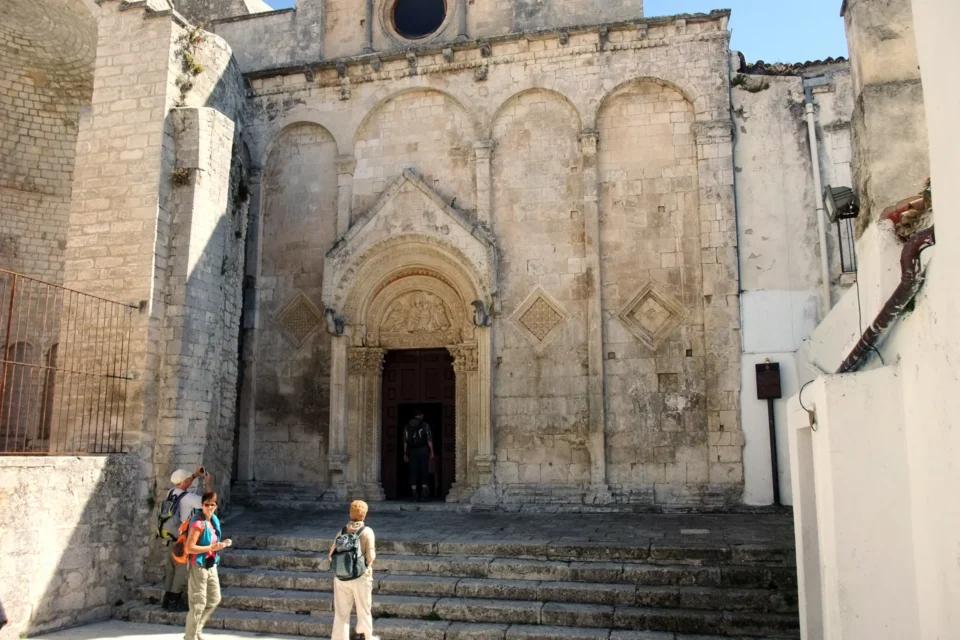
Demo — Monte Sant'Angelo Private Highlights Tour
Let a local expert design your Monte Sant’Angelo day.
Tell us your dates and pace. A travel designer replies within one working day.