Mont Blanc
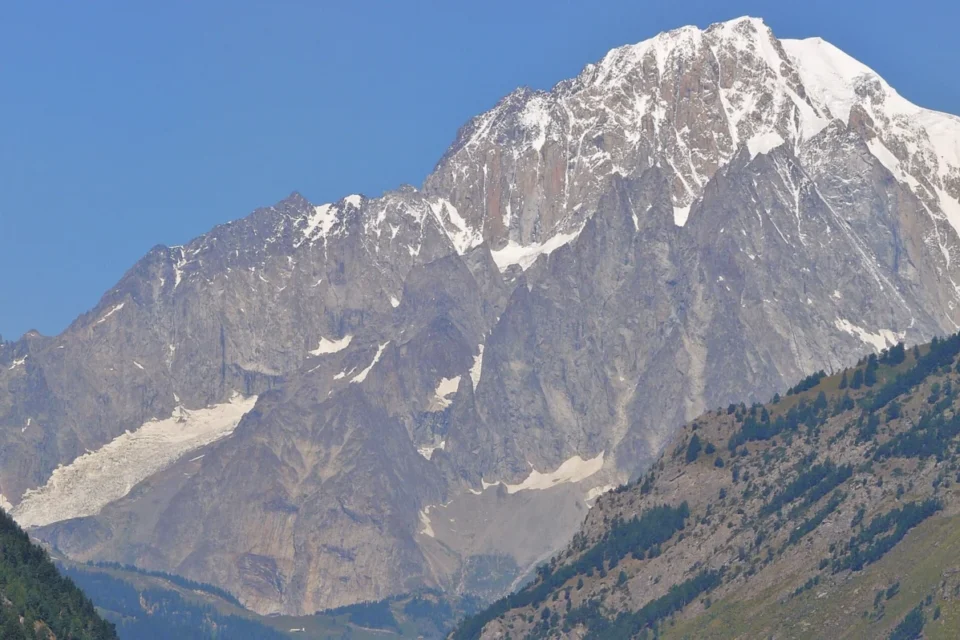
The Mont Blanc area of the Valley of Aosta gathers the glacial corridors of Val Ferret and Val Veny beneath the highest summit of the Alps, along the classic Italian legs of the Tour du Mont Blanc. Glacial lakes, medieval towers and hamlets of stone-and-lausa architecture complete a landscape that has defined European mountaineering for more than two centuries.
Why visit
This is the Italian face of Mont Blanc: a territory of glacially carved valleys, moraine amphitheatres and walls of rock and ice that include the Dente del Gigante and the Grandes Jorasses. The destination concentrates the Alps’ most celebrated long-distance path — the Tour du Mont Blanc — through its Aosta Valley stages, and offers them framed by working villages rather than high-altitude resorts. In Val Ferret the road ends beneath the peers of the massif’s north side; in Val Veny the Miage glacier spills its ice tongue toward mirror lakes and limestone pyramids; on the flanks, medieval towers at La Salle and Avise watch over the ancient road. What sets the area apart is the proximity of extremes: from Courmayeur‘s streets you can be walking a glacier moraine in twenty minutes, and from any valley floor the summits rise more than three vertical kilometres overhead. For hikers it is a stage network of world rank; for dreamers, the most compact expression of high alpine drama in Italy, with La Thuile and the Little St Bernard Pass as its western complement and Aosta as its historic base.
Character and history
The Mont Blanc area’s modern fame began with the conquest of the mountain in 1786, promoted by Horace-Bénédict de Saussure, an event that launched alpinism itself; Courmayeur’s guides became protagonists of the great first ascents on the Grandes Jorasses and the Brenva face, and the village grew into a capital of European mountaineering. Yet the territory’s older story is one of transit and survival: the valleys were crossed by pilgrims and traders heading for the Little and Great St Bernard passes, their hamlets — Entrèves, Planpincieux, Lavachey, Arp Nouvaz in Val Ferret; the scattered settlements of Val Veny — living from herding, guiding and the thin generosity of glacial soils. The medieval towers that still guard the Dora Baltea floor at La Salle and Avise recall the feudal families who controlled the road. The twentieth century layered engineering onto landscape: the first Mont Blanc cableway in 1957, the tunnel of 1965, and the mountain huts that turned the Tour du Mont Blanc into the most walked long route in the Alps. Today the area balances heavy seasonal visitation with a remarkably intact high-altitude environment, where glacier dynamics — most visibly the monitored Planpincieux ice tongue — keep the dialogue between village life and the mountain very much alive.
What to see
The two glacial valleys are the heart. Val Ferret runs from the foot of Mont Blanc toward the Grand Col Ferret on the Swiss border, its left flank crowned by the Dente del Gigante, Grandes Jorasses, Aiguille de Triolet and Mont Dolent, its floor dotted with the hamlets of Planpincieux, Lavachey and Arp Nouvaz; a flat path follows the valley with views that the regional tourism board describes as spectacular in every season, and winter converts part of it into cross-country tracks. Val Veny stretches from Entrèves to the Col de la Seigne under the Aiguille Noire de Peuterey and the Brenva and Miage glaciers; at its heart lies Lake Miage, an ice-dammed mirror where the glacier’s tongue calves its seracs, with the Pyramides Calcaires and Combal basin beyond.
The long-distance walker’s prize is the Tour du Mont Blanc, about 170 kilometres around the massif through Italy, Switzerland and France, whose Italian section crosses in from the Col de la Seigne at 2,591 metres, descends Val Veny past the Elisabetta hut, threads Courmayeur and rides the balcony of Val Ferret over the Bertone and Bonatti refuges toward the Elena hut and the Grand Col Ferret at 2,536 metres. For a quieter register, the Dora floor keeps its feudal towers: the Châtelard Castle at La Salle and the Avise Castle, medieval strongholds of the noble families who policed the road. Seasonal colour comes from Lake Arpy, an alpine lake in the hanging valley reached from the Colle San Carlo above Morgex.
How to experience
Give each valley its own day. In Val Ferret, walk the gentle floor path from Lavachey toward Arp Nouvaz — or the higher balcony toward the Bonatti refuge if you want the classic view of the Jorasses’ north face — using the summer shuttle to spare the valley floor from traffic. In Val Veny, hike from La Visaille toward Pont Combal and the Miage lake, or climb through larch to the Elisabetta hut under the glacier wall. Walkers with a week can commit to the full Tour du Mont Blanc circuit, booking huts well ahead; those with an afternoon can sample it on the Bertone balcony above Courmayeur. Non-hikers should ride the cableway toward Punta Helbronner for the glacier panorama from above. Reserve slower moments too: the towers at La Salle and Avise, hamlet churches, and a terrace lunch watching the seracs of Miage. Early starts reward photographers with pink alpenglow on the big walls.
Practical planning
The area is reached from Aosta by the western SR26 corridor toward Courmayeur, about an hour away, with the Mont Blanc Tunnel connecting onward to Chamonix; airports at Turin and Geneva serve longer approaches. In summer, private cars are restricted in the upper valleys — Val Ferret traffic stops at Lavachey and Val Veny at Fréney — so use the seasonal shuttles or the cableways. Huts and hotels on the Tour du Mont Blanc stages require reservations months in advance for July and August. Weather rules the program: afternoon storms build over the massif even in fine weeks, and glacier margins demand caution and, on the ice, a guide. Winter transforms access — valley floors become ski-touring and snowshoe terrain — and the pass roads close with snow. Always check valley access rules, lift calendars and glacier-security notices before setting out; they change with conditions.
Nearby places
- Courmayeur — the area’s capital, with the Skyway Monte Bianco and village tours.
- La Thuile — border village under the Little St Bernard Pass.
- Pré-Saint-Didier — thermal town at the western valley mouth.
- Aosta — Roman capital and practical base for the whole territory.
- Gran Paradiso National Park — the next protected massif eastward.
Worth building a day around.
Castello di Avise
Schede del portale turistico regionale e di Regione Autonoma Valle d'Aosta (patrimonio culturale): torre quadrata del XII secolo e corpo di fabbrica del 1492;…
Lago d'Arpy (Lac d'Arpy)
Scheda ufficiale del portale turistico regionale dedicata all'itinerario Colle San Carlo–Lago d'Arpy. Sentiero T dal Colle San Carlo (1858 m): 3,1 km, 55 min,…
Lago di Miage (Lac de Miage)
Il portale regionale indica il Lac Miage tra i laghi di testa valle e l'itinerario pedestre La Visaille–Pont Combal–Lac Miage. Raggiungibile a piedi da…
Tour de Châtelard (Castello di Châtelard)
Scheda ufficiale del sito turistico di La Salle: costruito nella prima metà del XIII secolo dal vescovo di Aosta Rodolfo Grossi, parzialmente distrutto nel…
Tour du Mont Blanc (versante valdostano)
Scheda ufficiale del portale turistico regionale con le 12 tappe del tour e la sezione valdostana (Val Veny, Chécrouit, Bertone, Val Ferret, Rifugi Bonatti…
Val Ferret
Pagina ufficiale del portale turistico regionale dedicata alla Val Ferret come area turistica del Monte Bianco, con regolamento di accesso, navetta e itinerari. Accesso…
Val Veny
Pagina ufficiale del portale turistico regionale con regolamento di accesso stagionale, parcheggi e itinerari (Elisabetta, Lac Combal, Lac Miage, Pyramides Calcaires). Estate: bus per…
Journeys in Mont Blanc.
Demo — Mont Blanc Private Highlights Tour
Let a local expert design your Mont Blanc day.
Tell us your dates and pace. A travel designer replies within one working day.