Mattinata
Mattinata folds into a green amphitheatre of olive groves on the Gargano’s southern coast, under a headland strewn with Daunian tombs and a mountain crowned by abbey ruins. Around the point, white cliffs guard some of Puglia’s most beautiful coves. It is the quietest of the Gargano’s seaside towns, and the best base for its walking trails.
Why visit
Mattinata offers what much of the Adriatic coast no longer can: a small resort town hemmed by mountains rather than beach clubs, where the morning walk is to a prehistoric necropolis and the afternoon swim is beneath faraglioni. Hikers get a classic ridge route linking an ancient tomb field to a medieval abbey; beach lovers get pebble coves of startling colour; and everyone gets the town’s plain of ancient olives, a landscape as characteristic as anything in Puglia.
Character and history
This is one of the smallest inhabited centres of the Gargano, sitting at 78 metres where the mountain meets a coastal plain long planted to olives. Human presence here is ancient: the spur of Monte Saraceno, rising steeply from the sea a few kilometres away, shows signs of life since the Bronze Age and hosts a necropolis-sanctuary fundamental to understanding the Daunian civilisation, its rock-cut tombs scattered across the hillside with the gulf below. The high ground stayed sacred long after the Daunians: on the 872-metre summit of Monte Sacro, an eleventh-century hermitage dependent on the monastery of Santa Maria di Calena grew into a priory in 1138 and then the Abbey of the Santissima Trinità, wealthy enough that its lands reached toward Bari before decline set in from the fifteenth century; by the seventeenth it was abandoned, leaving moss-covered Romanesque ruins among the maples. The town itself is a modern foundation beside older traces — near the port, the Agnuli site preserves part of a Roman rustic villa, and coastal watchtowers still line the shore.
What to see
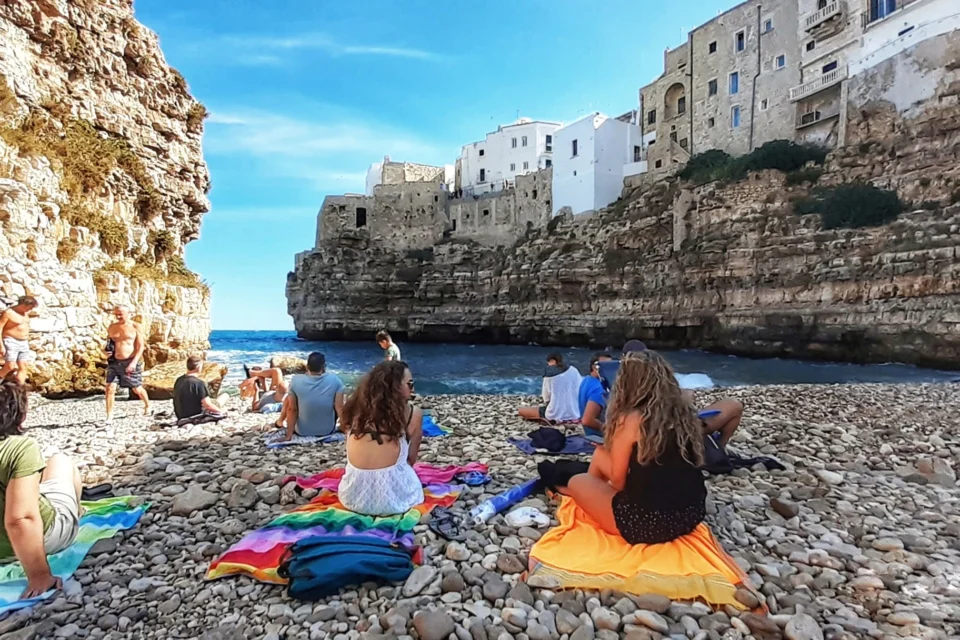
The Mount Saraceno headland is the signature sight: a short climb from the road puts you among the ancient tombs with a panorama over Mattinata’s olive plain and the sea. Inland and uphill, the Abbey di Monte Sacro rewards a half-day walk — the surviving proane with its arches and pillars, part of the apse and the Romanesque portal stand in deep woodland, reached by a trail walkable year-round. Back in town, the Museum Civico di Mattinata displays finds from local necropolises and settlements, giving context to the hillside tombs. North along the coast, the Baia di Vignanotica offers a white pebble beach under high cliffs seamed with sea caves, and just beyond it the Baia delle Zagare — a geological site of white cliffs and sea stacks, reachable on foot by trail — is the coast’s most photographed cove.
How to experience
Plan the town around two rhythms: boots in the morning, water in the afternoon. The Monte Saraceno to Monte Sacro route is a classic half-day hike needing proper shoes, long trousers and water — go in spring or autumn, when the woodland is at its best. Boat trips from the small harbour thread the caves and sea stacks of the northern coast, the easiest way to see Zagare and Vignanotica together. Evenings are for the seafront and the town’s simple trattorias; this is olive country, so taste the local oil, and treat the landscape itself — terraces, dry walls, ancient trees — as the main monument. For a softer day, the coastal road toward Vieste threads viewpoints over the coves, and the red-earth valley of Ripe Rosse adds a short, striking detour.
Practical planning
Mattinata lies on the coast road between Manfredonia and Vieste, easiest by car; parking is simple out of high season, and the town can be walked end to end in twenty minutes. Summer is busy but never oppressive thanks to the mountain air; May-June and September combine swimming with hiking weather. Beach access to the northern coves involves steep paths — check conditions locally — and the museum keeps limited hours, so confirm with the town or the Gargano park authority, parcogargano.it, before travelling. Two nights suit most travellers; three if the ridgeline trails call.
Nearby places
The broader Gargano area wraps around Mattinata — forest, cliffs and monastery towns of the promontory — and to the south the coast runs down to Manfredonia, whose castle museum holds many of the finds that give Monte Saraceno its meaning.
Worth building a day around.
Abbazia di Monte Sacro
Mattinata – Ente parco nazionale del Gargano img:is([sizes=auto i],[sizes^="auto," i]){contain-intrinsic-size:3000px 1500px} /*# sourceURL=wp-img-auto-sizes-contain-inline-css */ img.wp-smiley, img.emoji { display: inline !important; border: none !important; box-shadow:…
Baia delle Zagare
Mattinata – Ente parco nazionale del Gargano img:is([sizes=auto i],[sizes^="auto," i]){contain-intrinsic-size:3000px 1500px} /*# sourceURL=wp-img-auto-sizes-contain-inline-css */ img.wp-smiley, img.emoji { display: inline !important; border: none !important; box-shadow:…
Baia di Vignanotica
Mattinata – Ente parco nazionale del Gargano img:is([sizes=auto i],[sizes^="auto," i]){contain-intrinsic-size:3000px 1500px} /*# sourceURL=wp-img-auto-sizes-contain-inline-css */ img.wp-smiley, img.emoji { display: inline !important; border: none !important; box-shadow:…
Monte Saraceno
Mattinata – Ente parco nazionale del Gargano img:is([sizes=auto i],[sizes^="auto," i]){contain-intrinsic-size:3000px 1500px} /*# sourceURL=wp-img-auto-sizes-contain-inline-css */ img.wp-smiley, img.emoji { display: inline !important; border: none !important; box-shadow:…
Museo Civico di Mattinata
Mattinata – Ente parco nazionale del Gargano img:is([sizes=auto i],[sizes^="auto," i]){contain-intrinsic-size:3000px 1500px} /*# sourceURL=wp-img-auto-sizes-contain-inline-css */ img.wp-smiley, img.emoji { display: inline !important; border: none !important; box-shadow:…
Journeys in Mattinata.
Demo — Mattinata Private Highlights Tour
Let a local expert design your Mattinata day.
Tell us your dates and pace. A travel designer replies within one working day.