Massa Marittima
Massa Marittima is the metal-bearing hills’ finest surprise: a cathedral of Romanesque-Gothic grace above a sloping piazza, medieval walls and towers, and a museum system born of mining wealth. From Etruscan Lake Accesa to the shafts of the Subterraneo, this is a city where geology made history — and where history now makes one of inland Tuscany’s most rewarding small-town visits.
Why visit
Travellers crossing the Colline Metallifere, Tuscany’s old metal-bearing hills, rarely expect what Massa Marittima delivers: a cathedral worthy of far larger cities, mounted on a steep staircase above one of the region’s most photogenic squares. Wealth from silver, copper and other ores paid for the Duomo, the town palaces and the celebrated public fountains, and that medieval confidence still animates the streets.
The city works beautifully as a base for the southern Maremma’s inland half. Within a few hundred metres you can climb a thirteenth-century tower, descend into a mining museum, hear mechanical organs play themselves, and then drive out to an Etruscan archaeological park beside a lake. Few towns of this size pack so much verifiable history into so walkable a space.
Character and history
Massa Marittima’s fortunes were always written in rock. The Colline Metallifere have been worked since Etruscan times, and it was mineral wealth that financed the city’s golden age between the twelfth and fourteenth centuries. Its artistic ledger reads like a roll call of the era: Giovanni Pisano, Duccio di Buoninsegna, Ambrogio Lorenzetti and Goro di Gregorio all left work here, and a local veneration still attaches to Duccio’s Maestà.
The cathedral itself embodies that moment. Dedicated to Saint Cerbone, bishop of Vetulonia and patron of the city, it began in the eleventh century and reached its final form in the early fourteenth: a Pisan-style facade facing Piazza Garibaldi, a Gothic apse enlarged from 1287, likely with Giovanni Pisano’s involvement, and a Romanesque-Lombard bell tower. Because the building sits transversely to the square, its facade columns were deliberately spaced unevenly — a perspective trick that works to this day. Mining continued to shape the town into the twentieth century, and the municipal museum system, rooted in a civic collection founded in 1867, grew directly out of that heritage.
What to see
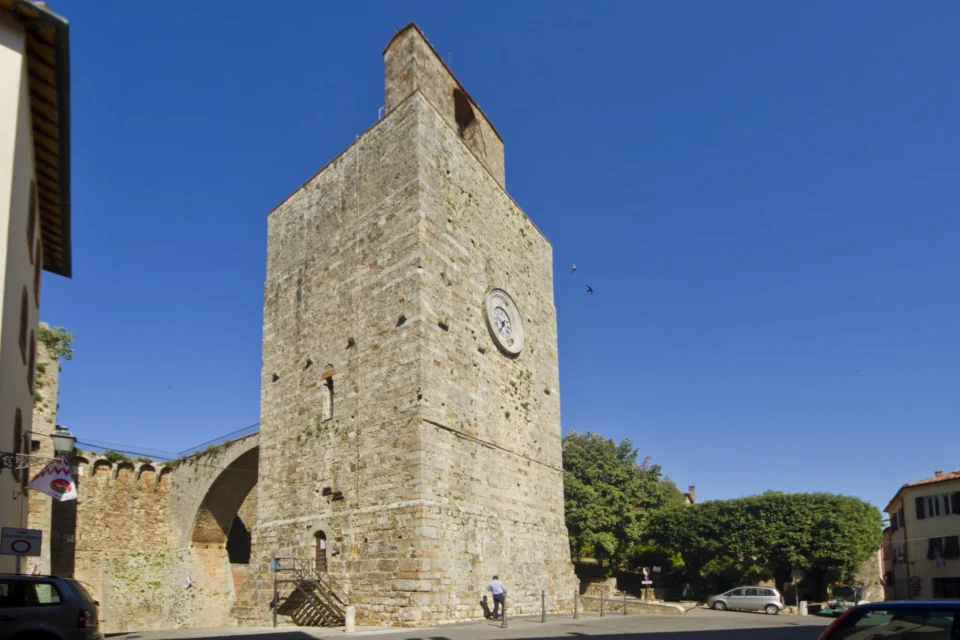
Start at the San Cerbone Cathedral. Goro di Gregorio’s marble Ark of Saint Cerbone of 1324 holds the patron’s relics, Giroldo da Como’s baptismal font of 1267 stands in the interior, and scenes of the saint’s life run across the facade architrave; Paul VI granted the church the title of minor pontifical basilica in 1975. Back on the square, the Candeliere Tower offers the classic climb over the rooftops.
The city’s museum system gathers several sites under one circuit. The Giovannangelo Camporeale Archaeological Museum grew from excavations and donations around the original civic collection, while the San Pietro all’Orto Museum (Medieval Art Collection) occupies a church financed by mining wealth in the twelfth and thirteenth centuries and keeps much of the city’s medieval painting. The Mining Museum – Subterraneo takes you underground into the world of the Colline Metallifere miners, and the Old Oil Mill and Ancient Carpentry Workshop preserves everyday industrial craft.
Two outlying sights complete the picture. The Museum of Antique Mechanical Organs on Corso Diaz lets musicians play original instruments, with an attached workshop where restorations happen in view of visitors. And a short drive away, the Lake Accesa Archaeological Park protects Etruscan settlement remains beside a spring-fed lake, with special evening openings during archaeology-themed nights. The Church of Sant’Agostino adds an austere Gothic interior to the centre’s itinerary.
How to experience
Massa Marittima is best done slowly and on foot. Arrive at the lower town, climb toward Piazza Garibaldi for the classic first view of the cathedral staircase, and let the morning take in Duomo, tower and museums. The combined museum circuit makes it natural to alternate art and industry — an hour of medieval painting, then the cool of the underground mine — which suits families as well as specialists.
Time a visit for one of the town’s cultural seasons if you can; the square hosts events through the year, and the Accesa park opens on special nights in summer. Audioguides for the main museums and the outdoor route are available free on izi.TRAVEL, a practical way to thread the story together. Finish with the region’s cooking — wild boar, pecorino, and the oils the old mill recalls — before the drive to the coast or the return over the hills.
Practical planning
Massa Marittima sits about an hour’s drive from Grosseto, Siena and the coastal resorts, and a car is the practical way in; buses connect but run infrequently. Parking lies just outside the walls, and the historic centre is entirely pedestrian. The town stands at around 380 metres of altitude, so evenings are cool even in summer.
The museum circuit sells combined tickets that cover the tower, archaeological museum, medieval collection, mine, mill and carpentry — good value if you plan more than two sites; individual sites keep different opening days, with winter closures common, so check before travelling. Spring and autumn are ideal, when the hills are green or golden and the light suits the stone. Sundays bring local families to the square; midweek is quietest.
Nearby places
- Castiglione della Pescaia — a walled fishing town and beach resort on the Maremma coast, under an hour away.
- Capalbio — the southernmost Maremma hill town, near the coast and the Tarot Garden.
Worth building a day around.
Antico Frantoio e Vecchia Falegnameria
The official combined venue page states that both the Antico Frantoio and Vecchia Falegnameria are visitable only by reservation. It gives Via Populonia 24…
Cattedrale di San Cerbone (Duomo di Massa Marittima)
The official tourism page labels an opening schedule and states that the cathedral is open every day 09:00-19:00 through 13 September 2026, with the…
Chiesa di Sant'Agostino
The official tourism page publishes summer 2026 opening hours for Sant’Agostino from Saturday 6 June through Sunday 13 September, every day 08:30-18:30, and warns…
Museo Archeologico "Giovannangelo Camporeale"
Official Museo Archeologico Giovannangelo Camporeale page, updated 2 September 2026: September 1-30 visiting hours are Tuesday-Sunday 09:30-13:00 and 14:30-18:00; Monday closed, last admission 30…
Museo degli Organi Meccanici Antichi "Santa Cecilia"
The official museum visit page publishes May-September hours 10:30-13:00 and 15:30-19:00, Monday closed except holidays, and €5 full/€4 reduced admission; it also publishes October-April…
Museo degli Squali & Dinosauri - Aquarium Mondo Marino
The official Aquarium Mondo Marino page publishes 1 April-31 October hours every day 10:00-13:00 and 15:30-19:00, full admission €10.90 and reduced €8.90 for children…
Museo della Miniera - Subterraneo
Official Subterraneo page, updated 2 September 2026: September 1-30 visiting hours are Tuesday-Sunday 11:00-13:00 and 14:00-16:00; Monday closed, last admission 30 minutes before closing.…
Museo di San Pietro all'Orto
Official Museo di San Pietro all’Orto page, updated 2 September 2026: September 1-30 visiting hours are Tuesday-Sunday 09:30-13:00 and 14:30-18:00; Monday closed, last admission…
Parco Archeologico del Lago dell'Accesa
The official museum page identifies the archaeological park around Lago dell’Accesa, approximately 7 km from Massa Marittima on SP49 at La Pesta, states that…
Torre del Candeliere
The official museum page, updated 2 September 2026, states that the Torre del Candeliere is open 1-30 September Tuesday-Sunday 09:30-13:00 and 14:00-18:00, Monday closed,…
Journeys in Massa Marittima.
Demo — Massa Marittima Private Highlights Tour
Let a local expert design your Massa Marittima day.
Tell us your dates and pace. A travel designer replies within one working day.