Marzamemi
A fishing hamlet that grew around one of Sicily’s great tuna fisheries, Marzamemi keeps the proportions of a place built for work rather than show: two squares, a stone harbour, low white houses, and water so clear it reads almost glass. Come for the atmosphere, the seafood, and the gentle pull of the southeast coast.
Why visit
Marzamemi rewards travellers who want Sicily’s coast without the crowds of the island’s headline resorts. The old tonnara complex — the tuna fishery that gave the village its shape and, for three centuries, its living — stands almost intact around the tiny Piazza Regina Margherita, creating one of the most photogenic village squares in southern Italy. The setting is disarmingly small: you can walk the whole old quarter in ten minutes, yet a full day disappears into swims, long lunches, and evening light on the sea walls. Its position, a short drive from the baroque towns of the Val di Noto and the tomato fields around Pachino, makes it an easy and restorative pause on a broader itinerary.
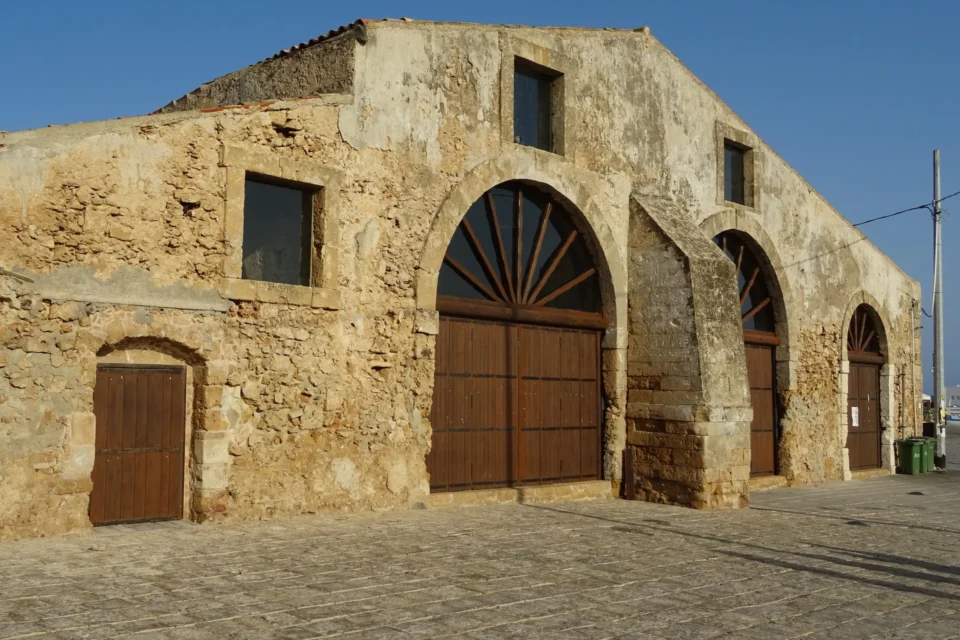
Scale is part of the appeal, but so is texture. The village’s buildings keep their working vocabulary — the boat-sheltering loggia with its three great gates, the stone slipway where the catch was once landed, warehouses given quiet new life — so that tourism has settled into an industrial shell rather than erasing it. Swimmers find rocky platforms and sandy inlets on either side, divers a scattering of wrecks offshore, and everyone a rationale to linger through the change of light that makes the white houses glow at closing hour.
Character and history
The village grew around the tonnara, the tuna trap and processing works that the regional Visit Sicily portal records as dating to the seventeenth century and ranking among the most important in Sicily. Built under Spanish rule, the fishery passed in 1655 to the Calascibetta barons of Piazza Armerina, and during the eighteenth century the complex took on the buildings you still see: the Prince’s Palace, raised around 1750 on the initiative of Baron Bernardo Calascibetta, a church dedicated to Our Lady of Mount Carmel, and rows of low fishermen’s cottages facing the landing place. In the later nineteenth century ownership moved to the Nicolaci family of the Princes of Villadorata of Noto, whose palace still defines the west side of the square.
Tuna remained the village’s reason for being into the twentieth century: an early-1900s factory produced tuna in oil, one of its chimneys survived the Second World War bombings, and the works only closed in 1954. What followed was a slow turn toward tourism, handled with unusual restraint — the stone Loggia degli Scieri where boats were sheltered, the slate landing of Largo Balata, and the cottages all still belong to their original architecture rather than to redevelopment.
What to see
The heart of the village is Regina Margherita Square, the paved piazza flanked by the former residence of the Princes of Villadorata and the little church of the tonnara. Around it cluster the vestiges of the fishery: the three-gated Loggia degli Scieri, once used to shelter the tuna boats and to hang the catch, and the surviving factory chimney by the harbour. The beach and rocky coves either side of the village offer clear swimming, and the small harbour still hosts a working fishing fleet alongside leisure craft.
How to experience
Eat the sea. The village’s restaurants specialise in tuna in every form — bottarga above all, often matched with the intense tomatoes grown nearby around Pachino — and menus follow the day’s catch. Swim in the morning before the day-trippers arrive, then linger over lunch in the square as it fills. Visit at dusk in summer, when the square becomes an open-air living room and the light on the white houses turns gold. The village pairs naturally with Noto, twenty minutes inland, or with a coastal day that ends watching the sun drop into the strait toward Africa.
Practical planning
Marzamemi is reached by car from Syracuse in under an hour, with the final approach through coastal farmland; parking sits at the village edge and the centre is pedestrian. The tonnara complex is effectively an open-air site you wander freely, though individual exhibitions and the palace interior keep their own schedules that change by season, so check locally rather than planning tightly around them. Summer brings heat, full terraces, and evening festivities; spring and early autumn deliver the same beauty with easier parking and quieter waters. Bring water shoes for the rocky coves.
Nearby places
The baroque splendour of Noto lies just inland, and the longer chain of Val di Noto towns — Avola, Scicli, Modica — make rewarding half-day trips. The city of Syracuse with its Greek theatre and Ortygia island anchors the coast to the north, while the Vendicari wetland reserve, with its own ruined tonnara and flamingo lagoons, sits between the two.
Worth building a day around.
Journeys in Marzamemi.
Demo — Marzamemi Private Highlights Tour
Let a local expert design your Marzamemi day.
Tell us your dates and pace. A travel designer replies within one working day.