Cuma
On a headland above the Tyrrhenian at the edge of Pozzuoli, Cuma holds a claim no other Italian site can: it was the first Greek colony on the Italian mainland, founded by seafarers from Euboea in the eighth century BC. Its acropolis hides the cave Virgil made immortal, and nearby lies Lake Avernus, the Romans’ doorway to the underworld.
Why visit
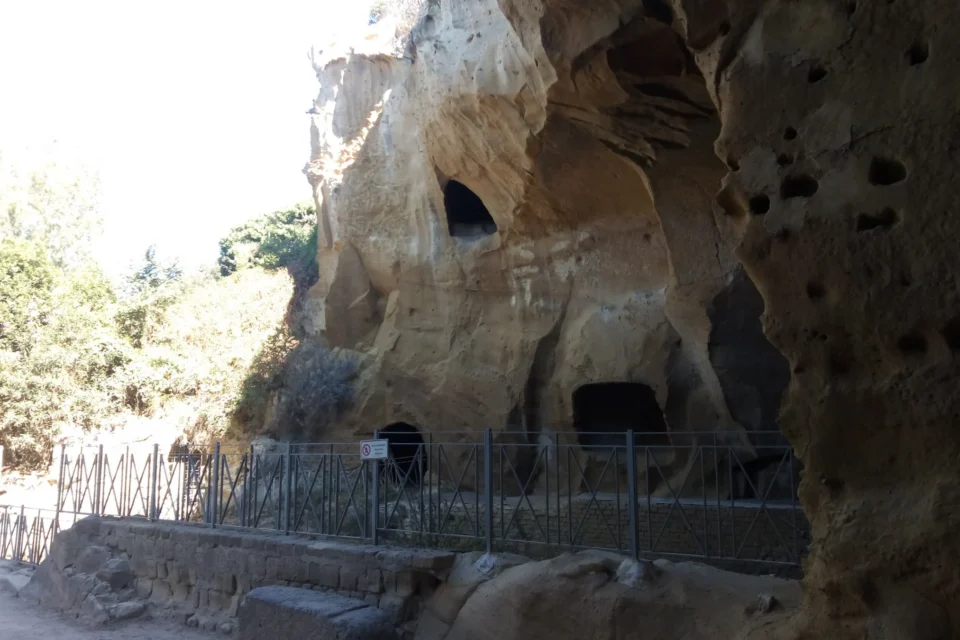
Cuma compresses an astonishing amount of ancient history into a small volcanic landscape. The archaeological park covers roughly fifty hectares of acropolis, walls and lower city, yet its single most famous monument is small and strange: the Cave of the Sibyl, a long trapezoidal gallery cut into the tuff, its three passageways lit by narrow light-wells. Standing inside, you understand why generations linked it to the prophetic sibyl who, in Virgil’s telling, guided Aeneas toward the underworld. Around the cave are the temples of the acropolis, later converted into churches; below stretches a Roman forum, baths and a necropolis; and all around rise sea cliffs with the islands of the gulf on the horizon. Because the site belongs to the Phlegraean Fields volcanic complex, geology and myth arrive together — craters, steaming ground and the deepest layers of Western literature in one outing that most visitors still have to themselves.
Character and history
The park authority dates the Greek foundation to around 740 BC, making Cumae the first Greek colony of the Italian mainland, established by colonists from Chalcis and Eretria. From this foothold, Greek culture and the Greek alphabet travelled inland to the Etruscans and eventually to the Romans — the alphabet you are reading descends by a long chain from the letters used here. Cumae grew rich and fought for it: the city defeated an Etruscan-led coalition on land in 524 BC, and with the Sicilian Greeks destroyed an Etruscan fleet offshore in 474 BC, an victory celebrated in a famous Pindar ode. Roman rule brought municipal normality, then strategic reinvention: in the 30s BC the architect Lucius Cocceius Auctus cut a network of galleries around Lake Avernus to serve Agrippa’s military port of Portus Julius, including a kilometre-long tunnel linking the lake to the city that now bears his name. Excavation began systematically in 1927 under Amedeo Maiuri, whose search for Virgil’s sibyl gave the acropolis cave its name in 1932 — the park notes the gallery itself is interpreted as a military tunnel of the Samnite era, one of archaeology’s franker self-corrections.
What to see
The Archaeological Park of Cuma spans the acropolis hill where the Cave of the Sibyl opens in darkness and light-shafts; beside it stand the terraces of the temples of Apollo and Jupiter, both later serving as churches, and the Byzantine tower that crowned the acropolis as a fortress. In the modern hamlet at the foot of the hill, the Roman Amphitheatre of Cumae preserves an arena ring in quiet decay on the Bacoli side. A short drive around the shore reaches Lake Avernus, the deep volcanic crater lake the Romans imagined as the mouth of Hades, ringed today by a walkable shore path. On its banks lie the scant remains of the Temple of Apollo, and into the tuff runs the Grotta di Cocceio, the great Roman gallery toward Cumae — battered by a 1943 explosion when it served as an ammunition store, now protected along with the bat colony that has settled it.
How to experience
Come prepared to walk outdoors for two to three hours: the acropolis climb, the cave and the lower terraces form a circuit with little shade, so morning is the kindest hour. The park’s museum and signboards carry the essential narrative, and the combined Phlegraean circuit ticket covers Cuma together with neighbouring sites of the archaeological park — good value if you plan to continue to Baia or Pozzuoli. Around Lake Avernus, hire of pedal boats and lakeside cafés alternate with stretches of Roman masonry, and the shore path makes a gentle hour’s stroll when you have exhausted hills for the day. Photographers should try the cave’s light-wells at midday, when shafts of sun reach the floor, and the acropolis viewpoints at dusk for Capri and Ischia on the horizon.
Practical planning
Cuma lies about forty minutes from central Naples by car, reached via Pozzuoli and the Arco Felice; buses from Naples also serve Cuma Baacoli on weekdays. The archaeological park, managed by pafleg.cultura.gov.it, publishes admission, closure days and opening calendars — verify before setting out, as the site closes weekly and on conservation days. Sturdy shoes matter on the acropolis paths, and the cave interior stays cool even in summer, worth a layer. The lake circuit is flat and stroller-friendly, unlike the acropolis. Combine the visit with Pozzuoli’s Roman amphitheatre and the Rione Terra for a full Phlegraean day, or with Baia’s castle and sunken-port remains if you are tracing the ancient coastline.
Nearby places
The adjoining Phlegraean coast offers Pozzuoli with its amphitheatre and bradyseismic old town, and Baia, the Roman elite’s resort bay; the whole area is gathered under Campi Flegrei. By ferry, Procida and Ischia — the island of Pithecusae, Cuma’s own mother settlement — sit directly offshore.
Worth building a day around.
Anfiteatro cumano
Il Parco indica apertura in collaborazione con la Pro Loco Citta di Bacoli solo su prenotazione con numero minimo di 5 partecipanti. Solo visite…
Antro della Sibilla
Il Parco ufficiale descrive l'Antro della Sibilla alle pendici dell'acropoli come nucleo della visita. Interno percorribile a piedi tramite il biglietto del parco
Grotta di Cocceio
Pagina ufficiale del Parco che documenta la galleria di 38-36 a.C. (Lucio Cocceio Aucto) per il Portus Iulius. Percorso interno su passerella quando aperto
Lago d'Averno
Localita gestita dal Parco Archeologico dei Campi Flegrei; il Comune di Pozzuoli lo documenta come luogo suggestivo del territorio. Anello lacustre percorribile; accesso pubblico…
Parco archeologico di Cuma
Pagina ufficiale MiC del Parco Archeologico dei Campi Flegrei con tariffe, chiusura settimanale (martedi) e dati di visita. Sentieri acropoli; parzialmente accessibile; chiusura settimanale…
Tempio di Apollo (Lago d'Averno)
Il Parco Archeologico dei Campi Flegrei pubblicizza il Tempio di Apollo tra i siti del lago d'Averno. Vista esterna;eventuale interno da verificare con il…
Journeys in Cuma.
Demo — Cuma Private Highlights Tour
Let a local expert design your Cuma day.
Tell us your dates and pace. A travel designer replies within one working day.