Courmayeur
Courmayeur sits at the foot of Mont Blanc, where a Walser-rooted alpine town of stone roofs and cobbled lanes grew into one of Europe’s most refined mountain resorts. Between the wild glacial corridors of Val Ferret and Val Veny, it pairs serious mountaineering heritage with spa calm, village bread festivals and a cable car that climbs to 3,462 metres.
Why visit
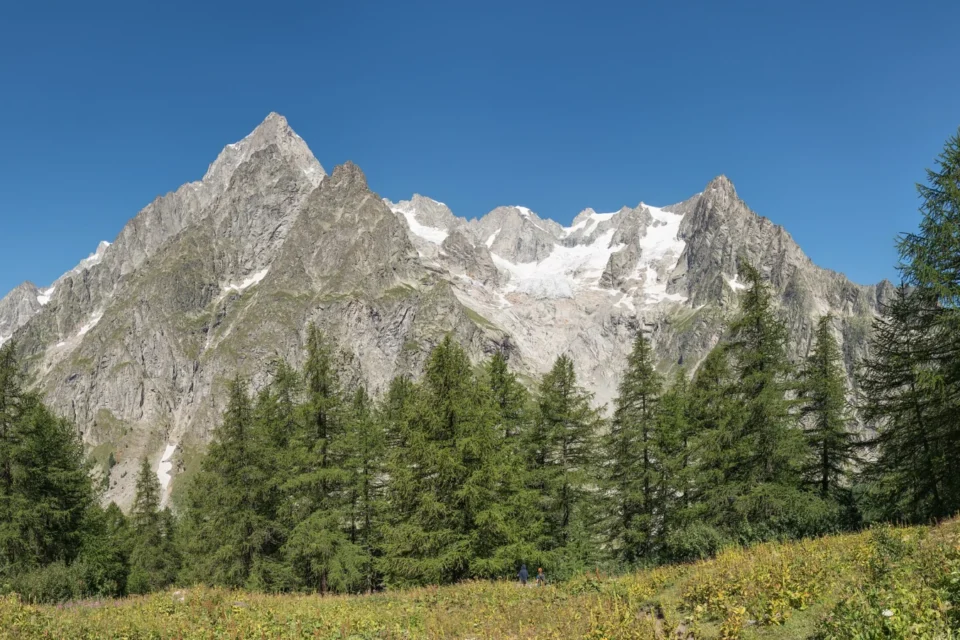
Few mountain towns offer such a complete shorthand of the Alps in one place. Courmayeur looks straight up at the highest summit in Europe — Mont Blanc, which the local tourism board describes as rising 4,810 metres — while keeping an intimate, human scale in its traffic-free centre of slate-roofed houses, converted wash-houses and artisan shops. In winter it is a classic ski destination with freeride terrain and heliski options; in summer it becomes the natural base for trekking stages of the Tour du Mont Blanc, climbing, mountain biking and high-alpine botany. What distinguishes it from other resorts is the layering: a medieval parish church and a sixteenth-century sanctuary share the valley with a rotating-cableway engineering feat, a Europe-record botanical garden and an alpine museum founded by one of Italy’s great mountaineers. Add the proximity of the thermal baths at nearby Pré-Saint-Didier and the easy reach of Aosta, and the town works equally well as a destination in itself or as the alpine capital of a longer Valley of Aosta itinerary.
Character and history
Courmayeur’s identity was shaped at the crossing point of ancient routes toward the Little and Great St Bernard passes, and by the mountain communities that settled the Mont Blanc slopes in the medieval period. For centuries it lived from agriculture, trade and guiding travellers across the cols, with its historic hamlets — Dolonne, Entrèves, La Saxe, Villair, Larzey, La Villette, Entrelevie and Plan Gorret — keeping their own ovens, chapels and communal traditions. The appearance of alpinism in the late eighteenth century, after the first ascent of Mont Blanc promoted by Horace Bénédict de Saussure, gradually turned Courmayeur into a base for climbers; the arrival of the railway era and then the first Mont Blanc cable car, opened in 1957, completed its transformation into an international resort. Through all of this the town has kept a distinctly Valdostan texture: communal bread ovens are still lit for the Lo Pan Ner festival, patronal feasts and folk groups animate the villages, and the local speech and cuisine remain close to the mountain life that produced them.
What to see
The town’s monument core gathers around Piazza Abbé Henry, where the Parish Church of San Pantaleone stands as the spiritual centre of the community, near the Duke of the Abruzzi Alpine Museum, which honours the mountaineer prince and preserves the memory of early Himalayan and polar expeditions. A short walk away, Malluquin Tower and the Waldensian Church of Courmayeur recall the valley’s defensive past and its religious diversity on Piazza Petigax, while the Abbé J.M. Henry Park at Plan Gorret offers a quiet green interlude.
For the mountain itself, Skyway Monte Bianco is the defining experience: its rotating cabins climb from the valley station — where the Hangar exhibition traces the history of the 1957 cableway — to the Pavillon du Mont Fréty and then Punta Helbronner at 3,462 metres. At the intermediate station lies Saussurea Alpine Botanical Garden, at 2,173 metres the highest botanical garden in Europe, created in 1987 and named for the flower that honours de Saussure; near the top, the Mont Blanc Crystals Exhibition displays mineral treasures extracted from the massif’s granite veins. In the valley bottoms, the Sanctuary of Notre-Dame de la Guérison at the entrance to Val Veny remains a living place of pilgrimage, and the Tour of the Villages of Courmayeur threads together the historic hamlets with their stone houses and lause roofs; across the Dora Baltea, the seventeenth-century Favre House at Dolonne is a fine survivor of rural alpine architecture.
How to experience
Begin with the villages rather than the lifts: an unhurried morning loop through Dolonne, Entrèves and La Saxe, ideally with the local guided-audio route, shows the town beneath its postcard image. Ride the Skyway early to catch the clearest light on the Grandes Jorasses and the Dente del Gigante, and linger at Pavillon du Mont Fréty, where the garden’s alpine pastures and rock beds reward slow walking. Walkers should sample at least one valley path: the flat, glacially carved floor of Val Ferret toward Arp Nouvaz, or the approach to the sanctuary in Val Veny. Winter visitors can combine the ski area with a snowshoe outing in the valleys, which remain accessible by shuttle. Plan a gastronomic interlude too — Courmayeur’s tables lean on Valdostan staples such as fontina, game and black bread, best timed around the autumn bread festival — and close the day with the short drive or bus ride to the thermal springs at Pré-Saint-Didier.
Practical planning
Courmayeur is reachable by road from Aosta via the funivie-served SR26 corridor, with motorway connections toward Turin and, through the Mont Blanc Tunnel, to Chamonix in France; travellers without a car can reach Aosta by train or coach and continue by regional bus. Book accommodation well ahead for high season, since the town fills quickly in winter and August. Weather on the high stations changes fast at any time of year: carry layers even on a sunny valley morning, and check lift operations before planning a summit-level visit. Val Ferret and Val Veny restrict private cars at peak times, so use the summer shuttles when offered. For hiking, the Tour du Mont Blanc stages around town are best attempted between late June and September, when refuges and lifts operate; guided mountain leaders are available for glacier routes.
Nearby places
- Mont Blanc — the massif itself, with Val Ferret, Val Veny and the Tour du Mont Blanc corridors.
- La Thuile — border village beneath the Little St Bernard Pass, with waterfalls and megalithic remains.
- Pré-Saint-Didier — historic thermal town a few minutes down the valley.
- Aosta — the regional capital’s Roman and medieval monuments.
- Gran Paradiso National Park — Italy’s oldest national park, east along the valley.
Worth building a day around.
Casa Favre
Scheda regionale (archiviata): edificio a Dolonne con architrave datato 1610, stemmi sabaudi e dei Favre, croce di Malta e giglio di Francia visibili dall'esterno
Chiesa Evangelica Valdese
Scheda regionale: tempio acquistato nel 1857 e inaugurato nel 1885, fiancheggia la torre Malluquin
Chiesa Parrocchiale di San Pantaleone
Chiesa parrocchiale principale, aperta al culto; pagina patrimoniale della Regione VdA documenta l'edificio e gli scavi 1997-1999
Cristalli del Monte Bianco
Pagina ufficiale del gestore dedicata all'esposizione permanente di cristalli nella stazione Punta Helbronner
Giardino Botanico Alpino Saussurea
Scheda regionale e sito del gestore: giardino sul Pavillon du Mont Fréty, raggiungibile con Skyway Monte Bianco, aperto da giugno a settembre
Hangar - la storia della funivia
Pagina ufficiale del gestore dedicata allo spazio espositivo sulla storia della funivia
Museo Alpino Duca degli Abruzzi
Scheda regionale e pagina del portale turistico di Courmayeur documentano il museo, inaugurato nel 1929 e completamente rinnovato per i 150 anni della Società…
Parco Abbé J.M. Henry
Scheda regionale: parco inaugurato nel 1901, ideato dall'abate Joseph-Marie Henry, in località Plan Gorret (1272 m)
Santuario di Notre-Dame de la Guérison
Portale ufficiale turistico di Courmayeur: santuario in Val Veny ai piedi del ghiacciaio della Brenva, aperto fino a fine settembre, tel. +39 0165 869085
Skyway Monte Bianco
Sito ufficiale del gestore con stazioni di Courmayeur, Pavillon e Punta Helbronner, biglietteria online e orari; scheda regionale dedicata
Torre Malluquin
Scheda ufficiale regionale: edificio medievale dei signori Malluquin, passato ai D'Avise nel XV secolo; all'interno vengono organizzate mostre
Tour dei villaggi di Courmayeur
Portale turistico ufficiale: percorso di visita fra le frazioni storiche di Courmayeur con case in pietra, tetti in losa e lavatoi
Journeys in Courmayeur.
Demo — Courmayeur Private Highlights Tour
Let a local expert design your Courmayeur day.
Tell us your dates and pace. A travel designer replies within one working day.