Corvara
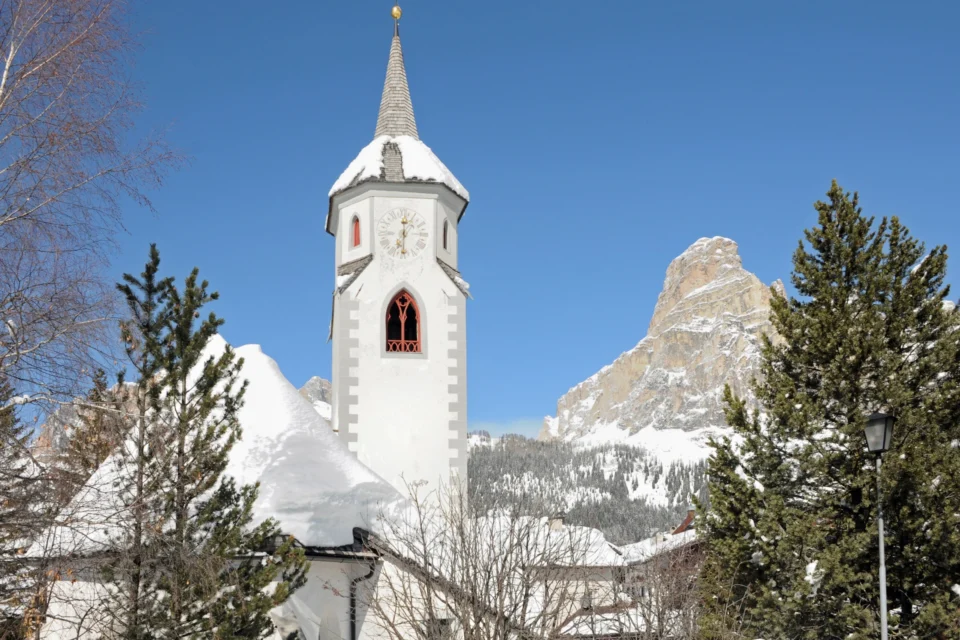
Corvara, first village of Alta Badia, sits beneath the pyramidal mass of Sassongher at the junction of the Gardena and Campolongo passes. A cradle of Ladin Alpine tourism with a late-Gothic church holding the valley’s only surviving winged altarpiece, it anchors the Sellaronda circuit in winter and some of the Dolomites’ finest hiking country in summer.
Why visit
Corvara is where Alta Badia begins. The official Alta Badia tourism site opens its map at this village — the highest of the Badia valley communities at the foot of the Sassongher — and everything the region is known for radiates from here: the Ladin language and its enrosadira alpenglow lore, the Dolomiti Superski lifts, the Sellaronda circuit that passes through, the Audi FIS Ski World Cup races on neighbouring slopes, and a dining scene that has turned mountain cooking into a destination of its own. Yet the village keeps its historic core: the Church of Saint Catherine, Corvara’s first church, surrounded by its old cemetery in the local manner, and above the hamlet of Colfosco the wall of the Sassongher, the mountain every postcard owes its composition to. Summer reverses the picture — lifts up, skis off, and a trail network toward waterfalls, biotopes and high passes takes over.
Character and history
Corvara was among the first Alpine villages to turn deliberately to tourism, and that early start shows in a hospitality culture that has had a century and a half to mature. Beneath the commercial surface, Ladin continuity runs deep: the municipality is officially trilingual, and the regional tourism authority frames Ladin as a language that, in a single word, “expresses the beauty of the Dolomites” — nowhere more than at dawn and dusk, when the enrosadira turns the rock rose and red.
The village’s oldest witness is the Church of Saint Catherine, first mentioned in 1347 and consecrated in 1452, standing in its walled churchyard at the Strada Col Alt. Inside hangs the treasure: a winged altarpiece of 1520 from the workshop of Ruprecht Potsch, described by the regional tourism site as the only well-preserved winged altar in the churches of Val Badia, its panels attributed by experts to Albrecht Altdorfer’s Danube school — though local legend insists on Titian, who is said to have passed through. In Colfosco, the late-Gothic Church of St Vigilius serves the Ladin-speaking hamlet under the Sassongher’s walls.
What to see
In the village, the Church of Saint Catherine and its 1520 altarpiece come first — open daily and lit gently enough for the panels to be read up close. At Colfosco, the parish church of St Vigilius makes the natural second stop, and the viewpoint chapel at the Gardena Pass marks the head of the Val Gardena climb with a small mountain chapel.
The landscape list is unusually strong for one municipality. The Sassongher offers the classic summit walk from Colfosco, its distinctive pyramid visible from every terrace in the valley; the Pisciadù Waterfalls tumble through the Val Mezdi above Colfosco on a marked trail that ends near the famous suspended bridge toward the Sella; and the small Corvara Biotope Lake at the village edge gives an easy, family-scale taste of the wetland ecology between the lifts.
How to experience
Summer: take the lifts up and walk down. One day for the Sassongher from Colfosco — start early, lunch at the summit refuge, descend via the Gherdenacia pastures; another for the Pisciadù trail and the pass chapels; an easy morning for the biotope and the church circuit. The Alta Badia summer programme layers guided hikes, via ferrata outings and the region’s food events — the Cëna sot les stëres and the Festa dl pan among them — onto this skeleton.
Winter: Corvara is a Sellaronda hub, and the ski schools, cross-country centre and World Cup slopes need little introduction; non-skiers get snowshoe trails and the village’s culinary calendar, which the official site treats as headline content rather than decoration. Either season, order Ladin dishes where offered — the valley’s cooking is part of its cultural argument.
Practical planning
Corvara lies about forty minutes by road from Bolzano up the Val Badia, with regional buses serving the valley; the village is walkable, and the lift system carries most summer and winter traffic. Lift and biotope access follow the Alta Badia seasonal calendar, with summer lifts typically running into early October — confirm dates before planning high-route days. The Sassongher trail is exposed on its upper section, so choose weather windows; the waterfall and biotope walks suit almost all abilities. Peak weeks are Christmas–New Year, February and August; June and late September deliver the quietest trails and the alpenglow evenings the Ladin tradition celebrates.
Nearby places
The rest of Alta Badia needs no car: San Cassiano lies down-valley, and the Alta Badia destination area gathers the whole valley. Over the Gardena Pass, Selva di Val Gardena and Val Gardena continue the circuit, while the Dolomites as a destination area frame the region’s protected landscape.
Worth building a day around.
Cappella al Passo Gardena
Listed as a cultural sight (chapel) under Corvara on the official South Tyrol tourism portal suedtirol.info culture-and-sights listing for the Dolomites Region Alta Badia.…
Cascate del Pisciadù
Listed as a natural sight under Colfosco (frazione of Corvara) on the official South Tyrol tourism portal culture-and-sights listing for the Dolomites Region Alta…
Chiesa di San Vigilio (Colfosco)
Official Alta Badia portal has a dedicated attraction page for the late Gothic church of Colfosco; suedtirol.info lists it as a cultural POI (first…
Chiesa di Santa Caterina
Official Alta Badia tourism portal lists opening hours daily 07:00-19:00 (validity 01.01.2026-31.12.2026) and contact +39 0471 836134; suedtirol.info lists the church as a culture…
Lago Biotopo di Corvara
Listed as a public POI ('Lago biotopo Corvara', Str. Sotscofes 8) on the official Alta Badia tourism portal POI inventory.
Sassongher
Official regional tourism portal suedtirol.info publishes a marked hiking route from Colfosco to the Sassongher summit describing it as the symbol mountain of Corvara…
Journeys in Corvara.
Demo — Corvara Private Highlights Tour
Let a local expert design your Corvara day.
Tell us your dates and pace. A travel designer replies within one working day.