Conversano
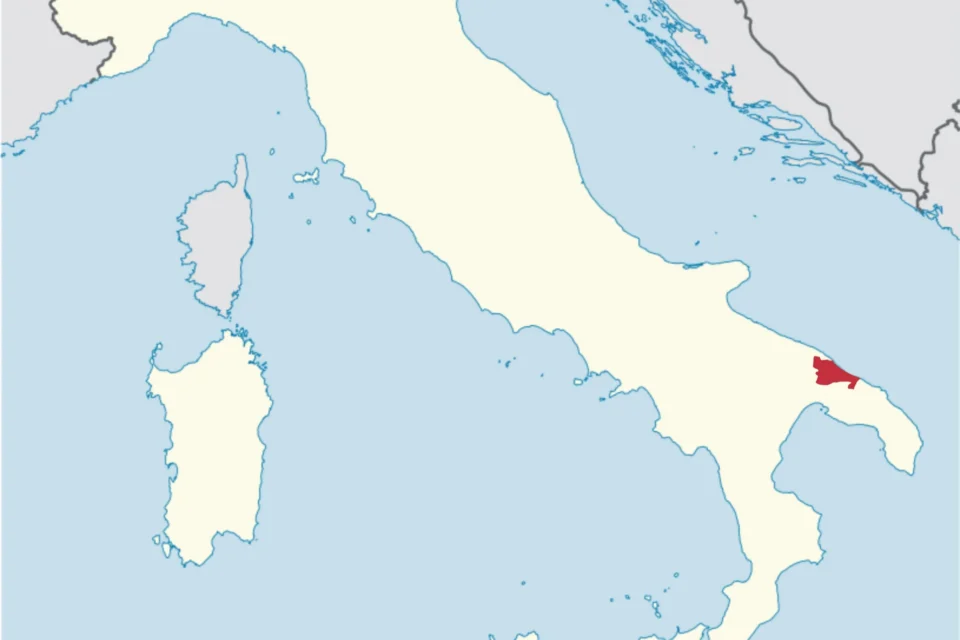
Conversano sits on a low hill half an hour southeast of Bari. Unlike its showier neighbours, it keeps the proportions of a working town: a compact medieval core around a great castle, olive groves on every approach, daily life continuing in every season. It rewards travellers seeking substance — Romanesque churches, an abbess-ruled monastery, paintings by Paolo Finoglio — without the crowds.
Why visit
Conversano offers an unusually complete slice of Apulian history in a town you can cross on foot in twenty minutes. The castle that anchors the historic centre was raised by the Normans around the mid-eleventh century as a fortress and later became the residence of the Counts Acquaviva, one of southern Italy’s most powerful dynasties. Around it lie a fine Romanesque cathedral, a Benedictine monastery with a singular story of female authority, Baroque churches and quiet piazzas. The surrounding countryside, stitched with ancient olive trees and dotted with masserie, invites slow exploration, and the beaches of the Adriatic coast are close enough for an afternoon. If you have already seen the famous white towns of the Itria Valley, Conversano is where you come to go deeper.
Character and history
The town’s roots reach back to antiquity. The ancient site of Norba, a Peucetian settlement with trade ties to the Greek colonies, stood nearby; a sixth-century BC necropolis attests to those exchanges, and megalithic walls still trace the oldest contours of the town. Rome absorbed Norba in 268 BC, and after the settlement faded in late antiquity the medieval Casale Cupersanem emerged, a bishopric by the seventh century.
The decisive chapter began with the Normans. Around 1054 Conversano became the capital of a county that at its widest stretch ran down toward Lecce and Nardò, passing through the hands of the Brienne, Enghien, Luxembourg, Sanseverino and Orsini families before the Acquaviva took control in the late fifteenth century. They ruled until feudalism was abolished in 1806, and their patronage shaped much of what visitors see today: the castle’s round tower, the enrichment of the churches, the paintings commissioned from the seventeenth-century Neapolitan master Paolo Finoglio. A curious footnote survives in the stables of the counts, who bred black Neapolitan stallions — a stallion born here in 1767 became one of the foundation sires of the Lipizzan breed.
The most distinctive institution, though, was the Benedictine monastery of San Benedetto. Traditionally founded in the sixth century and entrusted to Cistercian nuns from 1266, it became famous as the only convent in western Europe whose abbesses bore male insignia, mitre and all; its bell tower was deliberately built taller than the cathedral’s. Works by Finoglia still hang within.
What to see
The Castle Acquaviva d’Aragona crowns the upper edge of the historic centre, a trapezoidal fortress with four towers whose plain, dignified stonework conceals centuries of rebuilding by the Acquaviva and the Aragonese. Inside, the municipal picture gallery displays seventeenth-century canvases by Paolo Finoglia alongside works by the nineteenth-century painter Francesco Netti.
A few steps away stands the Basilica Cattedrale Maria SS. Assunta, which the comune describes as a jewel of Apulian Romanesque; dedicated to the Assumption and to San Flaviano, the town’s patron, it combines eleventh-century foundations with later Gothic and Baroque layers and a rose window of the fifteenth century. The Church del Carmine belongs to a Discalced Carmelite complex whose presence in the county dates to 1617. For a rest between monuments, Villa Garibaldi lies just outside the old walls, a garden of oaks and jasmine that looks back toward the castle — the residents’ favoured evening promenade.
How to experience
Approach Conversano the way locals do: park outside the centre and wander. Begin at the castle, then follow the lanes down through the cathedral quarter, pausing in the small piazzas where older men hold court and children play football against ancient walls. Time your visit around an aperitivo; the town’s bars and trattorie serve Puglia’s staples — orecchiette, burrata, cold-pressed oil from the surrounding groves — at prices the coast has long abandoned. In summer the castle and cloisters host concerts and exhibitions, and the estate of Marchione in the nearby hills offers shaded walks. The beaches and cliffs of the Adriatic, between San Vito and Polignano, are within easy reach by car for a morning swim. Drivers will find the SS 16 the simplest approach from Bari; a railway station links the town to the regional network for those without a car.
Practical planning
Conversano is a year-round destination; spring and autumn bring mild weather and the countryside at its most beautiful, while summer is livelier but busier on the coast. A half-day covers the main monuments comfortably, though the picture gallery deserves more time than most visitors budget. Check the comune’s website (comune.conversano.ba.it) for current opening arrangements at the castle, gallery and churches, as hours vary through the year and around religious festivals. Comfortable shoes matter: the historic centre is cobbled and gently steep. Consider pairing the town with a countryside agriturismo lunch — the surrounding Murgia farms produce some of the region’s best olive oil.
Nearby places
The Itria Valley begins almost at Conversano’s doorstep. Castellana Grotte, with its celebrated cave system, is a short drive inland and makes an obvious half-day pairing. To the west, Grottaglie is known for its ceramics quarter carved into the tufa ravine. Those following the coast south will find more of Puglia’s layered towns a little further on.
Worth building a day around.
Basilica Cattedrale Maria SS. Assunta
Comune di Conversano, in “Beni storico-artistici - Comune di Conversano”, identifies Basilica Cattedrale Maria SS. Assunta as a visitor-relevant attraction associated with Conversano. Verified…
Castello Acquaviva d'Aragona
Comune di Conversano, in “Beni storico-artistici - Comune di Conversano”, identifies Castello Acquaviva d'Aragona as a visitor-relevant attraction associated with Conversano. Verified source scope:…
Chiesa del Carmine
Comune di Conversano, in “Beni storico-artistici - Comune di Conversano”, identifies Chiesa del Carmine as a visitor-relevant attraction associated with Conversano. Verified source scope:…
Villa Garibaldi
Comune di Conversano, in “Beni storico-artistici - Comune di Conversano”, identifies Villa Garibaldi as a visitor-relevant attraction associated with Conversano. Verified source scope: destination…
Journeys in Conversano.
Demo — Conversano Private Highlights Tour
Let a local expert design your Conversano day.
Tell us your dates and pace. A travel designer replies within one working day.