Collodi
Collodi is the village that lent its name to Pinocchio. Carlo Lorenzini took the pen name of his father’s workplace, a hillside borgo of steep medieval lanes in the Valdinievole, and today the town pairs a literary monument park with a monumental sixteenth-century garden, Romanesque stones and views over the Pistoia hills. Children and garden-lovers both thrive here.
Why visit
Collodi works a rare double: it satisfies families travelling with children and travellers serious about gardens and history, in the space of a single afternoon. The Pinocchio Park turns the puppet’s adventures into an open-air path of mosaics and sculptures, while above it rises Villa Garzoni and one of the finest Italian gardens in Tuscany, its terraces, water stairs and hedge theatres cascading down the hill. Behind them climbs the old borgo itself, a vertical warren of stone houses winding up to a Romanesque parish church and the remains of the castle rock. The village is compact, walkable, and easy to reach from Pistoia, Lucca or Montecatini, which makes it one of the most efficient cultural stops in western Tuscany — and the butterfly greenhouse and adventure trails keep younger visitors engaged while adults study the baroque topiary.
Character and history
The village grew in the late twelfth century as a defensive settlement on the hillside, organised around a fortress at the slope’s foot with the parish church of San Bartolomeo at the summit; its plan has barely changed since. Its place in world culture came later and by accident of employment: Carlo Lorenzini’s father worked as a cook and gardener in the service of Villa Garzoni, and the writer, born in Florence in 1826, took the pen name Carlo Collodi from these slopes. His Storia di un burattino, first serialised in 1881, became the Adventures of Pinocchio known worldwide. The twentieth century added the monument: the Fondazione Nazionale Carlo Collodi built the Pinocchio Park as a literary garden in the 1950s, filling it with works by leading Italian artists, and later added the Butterfly House in its stone-and-glass greenhouse. The Garzoni garden, which had drawn princes and scholars for centuries, was restored alongside, and the villa, built on the ruins of the medieval castle, still anchors the ensemble above the village.
What to see
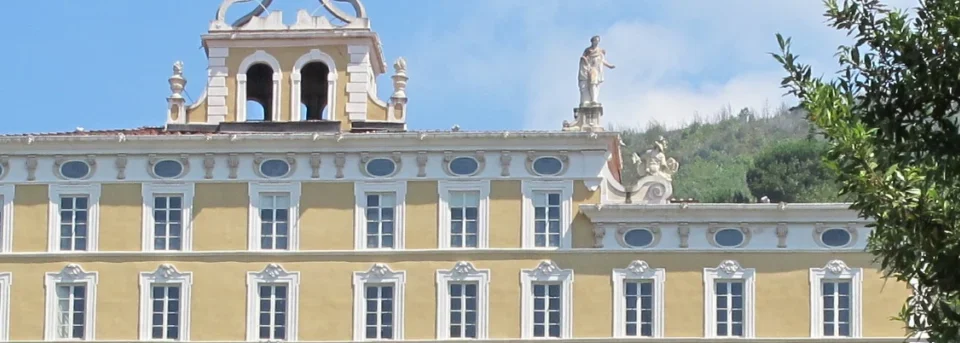
The Pinocchio Park is the heart of the visit: a monumental literary path where the Cat and Fox, the Fairy and the Great Whale appear in mosaics and sculpture, now joined by an interactive museum and the Sala del Grillo. Adjacent, the Garzoni Historic Garden stages its baroque geometry of clipped hedges, bamboo labyrinths and water features on terraces above the valley. The Villa Garzoni itself stands at the garden’s head, and the Butterfly House shelters hundreds of butterflies in a botanical greenhouse nearby. Above the gardens, the old borgo climbs to the Pieve di San Bartolomeo (Parish Church of St. Bartholomew), a twelfth-century Romanesque church with wide views, and ends at the Rocca of Collodi (castle remains), where the medieval rocca’s tower survives at the top of the village.
How to experience
Give the hill a full day. Start at the gardens in the morning light, when the hedges and water stairs are at their best and the tour groups have not arrived, then move into the Pinocchio Park, reading the path in order as its designers intended. The butterfly house suits the warm hours, when the greenhouse is at its liveliest. Afterwards, leave the ticketed ensemble and climb through the medieval borgo on foot — the lane is steep but shaded, and the view from the church and rocca over the Valdinievole is the village’s quiet reward. Time a visit to late August for the festival of San Bartolomeo, the village’s patron, with costumed re-enactments and food stalls; spring suits the garden best. Combine Collodi with nearby Montecatini Terme or Pistoia for a fuller itinerary.
Practical planning
Collodi lies on the road between Pescia and the Chiana corridor, roughly half an hour from Lucca, Pistoia or Montecatini; most visitors arrive by car, with parking at the foot of the hill, since the borgo lanes are stepped. The Pinocchio Park, garden, villa and butterfly house run on combined tickets with hours that change seasonally and close on some weekdays out of season, so check the official site before travelling. Summer brings heat to the climb; bring water and sturdy shoes. Families should allow at least half a day for park and garden together, more if the butterfly house and the borgo climb are added.
Nearby places
The spa towns of Montecatini Terme lie minutes away along the Valdinievole, and the art city of Pistoia — with its cathedral square and underground hospital visit — is a short drive east.
Worth building a day around.
Casa delle Farfalle
Listata tra le tre attrazioni ufficiali del sito pinocchio.it con biglietteria online Serra in pietra e vetro; percorso interno
Parco di Pinocchio
Sito ufficiale pinocchio.it (Fondazione Nazionale Carlo Collodi) con biglietteria online Ranatick, programmi e orari 2026 Percorso monumentale con statues e itinerari; mappe ufficiali sul…
Pieve di San Bartolomeo
Pieve documentata dal portale ufficiale Visit Tuscany in cima al castello; parrocchia attiva In cima al borgo, raggiungibile a piedi per le vie a…
Rocca di Collodi
Resti fortificati e Rocca con torre convertita in campanile documentati da Visit Tuscany Raggiungibile a piedi attraverso le vie medievali del borgo
Storico Giardino Garzoni
Giardino venduto sul sito ufficiale pinocchio.it con biglietteria online; riconosciuto monumento nazionale Terrazzamenti con scale; biglietto dedicato o combinato con il Parco
Villa Garzoni
Villa presentata sul sito ufficiale del sistema Collodi (pinocchio.it) insieme al giardino; il padre di Carlo Collodi vi lavoro' come giardiniere Facciata e corpo…
Journeys in Collodi.
Demo — Collodi Private Highlights Tour
Let a local expert design your Collodi day.
Tell us your dates and pace. A travel designer replies within one working day.