Civita di Bagnoregio
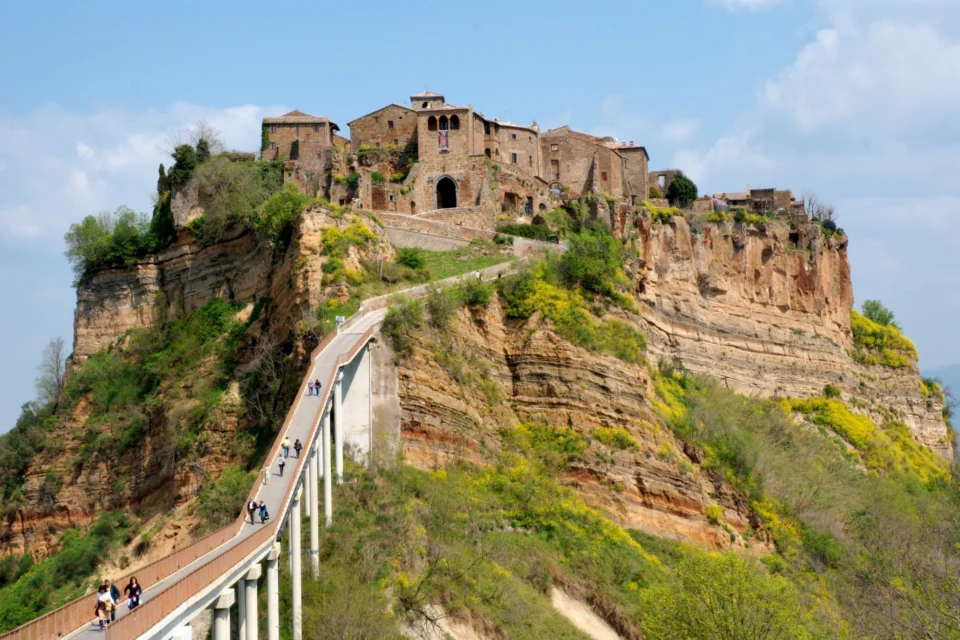
A lone tuff island above the eroding badlands of the Valle dei Calanchi, Civita di Bagnoregio is reached only on foot, by a long footbridge from the valley below. Nicknamed “the dying city” for the landslides that have gnawed it for centuries, it is now one of Italy’s most photogenic and most visited hilltop villages.
Why visit
No other place in Lazio looks like Civita. The old town crowns a crumbling spur of volcanic tuff, cut off from the modern world by a valley of clay badlands and joined to it by a single pedestrian bridge — the approach alone is an experience worth the trip. More than 700,000 visitors a year cross it, drawn by Etruscan foundations, medieval lanes, the duomo of San Donato, and the drama of a settlement literally slipping away, its story explained superbly in the town’s geology museum. Come early or late in the day, sleep over if you can, and you will have the calanchi almost to yourself.
Character and history
Antiquity runs deep here: the plateau was occupied in Etruscan times, and its ancient names — Novempagi, Balneum Regium — gave way to the medieval Bagnorea. Between the sixth and ninth centuries the town was repeatedly taken by Ostrogoths and Lombards, before passing to the Papal States under Louis I in 822. The city that survives on the spur is the older half: earthquakes and landslides progressively severed Civita from the lower town of Bagnoregio, and the Saint Bonaventure who was born here in the early thirteenth century became the patron of both. The Franciscan theologian who wrote the Legenda Maior on Saint Francis is remembered in a grotto, a house, a votive tempietto and the cathedral’s treasured relic. Centuries of collapses have claimed churches and quarters — a fragility that, paradoxically, preserves the town’s long war against geology as part of its fascination.
What to see
Entry is theatre in itself: through Porta Santa Maria, the gate guarded by stone lions holding a human head between their paws. The lane climbs to Piazza San Donato and the Church of San Donato, the duomo that served as cathedral until 1699, its interior keeping the town’s devotional heart. In the same piazza, the Renaissance Palazzo Alemanni-Mazzocchi houses the Geological and Landslides Museum, which explains the formation of the Valle dei Calanchi, the landslides that still move the slopes, and the monitoring and engineering works that keep Civita standing — essential context before or after the walk. Devotees of the patron saint follow the Grotto of Saint Bonaventure and the House of Saint Bonaventure, while the small Chapel of the Madonna del Carcere and the roofless Church of the Annunziata (former Sant’Agostino) trace the borgo’s quiet edges. The Belvedere of the Calanchi Valley off Piazza Alberto Ricci delivers the classic panorama across the badlands. In the lower town of Bagnoregio, the Cathedral of San Nicola (Bagnoregio) guards the Santo Braccio relic of the saint, the votive Tempietto of Saint Bonaventure (Bagnoregio) marks his birthplace, and the pyramid-shaped Garibaldi Memorial (La Piramide) and the motoring collection of the Taruffi Museum round out the comune’s sights.
How to experience
The essential move is timing: arrive at opening or stay to dusk. Day-trippers flood the bridge from mid-morning to late afternoon; early light and evening calm return the village to its few residents and cats. The walk from the Mercatello parking area up the footbridge takes about ten to fifteen minutes at a steady pace — steep at the Civita end, so bring water and good shoes. Buy the official Travel Card for entry and the geolocated audio guide, and fit the geology museum into your circuit; it makes the landscape legible. Then linger over lunch in a cave-like restaurant, then walk to the belvedere for the badlands panorama. The village empties wonderfully at night for overnight guests. Weekend crowds are heaviest in spring, autumn and August.
Practical planning
A half-day suffices for the village itself; add the lower town’s cathedral and museums for a fuller day, and consider two nights to experience Civita after the crowds leave. Access requires the paid entry ticket and the pedestrian bridge — no cars cross — so pack light and wear sturdy footwear; the climb is exposed in summer heat. Tickets, opening times and event calendars are published on the official portal civitadibagnoregio.cloud; the geology museum posts hours and closures on its cultura.gov.it page. Combine with the surrounding Tuscia: lake towns, Etruscan sites and Viterbo are all within an easy drive. In winter, check for fog and the occasional bridge closures after severe weather.
Nearby places
The lake country begins just west: Bolsena on its great volcanic lake, Montefiascone above it, Capodimonte on the southern shore and Marta at the outflow. The Etruscan strongholds of Tarquinia and Tuscania lie to the southwest, and the papal city of Viterbo anchors the province to the north.
Worth building a day around.
Belvedere della Valle dei Calanchi
Il portale ufficiale di Civita elenca il Belvedere tra i punti di vista privilegiati e la Valle dei calanchi tra i luoghi da visitare;…
Cappella della Madonna del Carcere
Il portale ufficiale di Civita elenca la Cappella Madonna del Carcere tra i luoghi da visitare nel borgo.
Casa di San Bonaventura
Il portale ufficiale di Civita elenca la Casa di San Bonaventura tra i luoghi da visitare nel borgo.
Cattedrale di San Nicola (Bagnoregio)
Il portale ufficiale di Civita elenca la Cattedrale tra i luoghi da visitare a Bagnoregio e ne documenta il 'Santo Braccio', reliquia di San…
Chiesa dell'Annunziata (ex Sant'Agostino)
Il portale ufficiale di Civita elenca la Chiesa dell'Annunziata (Chiesa di Sant'Agostino) tra i luoghi da visitare nel borgo.
Chiesa di San Donato
Il portale ufficiale di Civita (patrocinio del Comune di Bagnoregio) elenca la Chiesa di San Donato tra i luoghi da visitare a Civita e…
Grotta di San Bonaventura
Il portale ufficiale di Civita elenca la Grotta di San Bonaventura tra i luoghi da visitare nel borgo: luogo legato all'infanzia del santo patrono.
Monumento a San Bonaventura
Il portale ufficiale di Civita elenca il Monumento di San Bonaventura tra i monumenti da visitare a Bagnoregio.
Museo Geologico e delle Frane
Scheda ufficiale MiC (Luoghi della Cultura): aperto tutti i giorni 10:00-12:30 e 14:00-18:00 senza prenotazione, intero 5 euro (nota MiC: 3 euro museo, 5…
Museo Taruffi
Il portale ufficiale di Civita elenca il Museo Taruffi tra i luoghi da visitare a Bagnoregio: dedicato al pilota e costruttore bagnoregiano Piero Taruffi.
Porta Albana (Bagnoregio)
Il portale ufficiale di Civita elenca Porta Albana tra i monumenti da visitare a Bagnoregio.
Porta Santa Maria
Il portale ufficiale elenca Porta Santa Maria come ingresso del borgo, sorvegliata dai leoni con testa umana tra le zampe. Superata la porta si…
Sacrario Garibaldino (La Piramide)
Il portale ufficiale di Civita elenca il Sacrario Garibaldino, detto La Piramide, tra i monumenti da visitare a Bagnoregio.
Tempietto di San Bonaventura (Bagnoregio)
Il portale ufficiale di Civita elenca il Tempietto di San Bonaventura tra i luoghi da visitare a Bagnoregio.
Journeys in Civita di Bagnoregio.
Demo — Civita di Bagnoregio Private Highlights Tour
Let a local expert design your Civita di Bagnoregio day.
Tell us your dates and pace. A travel designer replies within one working day.