Campo Imperatore
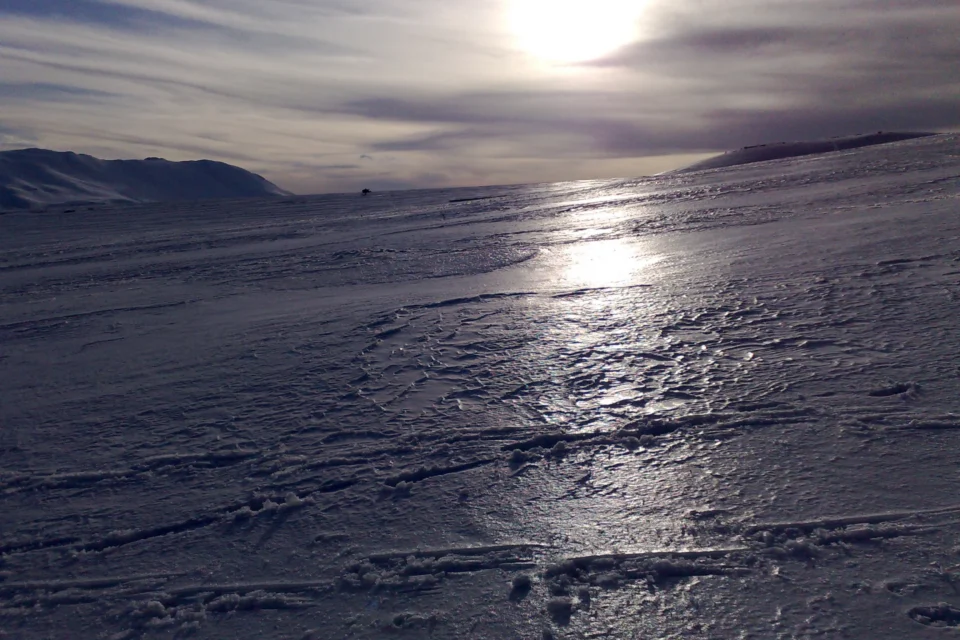
High on the Gran Sasso massif, Campo Imperatore is the largest plateau in the Apennines: a vast, treeless grassland ringed by rocky summits where sheep have grazed for thousands of years. It is the kind of place travellers remember by texture — wind, stone, wildflowers and silence — within easy reach of L’Aquila yet a world apart.
Why visit
Few landscapes in central Italy deliver this much drama for so little effort. The plateau stretches for roughly twenty kilometres at around 1,500 to 1,900 metres, wedged beneath Corno Grande, the highest peak of the Apennine chain, and its sister mountains of Prena, Camicia and Aquila. You drive up through beech woods and suddenly the land opens into an immense green sweep that locals have long nicknamed “Little Tibet”. It is a working pastoral landscape rather than a manicured viewpoint: flocks and semi-wild horses move across the grass, shepherds’ stone shelters dot the horizon, and the light changes by the minute. For hikers, cyclists, photographers and anyone who wants mountain air without Alpine logistics, it is one of the most rewarding day trips in Abruzzo — and the gateway to the Gran Sasso e Monti della Laga National Park.
Character and history
Campo Imperatore’s story is written in grass. The plateau formed tectonically and was then scoured by glaciers; until roughly 15,000 years ago it hosted the largest glacier of the Apennines, whose moraines still shape the terrain. Since antiquity the pastures have been summer grazing ground for flocks that wintered far away in Puglia, part of the great transhumance routes that structured the economy of medieval Abruzzo. Shepherds from villages such as Castel del Monte and Santo Stefano di Sessanio still move animals up in the warm months.
The twentieth century added less pastoral chapters. One of Italy’s earliest ski resorts took root here in the 1920s, and the landmark hotel beside the cable-car station became, in August 1943, the prison of Benito Mussolini after his fall from power — until German commandos freed him in the Gran Sasso raid of 12 September 1943. Science followed soon after: the observatory opened in 1965, and the plateau’s dark skies and high elevation made it a natural outpost for astronomy. Film crews discovered the scenery long ago, and the plateau has appeared in more than twenty productions, from “The Name of the Rose” to “The American”.
What to see
Two small institutions give the plateau unexpected depth. The Abruzzo Astronomical Observatory, near the hotel at about 2,200 metres, began as a station of the Rome Observatory and is now run by INAF’s Abruzzo observatory; its telescopes have long contributed to the survey of near-Earth asteroids, and the institute runs public evenings and outreach events — worth checking their programme before you come. Close by, the Campo Imperatore Alpine Botanical Garden ‘Vincenzo Rivera’ sits at 2,117 metres, the highest garden in the Apennines, founded in the early 1950s and tended by the University of L’Aquila. Its rock beds hold some 300 native mountain species, including the Apennine edelweiss, offering an intimate introduction to the flora you will meet on the surrounding slopes. The rest of the sightseeing here is the land itself: the gravelly riverbeds called fiumare below Monte Prena, glacial cirques under Monte Aquila, and long views toward the Calderone, Europe’s southernmost glacier, on the north face of Corno Grande.
How to experience
Come for a slow day. Drive the scenic road from Assergi or Castel del Monte, stopping at the viewpoints that reveal the plateau in layers, then continue to the western end for coffee or lunch on the terrace of the historic hotel. A cable car rises from Fonte Cerreto, above Assergi, to the hotel area — the easiest way up for those who prefer not to drive the mountain road, though services depend on weather and season, so verify operation in advance on the park’s official site, gransassolagapark.it. Walkers can strike out on gentle trackway rambles across the grass or link to serious ridgeline routes toward Corno Grande. Bring layers even in July: the climate is continental, and afternoon storms build fast. Cyclists prize the ascent roads, and in winter the plateau turns to cross-country skiing. Photographers should aim for early morning, when low light models the fiumare and the peaks burn pink.
Practical planning
The plateau lies about half an hour’s drive from L’Aquila and roughly two hours from Rome. There is no village on the plateau itself — refuges and the hotel provide food and limited lodging, while Assergi, Castel del Monte and Santo Stefano di Sessanio make excellent bases in restored medieval stone. Summer access is straightforward; in winter, check road and cable-car status before setting out, since snow and wind can close routes. The national park authority publishes trail, hut and cable-car updates on its official site. Sturdy shoes are enough for the plateau floor; proper mountain gear for the high ridges. Note that the plateau is protected parkland: keep to tracks and respect grazing animals.
Nearby places
The hill towns at the foot of the massif — Assergi with its Franciscan shrines, Castel del Monte, and the turreted Santo Stefano di Sessanio — pair beautifully with a plateau day, as do the fortress ruins of Rocca Calascio above them. Within the same province, Tagliacozzo lies to the south-west, a useful stop when travelling on toward the Sirente-Velino side of Abruzzo.
Worth building a day around.
Giardino Botanico Alpino di Campo Imperatore 'Vincenzo Rivera'
Reference source: managed structure of Universita degli Studi dell'Aquila, open 15 June-15 September daily, free admission, educational activities
Osservatorio Astronomico d'Abruzzo
Reference source documents the observatory at Campo Imperatore and public guided visits organised jointly with the alpine botanical garden ('Scienza in quota', summer openings);…
Journeys in Campo Imperatore.
Demo — Campo Imperatore Private Highlights Tour
Let a local expert design your Campo Imperatore day.
Tell us your dates and pace. A travel designer replies within one working day.