Camogli
Camogli packs the drama of the Ligurian coast into one painted seafront: tall houses in ochre and rose, a fortress on the rocks, a basilica above the waves, and a headland path to a cove where a medieval abbey seems to float. Once home to captains and shipwrights, this working town east of Portofino lives to the rhythm of boats.
Why visit
Camogli offers what neighbouring Portofino promises, in a more everyday key: a genuinely lived-in fishing town with extraordinary looks. The seafront is a single theatrical curve of tall painted houses — their bright facades traditionally renewed by the seafaring families so returning captains could recognise home from the water — stacked above a beach and a harbour of blue boats. Walkers get a coastline of real drama, from the stone steps to Punta Chiappa to the abbey cove of San Fruttuoso; swimmers get pebble coves and clean water; and eaters get one of the coast’s great seafood traditions, crowned by the famous fish festival that fills the port with frying pans each spring. It is an easy day trip from Genoa and a gentler base for exploring the Portofino peninsula.
Character and history
For centuries Camogli lived from the sea, and not modestly: for more than a hundred years its captains and crews sailed tall ships — pinque, brigantines, schooners — to the far ends of the world, a tradition the civic maritime museum keeps alive with exhibits linking the town to Garibaldi’s campaigns and even to the remote island of Tristan da Cunha, where Camogliese sailors settled. The town’s look reflects that confidence. Shipowners built the tall, close-set houses along the shore, painting them in strong colours with trompe-l’oeil windows, and the harbour filled with the yard’s boats. The basilica and fortress speak of wealth and watchfulness in equal measure. Today the town balances its working identity with tourism — beaches, hiking, festivals, and a cultural calendar that includes a September communication festival and the programming of its nineteenth-century Teatro Sociale — without ever quite becoming a museum of itself.
What to see
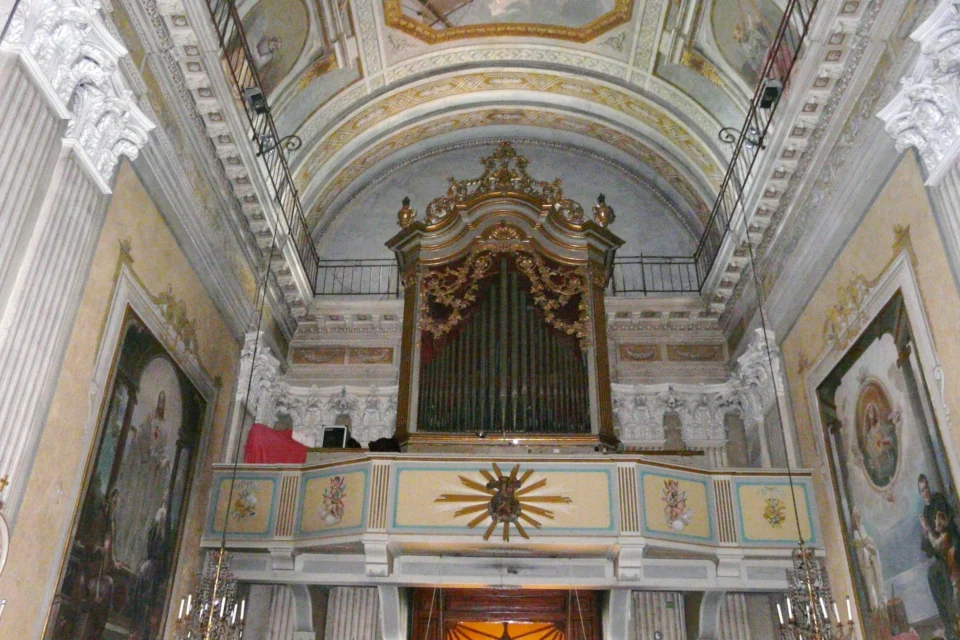
Start at the water. The Basilica of Santa Maria Assunta rises on the rocks above the sea at the heart of the old town, its baroque interior a cool contrast to the glittering waterfront below. Beside it on the promontory stands the Castle of the Dragonara, the maritime fortress that guarded the harbour for centuries. In the fortress precincts, the Gio Bono Ferrari Maritime Museum recounts the town’s ocean-going age — sailing ships, Garibaldi, Tristan da Cunha — with a hands-on virtual tour for visitors. Higher on the hillside, the Sanctuary of Our Lady of the Boschetto shelters beneath olive trees, its walls lined with sailors’ ex-voto paintings; the little Church of San Donato holds the oldest corner of the borgo; and in the Ruta hamlet above town, the Church of Santa Maria Assunta marks the older settlement on the ridge. In town, the Teatro Sociale — a nineteenth-century Italian-style playhouse and the town’s cultural anchor — is worth a look even between performances. But the essential outings are on foot or by boat: the climb to San Rocco and Punta Chiappa, where a church square looks down on the rocky point below the Portofino park, and the coast path or ferry to the Abbey of San Fruttuoso, the FAI-restored Benedictine complex in its cove, where the Doria family tombs sleep in white marble and the statue of the Christ of the Abyss rests in the bay outside.
How to experience
Walk, swim and eat — in that order each day. Take the path from the old town up through olive terraces to San Rocco in the morning, then down the long stone stairway to Punta Chiappa for a swim off the flat rocks; in summer a ferry can carry you back or onward to San Fruttuoso, whose cove rewards either the hike or the boat with a swim in view of the abbey. Back in town, lunch belongs to the harbor trattorie — anchovies, muscoli a la scapada, fried catch — and Camogli’s most famous tradition, the Sagra del Pesce, when volunteers fry fish in giant pans in the square and serve it to the whole town in honour of the fishermen’s patron saint, distills this identity into one unforgettable day. Beach clubs and free coves line the shore east of the centre; the municipality maintains accessible bathing services too. Browse the Tuesday market, catch a performance at the Teatro Sociale, or simply join the evening passeggiata under the painted facades with gelato in hand.
Practical planning
Camogli sits on the Golfo Paradiso about twenty kilometres east of Genoa, with frequent trains on the Genoa–Pisa coastal line stopping a few minutes’ walk above the seafront; drivers should use the signed car parks above the town, as the old streets are largely pedestrian. The town is built vertically — expect stairs — and the sea is pebbled rather than sandy, so water shoes help. Spring and autumn are wonderful for hiking the headland paths; summer brings bathing, boats and festivals, along with crowds at weekends. Ferry services connect the harbour with San Fruttuoso, San Fruttuoso’s abbey hours vary seasonally, and the maritime museum keeps its own schedule — check fondoambiente.it, museomarinaro.it and the municipal site before setting out, since arrangements can change with the weather and the season.
Nearby places
The Portofino coast begins at Camogli’s doorstep. Portofino and its peninsula trails lie just across the headland, with Santa Margherita Ligure as the lively middle town; Rapallo adds a castle-and-cable-car flavour further along the gulf, and Sestri Levante its two-bay promenade beyond. Eastward, Genoa makes an easy counterpoint of palazzi and port.
Worth building a day around.
Abbazia di San Fruttuoso
FAI official page (Bene FAI aperto al pubblico, Acquista il biglietto): donated to FAI in 1983, abbey with Doria tower and Tota Virginis tomb;…
Basilica di Santa Maria Assunta
Main church of Camogli, open for worship; identity and position cross-checked on Wikipedia/Wikidata and municipal documentation. Baroque basilica on the seafront promontory, reached by…
Castello della Dragonara
Medieval maritime castle (13th century) defending the borgo; identity and position documented in the historical literature and encyclopaedic sources; current interior visiting not published.…
Chiesa di San Donato
Medieval church in Piazza San Donato, open for worship; encyclopaedic documentation and parish context (diocese of Genoa, vicariato of Recco-Uscio-Camogli). In the heart of…
Chiesa di Santa Maria Assunta (Ruta)
Historic parish church of the Ruta frazione; encyclopaedic documentation and diocesan parish context. Hillside hamlet on the via Aurelia above Camogli.
Museo Marinaro Gio Bono Ferrari
Official museum website: opening Tue-Sat 9:50-12:15, Sun 9:50-12:10, closed Mon; free entry; guided visits for groups by reservation; 2026 news posts live. unknown
San Rocco e Punta Chiappa
Park authority page dedicated to San Rocco-Punta Chiappa (san Rocco church, 14th-century, and the flat rocks of Punta Chiappa); classic panoramic spot facing San…
Santuario di Nostra Signora del Boschetto
Referenced by the official Museo Marinaro site (ex-voto gallery curated with the museum); sanctuary open for worship. Hill sanctuary above Camogli; pedestrian access.
Teatro Sociale di Camogli
Municipal heritage page: inaugurated 30 September 1876, horseshoe plan with four tiers of boxes; cultural reference point with public-hours section. unknown
Journeys in Camogli.
Demo — Camogli Private Highlights Tour
Let a local expert design your Camogli day.
Tell us your dates and pace. A travel designer replies within one working day.