Cabras
On the shore of Sardinia’s largest lagoon, a few kilometres north of Oristano, Cabras is the gateway to the Sinis peninsula and keeper of one of archaeology’s great treasures. Stone giants rise from a Nuragic necropolis, Phoenician ruins face the open sea, mullet roe cures into prized bottarga, and a broad golden beach runs beside a sixteenth-century tower.
Why visit
Cabras works on every kind of traveller. Archaeologists come for the Mont’e Prama giants — a monumental statuary complex unique in the Mediterranean — and the ruins of Tharros; beach-goers for the strange quartz sands of Is Arutas; food lovers for lagoon bottarga, the so-called Sardinian caviar. The town itself stays workaday and welcoming, an excellent base from which the lagoon, the sea and the historic streets of nearby Oristano are all within easy reach.
Character and history
People have lived around the Cabras lagoon since the earliest times: the prehistoric village of Cuccuru is Arrius and the settlement of Sa Osa, occupied from the third millennium BC, anchor the local museum’s story. On the Sinis coast, Tharros grew from a Phoenician foundation of the eighth century BC into a major Punic and Roman city, later a early-medieval centre, its stones quarried for towers and churches across the centuries. The most sensational discovery came in 1974 at Mont’e Prama, where ploughing uncovered a necropolis of the tenth-to-eighth centuries BC and the fragmented stone warriors known as the Giants — the largest archaeological find in the late twentieth-century Mediterranean. Fishing shaped the town’s more recent identity: its fish ponds still supply the mullet whose roe, dried and pressed, is the region’s gastronomic signature, while the seaside hamlet of Torregrande grew from farms and nets beside its great coastal tower.
What to see
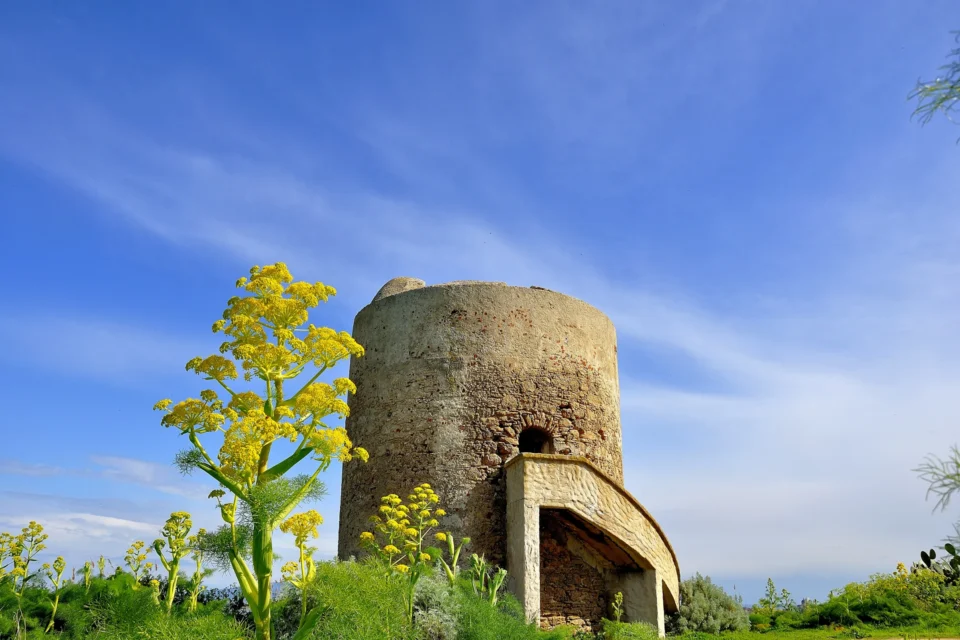
Begin at the sea: the Torregrande is the largest of the Spanish-era coastal towers in Sardinia, built between 1542 and 1572 above a long sandy beach and the marina at the tower’s feet. In nearby Oristano, the Walls and Tower of Mariano preserve the medieval defences of the Giudicato age — a tower of around 1290 raised in sandstone blocks taken from Tharros, standing in Piazza Roma. On the elegant Piazza Eleonora d’Arborea, the Palazzo degli Scolopi layers histories: a synagogue site, a Jesuit convent, the Scolopi schools, and today the town hall, with classical remodelling by the architect Antonio Cano and paintings celebrating Eleonora d’Arborea in its former church. Facing it, the Palazzo Corrias Carta, completed in 1874 to a design by Gaetano Cima, is reckoned the finest piece of nineteenth-century Sardinian civil architecture, its rounded corner reconciling the square’s lines. Back in Cabras, the civic museum Giovanni Marongiu displays the Mont’e Prama story alongside finds from Cuccuru is Arrius, Sa Osa, Tharros and a Roman wreck off Mal di Ventre.
How to experience
Split your time between lagoon and sea. Mornings suit the museum and the tower; afternoons belong to the Sinis beaches — Is Arutas, Maimoni and Mari Ermi, all formed of rounded quartz grains — or the quieter white sand at San Giovanni di Sinis beside the ruins. Boat and diving trips explore the marine protected area, where Roman wrecks lie offshore; cyclists and walkers follow flat lanes between the lagoon and the coast, with flamingos frequenting the shallows in season. Eat where the bottarga is made: grated over pasta, sliced with olive oil, or in the local spaghetti alla bottarga. The medieval hamlet of San Salvatore di Sinis, a cluster of low houses around a spring, doubled as a film set in the late 1960s and is worth the detour.
Practical planning
Cabras is about ten minutes by road from Oristano, which has the nearest rail station and the fullest services; a car is the practical way to reach the beaches and Tharros. Summer weekends fill the coastal car parks early, and the quartz sand can scorch bare feet — water shoes help. The town has pharmacies, banks and a good range of family restaurants; accommodation is simple and best booked ahead in July and August. Museum hours and site access change seasonally, so check the civic museum’s pages before visiting the Mont’e Prama displays.
Nearby places
Oristano — with the monuments listed above, its cathedral and the pageant of the Sartiglia — is the immediate urban companion, while the Sinis Peninsula holds the beaches, Tharros and the marine protected area within its bounds. Westward along the gulf, lagoon wetlands and fishing villages continue the same quiet rhythm. (Neighbours taken from the same-region candidate list, as the province field is blank in the canonical record.)
Worth building a day around.
Mura e torre di Mariano
Regione Sardegna - SardegnaTurismo (official regional tourism portal), in “Mura e torre di Mariano | SardegnaTurismo”, identifies Mura e torre di Mariano as a…
Palazzo Corrias Carta
Regione Sardegna - SardegnaTurismo (official regional tourism portal), in “Palazzo Corrias Carta | SardegnaTurismo”, identifies Palazzo Corrias Carta as a visitor-relevant attraction associated with…
Palazzo degli Scolopi
Regione Sardegna - SardegnaTurismo (official regional tourism portal), in “Palazzo degli Scolopi | SardegnaTurismo”, identifies Palazzo degli Scolopi as a visitor-relevant attraction associated with…
Torregrande
Regione Sardegna — SardegnaTurismo, in “Torregrande | SardegnaTurismo - Sito ufficiale del turismo della Regione Sardegna”, identifies Torregrande as a visitor-relevant attraction associated with…
Journeys in Cabras.
Demo — Cabras Private Highlights Tour
Let a local expert design your Cabras day.
Tell us your dates and pace. A travel designer replies within one working day.