Burano
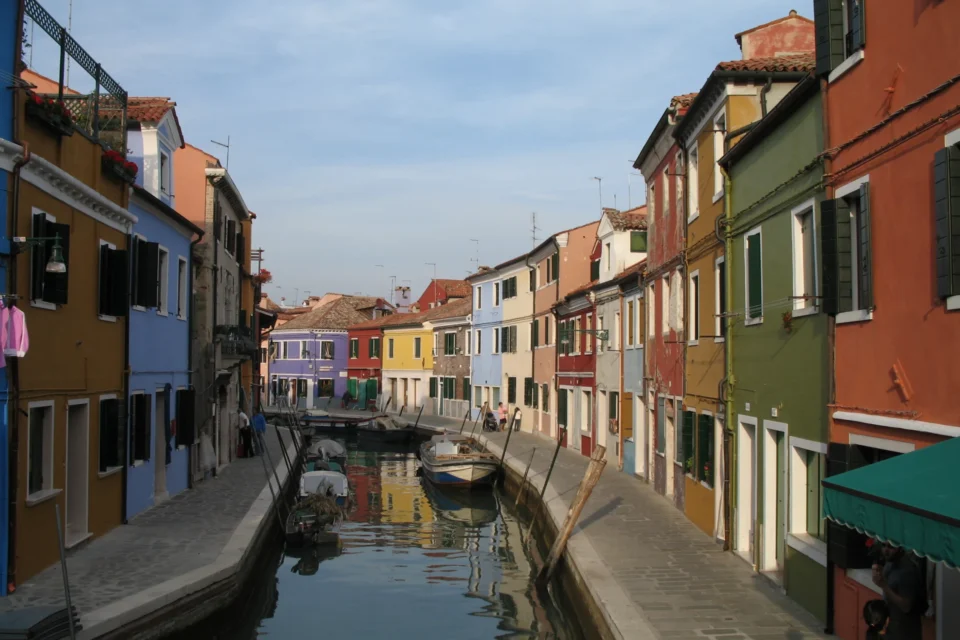
In the northern lagoon, Burano turns fishing-village practicality into pure spectacle: houses repainted in fierce blues and yellows so returning fishermen could find their doors, canals fringed with washing and boats, and a lace-making tradition that once dressed European courts. Small enough to cross on foot, it remains an inhabited island with a working heart.
Why visit
Burano compresses the lagoon’s pleasures into a couple of square kilometres. The colour alone justifies the crossing from Venice, but the island offers more than its painted facades: a museum that safeguards five centuries of needle lace, a parish church with a famously tilted bell tower, and quiet back lanes where laundry snaps overhead and nets are still mended. Photographers arrive for the light on the Rio Pontinello and the reflections of Piazza Galuppi, while lovers of craft come to watch merlettaie working at their pillows, a living link to the island’s golden age. Because Burano is also residential, timing matters; visit early or late in the day and the crowds recede, leaving the village to its residents, cats and bicycles. Combined with neighbouring Torcello and Mazzorbo, it forms the essential northern-lagoon day.
Character and history
Burano grew as a community of fishermen and sailors, its houses painted in saturated colours according to a system whose practical origin is the island’s favourite story: in the lagoon’s frequent fogs, each family’s hue marked their door. Its prosperity, however, rested on a finer thread. Lace of needle-worked perfection was collected in the sixteenth century under the name of punto in aria, and when the craft languished, the Senate-recognised Scuola dei Merletti was founded in 1872 by Countess Andriana Marcello to revive the tradition and train new lace-makers. The school’s pupils sustained the art into the twentieth century, producing work of astonishing intricacy, and the school’s archive of drawings and photographs remains the definitive record of Venetian lace. The island’s parish life has centred on San Martino, whose sixteenth-and-seventeenth-century church acquired a campanile whose lean has become the island’s second emblem after its colours. Burano’s lagoon setting lies within the UNESCO World Heritage Site of Venice and its Lagoon, inscribed for the extraordinary interweaving of human settlement and a fragile marine environment.
What to see
The essential stop is the Lace Museum, housed since 1981 in the old Scuola dei Merletti on Piazza Galuppi; more than a hundred masterpieces from the school’s collection hang beside examples of Venetian production from the sixteenth to the twentieth century, and lace-makers demonstrate techniques in the morning. A few steps away, the Church of San Martino Vescovo guards its famous leaning bell tower, visible down the lanes from surprising angles. Between the two, wander without agenda: the lanes off Via Baldassarre Galuppi, named for the composer born on the island, deliver the classic colour combinations, while the outer canals show the fishing boats and crab pots that explain the village economy. The civic library of the Comune di Venezia on the island, a modest reading room, signals that Burano is a neighbourhood of Venice rather than a stage set.
How to experience
Cross early by vaporetto from Fondamente Nove, ideally on a weekday, and walk the perimeter before the midday groups land. Watch the lace demonstration at the museum before browsing the island’s shops, distinguishing handmade merletto from machine imports by price and patience. Stop for a lunch of risotto di gò, the lagoon goby that is Burano’s signature dish, then continue by boat to Torcello’s basilica or Mazzorbo’s vineyard before returning for the evening light, when the colours deepen and the day-trippers have gone. Painters and photographers should allow a second visit at dawn, when the lanes are empty.
Practical planning
Regular vaporetto lines link Burano with Fondamente Nove in Venice and with Murano, Torcello and Punta Sabbioni; the crossing takes around forty minutes. The island is flat and small, needing no transport once landed, but services thin out in winter and many restaurants close on one or two weekdays, so check before setting out. The Lace Museum opens on the municipal museum schedule, with seasonal hours; verify current times and consider a museum pass if combining with Venice’s civic museums. Bring cash for small workshops, respect residents’ doorways when photographing, and pack windproof layers, as the northern lagoon is exposed in every season.
Nearby places
Murano with its glass furnaces lies on the same lagoon circuit, Torcello sits a two-minute ferry hop across the water, and Venice itself anchors every route; the wider Venice Lagoon and the Lido complete the northern circuit.
Worth building a day around.
Chiesa di San Martino Vescovo
Parish listed with address, phone and priest in the official parish directory of the Patriarcato di Venezia (institutional source); the church is the main…
Museo del Merletto
Official Fondazione Musei Civici di Venezia site (museomerletto.visitmuve.it) opened and read: museum opened 1981 in the spaces of the historic Scuola dei Merletti, with…
Journeys in Burano.
Demo — Burano Private Highlights Tour
Let a local expert design your Burano day.
Tell us your dates and pace. A travel designer replies within one working day.