Brisighella
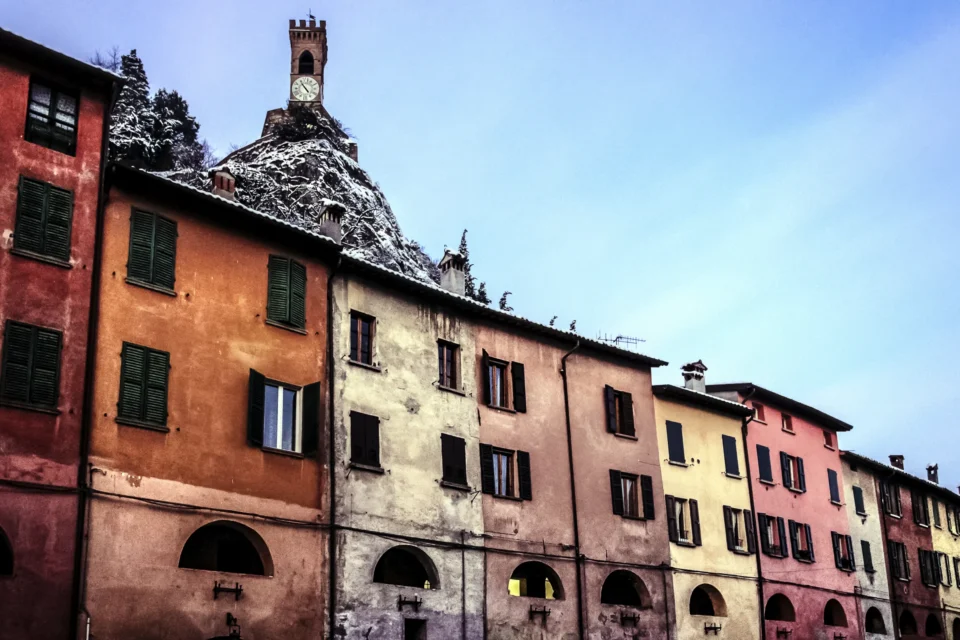
Three selenite pinnacles carry three monuments above a honey-coloured medieval borgo in the Lamone valley. Brisighella pairs the Romagna countryside’s best table — an olive oil so prized it carries Italy’s oldest DOP — with a gypsum-ridge landscape of caves and badlands, and a covered street where donkeys once sheltered while carters hauled stone down from the hills.
Why visit
Brisighella has the credentials — counted among I Borghi più belli d’Italia and holding the Touring Club’s Orange Flag — yet keeps the scale and rhythm of a working hill town. The setting is the drama: cliffs and caves of the Vena del Gesso Romagnola regional park rise directly behind the roofs, and the old centre clings to its outcrop halfway between Ravenna and Florence on the Faenza railway line. The sights compose a perfect half-day: a fortress on its rock, a clock tower on another, a sanctuary on the third, and the celebrated Via degli Asini threading between them, an elevated covered walkway unlike anything else in Romagna. Then there is the oil — extra-virgin, DOP-protected, the region’s crown jewel — pressed from groves you can walk through on a themed trail. Food festivals mark the calendar from spring sagre to September’s ancient Monticino fair and a November festival of olives.
Character and history
The village grew under the protection of the fortress attributed to the Manfredi lords of Faenza, and its street plan still obeys medieval logic: a single spine climbing towards the Rocca, houses stacked for defence, gateways marking the old toll points. The Via degli Asini began as a service gallery for gypsum carters; their pack animals rested in its arched loggia, giving the street the name visitors still use. Gypsum made the town’s fortune in another way — the bright selenite quarries of the ridge shaped both the landscape and the trade routes, and the quarrying legacy is now read through the geological museum on the Monticino hill. Faith marked the third summit, where the neoclassical Sanctuary of the Beata Vergine del Monticino watches over the valley. Beyond the borgo, the countryside kept older layers: the Romanesque Pieve di San Giovanni in Ottavo, built against a Roman road milestone, and a web of footpaths now promoted as cultural cammini, including routes traced to Dante. Today the town lives from oil, agriculture, small crafts and a growing reputation for slow, well-signed tourism.
What to see
Climb first to the Manfredi Fortress (Rocca Manfrediana) on its selenite crag; its courts and towers hold museum displays, and on summer Saturdays the “Rocca at sunset” openings show the walls at their most atmospheric. Descend into the old centre for the Via degli Asini (Via del Borgo), the covered elevated street whose arches once sheltered donkeys, now lined with small craft shops and artists’ corners. On the Monticino hill, the Sanctuary of the Beata Vergine del Monticino and the open-air Monticino Geological Museum (open-air), set behind the sanctuary in a former gypsum quarry, explain the ridge beneath your feet. In the lower town, the Collegiate Church of Saints Michael and John the Baptist fronts the main square, with the modest Church of San Francesco nearby. Drive or walk out to the Romanesque Pieve di San Giovanni in Ottavo (Pieve del Tho), solitary among fields. Nature completes the circuit: the Tanaccia Cave in the gypsum park offers guided visits in the warm months, and the Olive Oil Trail loops from town through the historic groves towards the pieve.
How to experience
Come hungry and make the oil the through-line of the stay. Taste the DOP oil at a frantoio (mill) during pressing season, when the new oil is grassy and peppering, and eat the local table — spoja lorda pasta in broth, Moretto artichoke, Mora Romagnola cured meats — in the trattorie under the arches. Time a visit to the sagre if you can: spring food festivals, the September Antica Sagra del Monticino, and the November Sagra dell’Ulivo e dell’Olio. Walk the three hills as the locals do, on the staircase carved through the gypsum that links Rocca, clock tower and sanctuary, with valley views from each summit. Hikers can join the Cammino di Dante or walk trail CAI 505 towards Faenza through the hills; spa seekers have long made the nearby thermal springs part of the itinerary. Photographers should aim for early morning mist in the Lamone valley or the golden hour from the Rocca.
Practical planning
Brisighella sits on the Faenza–Florence railway, about half an hour from Faenza and a scenic ride from either city; the station is a flat walk from the borgo gate. By road, it lies off the road linking Faenza with the Apennine passes, with parking lots at the edges of the old centre. The Pro Loco office on Via Naldi handles information in season, roughly mid-April to mid-October. Museum and fortress openings change with the calendar — the Rocca, for example, runs special sunset tours on Saturdays from May to October — so check brisighella.org and brisighellamusei.it before you go. Cave visits run in the warmer months only. Wear real shoes: every sight involves gypsum steps. May–June and September–October combine oil-country colour with mild walking weather.
Nearby places
Faenza, a UNESCO Creative City for ceramics, is the natural companion — reachable by train or on foot over the hills by marked trail. On the other side, the Adriatic edge of the province offers Cervia, its salt pans and seafront a different Romagna entirely.
Worth building a day around.
Chiesa di San Francesco
Comune di Brisighella 'Ulteriori edifici di culto' page (rendered unusable at fetch; identity from municipal listing).
Collegiata dei Ss. Michele e Giovanni Battista
Named by Touring Club reference page; official borgo site 'le chiese' page timed out (see BROKEN source).
Grotta Tanaccia
Official borgo site park pages and Around Faenza guide (guided excursions).
Museo Geologico del Monticino
Named by regional tourism portal and Around Faenza guide.
Pieve di San Giovanni in Ottavo (Pieve del Tho)
Dedicated page on official borgo site; regional and Touring confirmation.
Rocca Manfrediana
Official civic-museum site with tickets, hours contacts and guided tours.
Santuario della Beata Vergine del Monticino
Official tourism portal page stating exterior-only visit.
Sentiero dell'Olio
Regional tourism portal and Around Faenza guide.
Via degli Asini (Via del Borgo)
Dedicated page on the official borgo site and municipal portal.
Journeys in Brisighella.
Demo — Brisighella Private Highlights Tour
Let a local expert design your Brisighella day.
Tell us your dates and pace. A travel designer replies within one working day.