Baunei
Where the Supramonte mountains tumble into the southern Gulf of Orosei, Baunei commands one of the most dramatic meetings of rock and sea in the Mediterranean. A stone village on the slopes of Monte Santo, a high karst plateau, and roughly forty kilometres of limestone coast lined with fabled coves — all within one municipality, Sardinia at its steepest and wildest.
Why visit
Baunei offers what few places can: a genuine mountain village and a coastline of worldwide fame in a single territory. From the Golgo plateau you can walk down to a beach that was crowned the most beautiful in the world by an international ranking in 2025, or boat out to coves of blinding white pebbles that no road will ever reach. Hikers, climbers, sailors and slow travellers all find their version of the place — and the village itself, cool and quiet above the coast, remains refreshingly ordinary after the spectacle below. Unlike the resort towns further north, life here still follows the rhythm of the shepherd calendar, and that contrast is precisely the point.
Character and history
Tradition has it that Baunei was founded around 1015 by a goatherd fleeing an Arab raid, high on the limestone ridge where mountain and shepherd trails met. The village grew around the church of San Nicola di Bari and subsisted for centuries on pastoral life, chestnut woods and transhumance routes that linked the mountains to the shore. Its coastal territory — shared with the down-hill hamlet of Santa Maria Navarrese — preserves traces of far older presence, from Eneolithic finds in sea caves to Nuragic bronzetti that now rest in Cagliari’s archaeological museum. For generations the coves were known chiefly to fishermen and charcoal burners, accessible only by goat paths or by sea. The twentieth century brought climbers to the great sea stack of Pedra Longa and cavers to the deep sinkholes of the Golgo, quietly turning a remote pastoral community into one of the Mediterranean’s benchmark outdoor destinations.
What to see
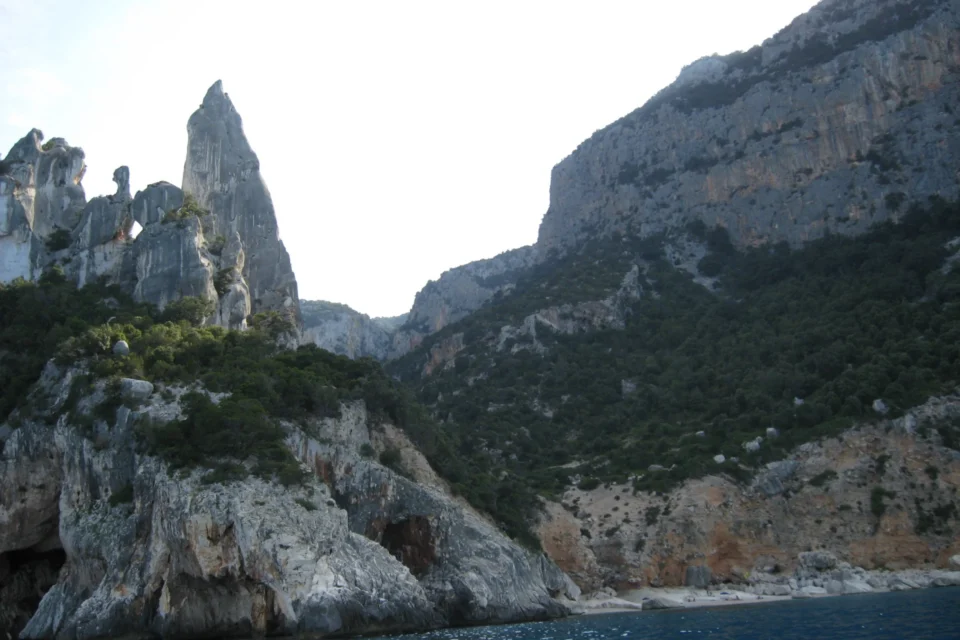
The coves are the headliners. Cala Goloritzè, a natural monument since the 1990s, is closed in by the 143-metre limestone spire of the Aguglia and guarded by strict access rules; Cala Mariolu charms with a beach of tiny white and pink pebbles, while neighbouring Cala dei Gabbiani sits beneath cliffs that ring with the cries of the gulls that give it its name. Inland on the coast, the Cave del Fico, reached by boat between Mariolu and Biriala, preserves stalactite chambers and the memory of the Mediterranean monk seal, whose last refuge these caverns were. Above it all, the Golgo plateau offers the vertiginous sinkhole of Su Sterru and views that sweep from the Gennargentu massif to the open sea.
How to experience
Choose between land and sea, or combine both. Walkers reach Goloritzé on foot from the Golgo plateau in roughly an hour and a half — booking is mandatory in the main season and visitor numbers are capped, so reserve ahead through the official Heart of Sardinia platform and expect an access contribution; check current rules on costadibaunei.it. Boat excursions from Santa Maria Navarrese and Arbatax call at the coves and the Fico cave, though boats must keep outside the buoy line at Goloritzé. For the full mountain-to-sea experience, hike the waymarked routes that descend the Supramonte, or tackle a section of the celebrated Selvaggio Blu with a guide. End the day back in the village with a plate of roast suckling pig or culurgiones.
Practical planning
Baunei is reached from the SS 125 Orientale Sarda; the coast road down to Santa Maria Navarrese is the departure point for most boat traffic. The winding route up to Golgo is scenic but narrow — take it slowly. Services in the village include shops, pharmacies and family-run hotels; the coves themselves have almost none, so carry water, shoes for pebble beaches and sun protection. Access rules to Goloritzé change with the seasons and are enforced on the trail, so confirm requirements shortly before your visit rather than relying on older advice. Spring and late September offer the best mix of calm seas and quiet trails.
Nearby places
The rest of the east coast extends the same landscape. Arbatax to the south is a handy port with the red porphyry rocks that give it its name, while the Gulf of Orosei stretches north towards Cala Gonone, whose sea caves complete the coastal circuit. Inland, the mountain landscapes of the Gennargentu offer the island’s highest ground. (Neighbours selected from the same region because the province field is blank in the canonical record.)
Worth building a day around.
Cala dei Gabbiani
Regione Sardegna - SardegnaTurismo (official regional tourism portal), in “Cala dei Gabbiani | SardegnaTurismo”, identifies Cala dei Gabbiani as a visitor-relevant attraction associated with…
Cala Goloritzè
Regione Sardegna — SardegnaTurismo, in “Cala Goloritzè | SardegnaTurismo - Sito ufficiale del turismo della Regione Sardegna”, identifies Cala Goloritzè as a visitor-relevant attraction…
Cala Mariolu
Regione Sardegna - SardegnaTurismo (official regional tourism portal), in “Cala Mariolu | SardegnaTurismo”, identifies Cala Mariolu as a visitor-relevant attraction associated with Baunei. Verified…
Grotta del Fico
Regione Sardegna — SardegnaTurismo, in “Grotta del Fico | SardegnaTurismo - Sito ufficiale del turismo della Regione Sardegna”, identifies Grotta del Fico as a…
Journeys in Baunei.
Demo — Baunei Private Highlights Tour
Let a local expert design your Baunei day.
Tell us your dates and pace. A travel designer replies within one working day.