Barga
Barga crowns a rocky spur of the Serchio valley with a Romanesque duomo open to the white wall of the Apuan Alps. A medieval walled town that sent thousands of emigrants to Scotland, it keeps a poet’s house museum, a summer jazz festival, and one of Tuscany’s most rewarding short climbs through gated lanes.
Why visit
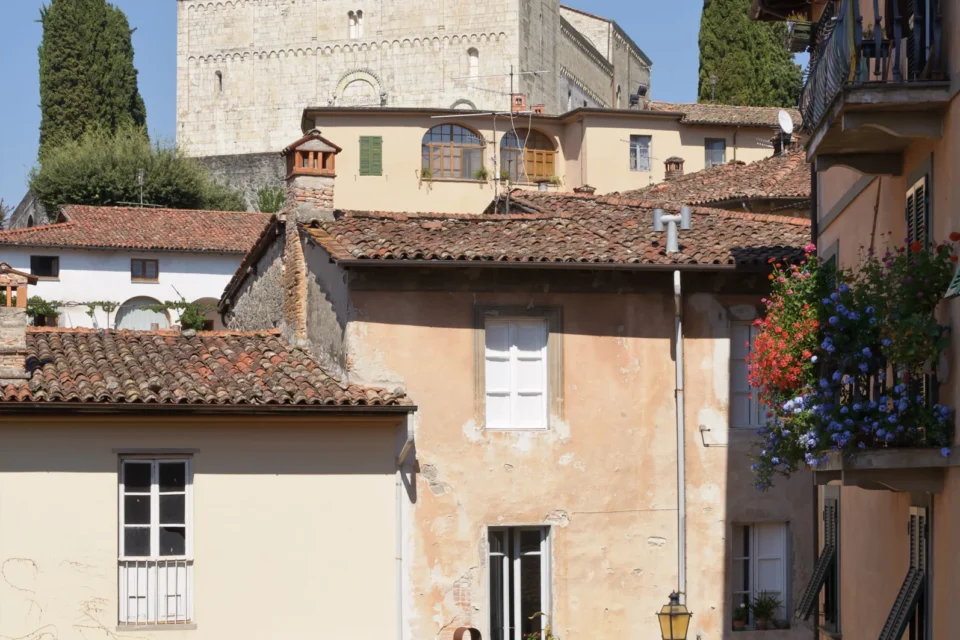
Barga has the shape of a stage set and the substance to back it. The town sits at 410 metres on a spur above the Serchio, between the Apennines and the Apuan Alps, its honey-coloured houses climbing through three medieval gates to a collegiate church that faces the mountains across an open terrace. It belongs to the Borghi più Belli d’Italia network and holds the Touring Club’s Orange Flag, yet its tone is less touristy than its neighbours on the coast: the schools, cafés, and workshops belong to a living town. The poet Giovanni Pascoli wrote his finest work a few kilometres away, the Garfagnana’s food culture starts here, and the views alone justify the climb.
Position makes it doubly useful. Barga stands at the threshold between Lucca’s low valley and the wilder Garfagnana above, so it works equally as a first stop into the mountains or a quiet base for coastal forays over the foothills. The surroundings read like a cross-section of northern Tuscany — chestnut woods, terraced plots, and the great limestone wall of the Apuan range — and the light changes with them through the day, which is why painters and photographers keep returning to the same terrace by the duomo.
Character and history
The municipality describes Barga as a walled medieval village entered through three gates — Porta Reale, Porta Macchiaia, and Porta di Borgo — grown around its castle district and its Romanesque collegiate church, dedicated to San Cristoforo. The church’s austere carving and the lion at its parapet watch over Piazza del Duomo at the town’s summit. Later centuries gave Barga an unusual second identity: waves of emigration to Scotland in the nineteenth and twentieth centuries were so extensive that the town became known for its Scottish connections, a bond still renewed each year by a festival celebrating it. The Conservatorio di Santa Elisabetta, founded as a fifteenth-century Clarisse monastery and converted in 1788 into a girls’ school by Grand Duke Pietro Leopoldo, keeps a Robbia-school altarpiece within.
Literature belongs to Castelvecchio Pascoli, four kilometres below: Giovanni Pascoli lived there from 1895 until his death in 1912, and the municipality notes the house and its landscape inspired his most famous collections, including Canti di Castelvecchio.
What to see
Climb through the gates to the Duomo di San Cristoforo, the Romanesque collegiate church on the summit terrace, then trace the castle quarter and its walls around the spur. The Palazzo Pretorio on the way up houses the Antonio Mordini Civic Territory Museum covering the Serchio valley’s past, while the Conservatory of Santa Elisabetta below preserves its Robbia-school altarpiece. Down in Castelvecchio, the Giovanni Pascoli House Museum preserves the poet’s rooms and study. The Romanesque pieve of Santa Maria a Loppia in the valley completes the early-medieval picture, and Barga is a stage on the Via Matildica del Volto Santo, the pilgrimage route running toward Lucca.
How to experience
Take the town on foot and let the weather decide: clear days belong to the duomo terrace and its alpine backdrop, grey days to the museum and a slow lunch. In summer the town spills outdoors — the Festa delle piazzette animates the little squares, and the Barga Jazz Festival has made the town a destination for musicians — while the Scottish festival renews the emigration bond each year. Walk a stretch of the Via Matildica from Barga toward Lucca’s cathedral, the route’s destination, or drive up the Serchio into the Garfagnana for farro-based cooking, the local IGP grain that anchors menus here. Opera lovers have long made the summer season a fixture.
Practical planning
Barga lies about forty minutes north of Lucca by car on the Serchio valley road, with a regional rail line along the valley serving the station below town. The historic centre is stepped and cobbled — pack real shoes and leave the car in the lots outside the gates. The Pascoli house museum and civic museum keep fixed weekly closing days and seasonal hours, so check before building a day around them. Spring and autumn give the clearest mountain views; summer brings festivals and warm evenings. Farro, porcini, and neccio chestnut flour define the tables.
Nearby places
The city walls and churches of Lucca anchor the valley to the south, the artists’ town of Pietrasanta and the beaches of Forte dei Marmi and Viareggio lie over the Apuan foothills toward the coast.
Worth building a day around.
Casa Museo di Giovanni Pascoli
Visit Tuscany destination page: the house where the poet lived with his sisters, 4 km from Barga in Castelvecchio Pascoli (frazione of Barga), celebrated…
Castello di Barga e borgo murato
Visit Tuscany destination page: castle on a rocky spur; the medieval borgo is ringed by 16th-century walls entered through three gates (Porta Reale, Porta…
Conservatorio di Santa Elisabetta
Visit Tuscany destination page: 15th-century Clarisse monastery founded by the Beato Michele Turignoli, transformed in 1788 by Pietro Leopoldo into a female conservatory; three…
Duomo di San Cristoforo
Visit Tuscany destination page: the Duomo di San Cristoforo is reached via via del Pretorio beyond Piazza Ser Barghesano, overlooking the old-town rooftops with…
Museo Civico del Territorio Antonio Mordini
Visit Tuscany destination page lists the Museo Civico del Territorio Antonio Mordini among Barga attractions.
Pieve di Santa Maria a Loppia
Visit Tuscany destination page lists the Pieve di Santa Maria a Loppia among Barga area attractions (frazione Loppia).
Via Matildica del Volto Santo (tappa Barga)
Visit Tuscany destination page: the Via Matildica del Volto Santo, 105 km from Mantua to the Duomo di San Martino in Lucca, passes through…
Journeys in Barga.
Demo — Barga Private Highlights Tour
Let a local expert design your Barga day.
Tell us your dates and pace. A travel designer replies within one working day.