Bard
Bard clings to a rocky spur where the Dora Baltea forces through the narrowest gorge of the Aosta Valley, watched over by one of Europe’s most dramatically sited fortresses. A restored nineteenth-century stronghold, a medieval village of stone lanes, and museums on Alpine life and mountain frontiers make this small town an essential stop on the valley’s castle route.
Why visit
Bard compresses two attractions of European caliber into a single village. The fortress above is a masterpiece of nineteenth-century military engineering, rebuilt after Napoleon ordered its medieval predecessor razed, and reborn in 2006 as a cultural center whose museums treat the Alps — their geology, wildlife, climate and human adaptation — with genuine sophistication. Below, the old village is a warren of restored stone houses, arcades and squares, counted among Italy’s most beautiful borghi. The setting completes the appeal: the fort commands the gorge that every army, pilgrim and traveler crossing the Great St Bernard once had to negotiate, and the views along the valley in both directions are superb. Interactive galleries and a dedicated children’s museum make it unusually family-friendly for a monument of this scale, and the frequent program of temporary exhibitions gives even repeat visitors something new inside the ramparts.
Character and history
A fortified site has crowned the Bard promontory since at least the eleventh century, and its lords’ stronghold passed to the House of Savoy in 1242 after their expulsion. The fortress entered legend in May 1800, when a small Austro-Piedmontese garrison blocked Napoleon’s Reserve Army descending from the Great St Bernard toward the Po plain; returning victorious from Marengo, the First Consul dubbed it the “vilain castel de Bard” and had it razed to the ground. The Savoy state answered between 1830 and 1838 with the fortress seen today, designed by military engineer Francesco Antonio Olivero under Carlo Felice and completed in the reign of Carlo Alberto — a barbed cluster of separate opera buildings stepped from 400 to 467 meters, mounting over four hundred pieces, yet never again tested in battle. Decommissioned and neglected in the twentieth century, the complex was acquired by the autonomous region and restored as its flagship cultural venue, reopened in 2006 with the Museum of the Alps at its core.
What to see
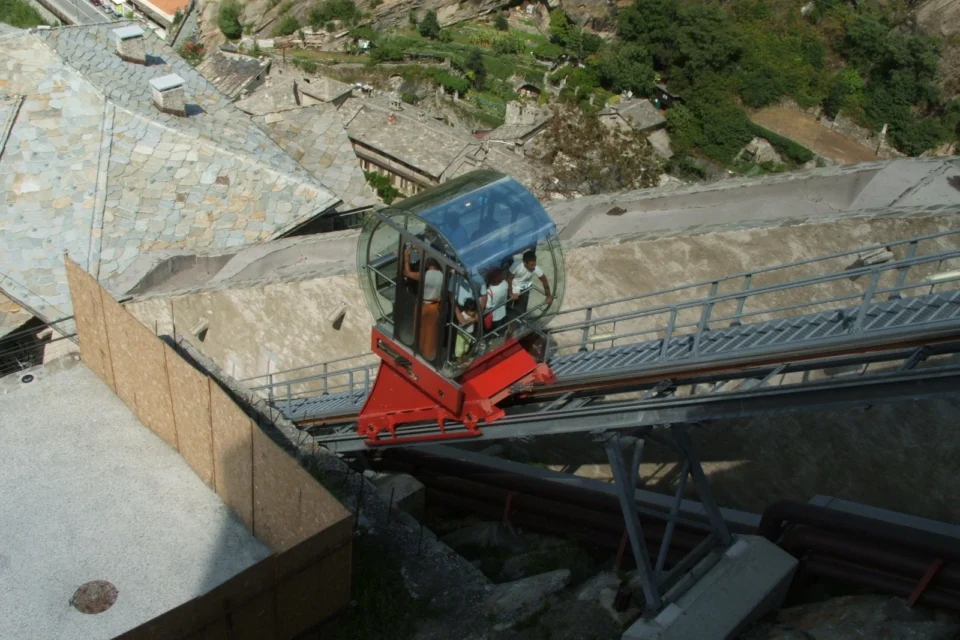
The Fort Bard complex divides naturally into its opera buildings. In the tallest, Opera Carlo Alberto, the Museum of the Alps unfolds across multimedia galleries on Alpine territory, nature and climate, while the same building preserves the The Prisons of Fort Bard — a row of isolation cells whose exhibit recalls notable detainees, including Cavour. At the fort’s base, Opera Ferdinando houses the Il Ferdinando. Museum of Fortifications and Frontiers, exploring mountain defense and the very idea of a frontier, and the middle level hosts Le Alpi dei Ragazzi (The Alps for Kids), a hands-on space for young visitors. Back down in the village, the Historic Village of Bard repays a slow loop of lanes, arcades and small squares, and the Parish Church of Santa Maria Assunta with its Romanesque bell tower stands on the pretty Piazza Cavour. A panoramic funicular lifts visitors from the village to the fortress gates — a short ride with long views.
How to experience
Devote a full day. Enter the village first, coffee in the square, then take the funicular up and work downhill through the museums — the Alps galleries in the morning, the fortifications museum after lunch, the prisons on the way down. Check the temporary-exhibition calendar before arriving: the fort’s halls host rotating shows that can double the visit’s value. Families should bank on the children’s museum as the anchor and plan rampart walks around it. The Napoleonica reenactment each season revives the 1800 siege with uniforms and cannon smoke — dates vary, so look ahead. Between fortress sessions, walk the gorge-side lanes and cross to the viewpoints facing the rock; the fort’s silhouette is most photogenic from the valley road in late afternoon. A bottle of local wine from the vineyards around the gorge makes the fitting souvenir of a fortress that guarded, and now celebrates, this Alpine frontier.
Practical planning
Bard sits on the SS26 along the Dora Baltea, south of Aosta, with the A5 motorway exit at Verrès or Pont-Saint-Martin nearby; trains and buses stop at Hone-Bard across the river, a short walk from the village. Car parks serve both village and fort, and the funicular carries visitors who prefer not to climb the fort road. The fortress opens on seasonal schedules with weekly closure days, and museum access is by ticket with concessions — verify current hours and exhibition dates on the operator’s site before traveling. Allow at least three hours inside the fort, more with children or exhibitions. Surfaces are cobbled and steep in the village; comfortable shoes are essential. Spring through autumn offers the fullest program, while winter visits pair well with nearby ski resorts — check the funicular’s operation in the coldest weeks.
Nearby places
The castle country spreads in both directions: Verrès and Issogne upstream, Fénis toward Aosta, and Châtillon at the junction for the Matterhorn valley. Aosta itself, with its Roman monuments, lies half an hour north.
Worth building a day around.
Borgo di Bard
Pagina ufficiale del Forte di Bard dedicata al borgo; Comune di Bard e associazione I Borghi piu belli d'Italia (adesione febbraio 2025) confermano il…
Chiesa parrocchiale di Santa Maria Assunta
Pagina ufficiale del borgo (fortedibard.it) e scheda I Borghi piu belli d'Italia documentano la chiesa parrocchiale del XII secolo sulla piazza del municipio; orari…
Forte di Bard
Sito ufficiale con orari 2026, tariffe (intero 15 EUR, cumulativo All Forte 24 EUR), biglietterie alle partenze ascensori; aperto tutti i giorni in estate,…
Il Ferdinando. Museo delle Fortificazioni e delle Frontiere
Pagina museo ufficiale: tre sezioni (Museo del Forte e delle Fortificazioni; Le Alpi Fortificate 1871-1946; Le Alpi, una frontiera?); circa 2000 mq nell'Opera Ferdinando…
Le Alpi dei Ragazzi
Pagina museo ufficiale con orari dedicati 2026 e sei turni di visita guidata nei festivi; attività didattiche prenotabili Visite a turni guidati (10.30-16.30 nei…
Le Prigioni del Forte di Bard
Pagina ufficiale dedicata: itinerario storico permanente con filmati, documenti e ricostruzioni 3D nelle 24 celle dell'Opera Carlo Alberto 24 celle di dimensioni ridotte (ca.…
Museo delle Alpi
Pagina museo ufficiale con percorso espositivo di 25 sale in tre sezioni; incluso nel biglietto d'ingresso al Forte; visite guidate prenotabili (80 EUR ogni…
Journeys in Bard.
Demo — Bard Private Highlights Tour
Let a local expert design your Bard day.
Tell us your dates and pace. A travel designer replies within one working day.