Bagno Vignoni
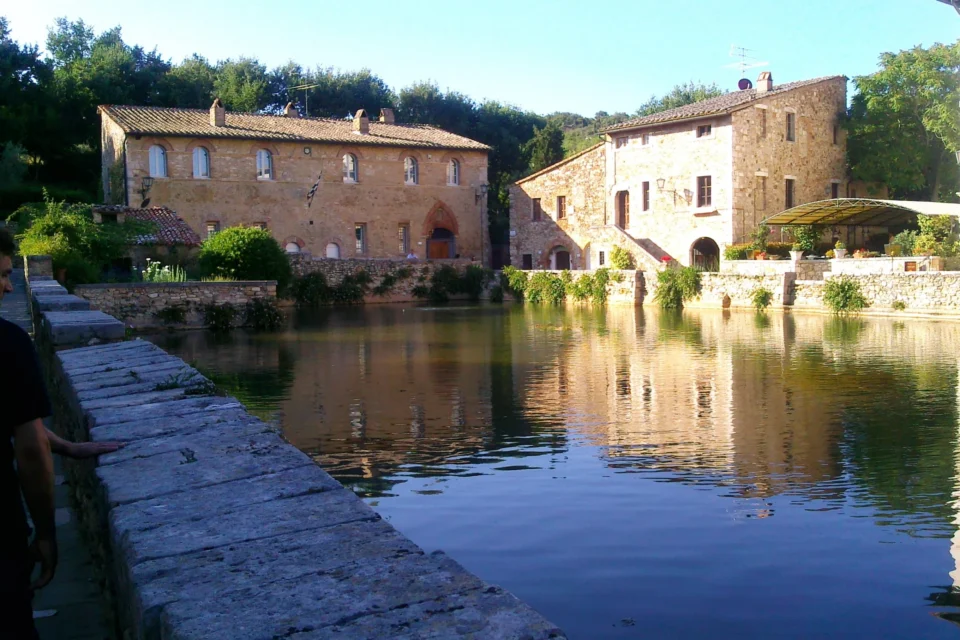
In the Val d’Orcia, Bagno Vignoni is a village with no piazza at all — its central square is a pool of steaming Renaissance thermal water. Pilgrims on the Via Francigena came here to bathe, Lorenzo the Magnificent and Saint Catherine came after them, and travellers still come for the same mineral warmth, set in a UNESCO-listed landscape.
Why visit
Bagno Vignoni takes a familiar Tuscan formula — stone houses around a square — and replaces the piazza with water. Piazza delle Sorgenti, the great rectangular basin at the village heart, has collected the hot spring’s flow since Roman times, and the steam rising over it at dawn is one of the Val d’Orcia’s defining images. The village sits inside the UNESCO World Heritage landscape of the Val d’Orcia, on the line of the medieval Via Francigena, and pairs its bathing tradition with quick access to Pienza, Montalcino, and San Quirico d’Orcia. For walkers, bathers, and anyone chasing the slow Tuscan evening, it compresses remarkably well.
It also plays to a specific strength: everything memorable here happens within a few hundred metres. The pool, the arcades, the Romanesque church, and the mills are one continuous circuit, which makes the village ideal for a two-night stop between heavier sightseeing days, or an unhurried finale to a Val d’Orcia drive. Travellers who need turnover and variety should look elsewhere; those who want a single, memorable place to settle into for a weekend of water and hills have found it.
Character and history
The thermal use of the site is ancient: the spring’s abundant, perpetual flow made the village a stop on the Via Francigena, the pilgrimage road linking northern Europe to Rome, where travellers paused to bathe before the Apennine crossings. The portal of the municipality of San Quirico d’Orcia, which administers the village, promotes the waters as central to the area’s identity of thermal baths, history, and wellness. Renaissance dignity followed: a loggia said to have hosted Saint Catherine of Siena stands beside the pool, and the humanist tradition records Lorenzo de’ Medici among the notable visitors drawn by the waters. Milling grew from the same source — the Parco dei Mulini below the village harnessed the hot water to grind grain for the passing traffic of pilgrims and merchants.
What to see
The village clusters tightly around Piazza delle Sorgenti, the steaming pool framed by arcades and stone facades, with the Loggia of Saint Catherine and the church of San Giovanni Battista — a Romanesque parish church standing directly beside the water — on its edges. Below the village, the Mills Park preserves four medieval mill structures carved into the travertine, including two entirely underground, and the gullies and basins that fed them; at its base, the thermal water re-emerges in shallow modern pools where bathers soak at no charge. Above the valley, the little Romanesque church of San Biagio at Vignoni marks the site of the abandoned castle village on its hill.
How to experience
Plan the day around water and landscape. Walk the Francigena stretch between Bagno Vignoni and San Quirico d’Orcia through the classic crescent of hills that photographers know from every Val d’Orcia postcard; the municipality advertises an extensive trail network across the territory for walking and cycling. Soak in the free pools of the Mills Park at the end of the day, when the steam thickens and the crowds thin — bring a towel and shoes that can get wet. Book access to the spa pools that face the historic basin for the full thermal tradition, since the square’s pool itself is for looking, not swimming. Finish with dinner in the square as the mists close over the water.
Film crews discovered the village long ago, and scenes of well-known Italian cinema were shot against the flooded piazza; the local portal keeps a running list of productions, and recognising a frame or two becomes part of the pleasure of an evening walk. Wine completes the picture: the cellars of Montalcino and Montepulciano lie either side of the valley, and tastings are easy to arrange from the village’s own wine bars.
Practical planning
The village lies on the SP146 between San Quirico d’Orcia and Castiglione d’Orcia, about forty minutes by car from Siena; parking sits at the entrances and the village is entirely pedestrian. A car is close to essential; buses run to San Quirico but are sparse. Accommodation is characteristically in converted historic buildings and spa hotels, priced at a premium in high season — shoulder seasons are ideal. Free public pools have rules of use posted on site and are periodically closed for cleaning or maintenance, so check conditions locally. Combine with Montalcino’s wine cellars twenty minutes away.
Nearby places
The Val d’Orcia constellation surrounds the village: San Quirico d’Orcia with its Horti Leonini gardens next door, the ideal town of Pienza, the Brunello capital of Montalcino, and the hilltop vaults of Montepulciano, all inside the UNESCO-valued valley itself.
Worth building a day around.
Chiesa di San Biagio a Vignoni
Listed in the CEI BeWeB census of church heritage ('chiesa sussidiaria'); the medieval gate and walls beside it are freely viewable from the public…
Chiesa di San Giovanni Battista
Official page of the municipal tourism portal Visit San Quirico d'Orcia documents the church, its interior works (18th-c. Sienese painting; Salimbeni fresco fragment) and…
Loggiato di Santa Caterina
Portico openly accessible from the public square; documented by the municipal tourism portal Visit San Quirico d'Orcia (chapel built 1660, linked to St Catherine…
Parco dei Mulini
Official Comune di San Quirico d'Orcia page documents the milling complex and its four mills; visitor arrangements published in a dedicated Comune page; guided…
Piazza delle Sorgenti
Central public square of the borgo, freely viewable at all times; described by the official regional tourism portal Visit Tuscany and by the municipal…
Journeys in Bagno Vignoni.
Demo — Bagno Vignoni Private Highlights Tour
Let a local expert design your Bagno Vignoni day.
Tell us your dates and pace. A travel designer replies within one working day.