Assisi
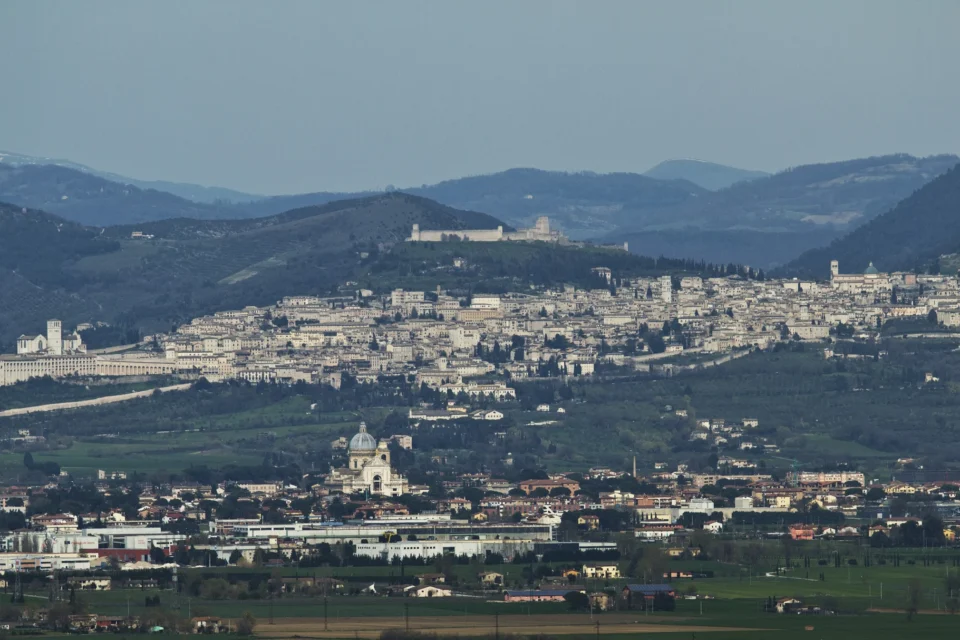
Assisi rises in pink stone on the slopes of Monte Subasio, a hilltown woven through with the life of Saint Francis. Between the double basilica that guards his tomb, Roman temples, medieval towers and hermitages in the holm-oak woods, it is one of Italy’s essential destinations — and, walked slowly, one of its most peaceful.
Why visit
Few towns anywhere carry so much weight in so little space. Assisi gave the world Francis of Assisi, and the Papal Basilica of Saint Francis — begun two years after the saint’s death in 1226, its Upper Church consecrated in 1253 — is both the pilgrimage centre of a global faith and one of the summits of Western painting, its walls covered in thirteenth- and fourteenth-century fresco cycles including Giotto’s Stories of Saint Francis alongside works associated with Cimabue. With the Treasure Museum and the Sacro Convento alongside, the complex belongs, with the town’s other Franciscan places, to the UNESCO World Heritage list.
Yet Assisi is far more than a single shrine. The Roman city of Asisium left the temple that became Santa Maria sopra Minerva, an amphitheatre still cradling houses along its elliptical arena, a Roman forum open beneath the medieval square, and painted Roman houses recalling the poet Propertius, a native son. Above the roofs stands the Rocca Maggiore, the fortress rebuilt by Cardinal Albornoz from 1356, commanding the whole Umbrian valley.
And there is the setting: the town glows rose because it is built of the pietra rosata quarried from Monte Subasio itself, the mountain that towers behind it, wrapped in olive terraces, woods and silence.
Character and history
People have lived this hill since the Neolithic; an Umbrian settlement grew here between the ninth and sixth centuries BC, and after Rome’s victory at the Battle of Sentino in 295 BC the city of Asisium became a Roman municipium in 89 BC. Sacked by Totila’s Goths in 545 and later contested between dukes, communes and neighbouring Perugia, it finally fell within the Papal States until Italian unification.
The event that rewrote its destiny was the birth of Francesco Bernardone around 1181–1182, son of a cloth merchant, whose radical embrace of poverty drew companions from across Europe and, after his death in 1226, a basilica of unmatched importance. The Franciscan story threads through the whole hill: the cathedral of San Rufino, where Francis and Clare were baptised; San Damiano below the walls, the ruined church he was told to rebuild, where he wrote his Canticle of the Creatures; the Eremo delle Carceri in the mountain woods where he withdrew to pray; and the great basilica of Santa Maria degli Angeli on the plain, enclosing the little Porziuncola chapel from which the Franciscan movement spread.
Medieval Assisi laid its own civic layer over the Roman one: Piazza del Comune with the Palazzo dei Priori, the Torre del Popolo of 1305, and the austere Abbey of San Pietro founded in the tenth century. Two centuries of visitors have not dulled the order beneath it all.
What to see
Start at the Papal Basilica: the dark, dense Lower Church, the luminous Upper Church with the fresco cycles, and the crypt where the saint’s remains rest — the tomb stays open late for prayer on Friday and Saturday nights. In the same complex, the Treasure Museum displays the Sacro Convento’s liturgical riches.
Work down through the town: Basilica of Saint Clare, which holds the saint’s tomb and the San Damiano crucifix that spoke to Francis; the civic medieval set of Piazza del Comune, the Santa Maria sopra Minerva temple and the Roman forum beneath; the cathedral of San Rufino with the Diocesan Museum and underground route; then the climb to the Rocca Maggiore.
Keep a half-day for the Franciscan places beyond the walls: San Damiano, the Rivotorto sanctuary protecting the hovel where the first brothers lived, Santa Maria degli Angeli and the Porziuncola below town, and the Monte Subasio Regional Park reaching up to the hermitage. For quiet of a different kind, the FAI-managed Bosco di San Francesco opens straight from the Upper Basilica’s piazza.
How to experience
Walk everywhere — the town is a vertical sequence of lanes and arches, and cars are largely irrelevant inside. Visit the Upper Church early or late in the day to see the frescoes with space to breathe, then take the covered lanes towards Saint Clare as the light warms the pink stone. In the late afternoon, climb to the Rocca for the valley-wide view, and descend through the Roman amphitheatre’s quiet ring of houses for dinner.
Reserve a full day for the Franciscan geography outside the walls: the path from the town down to San Damiano and, on the other side, the road up through the woods to the Carceri hermitage, where the caves of the saint’s prayer hollow the rock. Nature lovers can cross the Bosco di San Francesco’s sixty-four hectares of reclaimed woodland and olive terraces, where a land-art “Terzo Paradiso” of 121 olive trees by Michelangelo Pistoletto hides in the valley — a modern meditation on the saint’s bond with creation.
Practical planning
Assisi sits in central Umbria on the Rome–Foligno–Perugia rail line, with the station a few kilometres from the hilltop town connected by bus and shuttle; by road it lies just off the SS75 from Perugia and Foligno. Pilgrimage seasons bring serious crowds in spring, early autumn and around the October feast days, while winter shows the town at its quietest — modest dress is expected in the churches, and large bags are checked at the basilica. Opening arrangements at the Franciscan sites, museums and lifts follow their own calendars, so confirm times on the official basilica and museum sites before travelling. Comfortable shoes are non-negotiable: Assisi’s lanes are steep, stepped and cobbled. Staying overnight in the old town lets you hold the evening and early hours, when the day visitors are gone and the hill belongs to its bells.
Nearby places
- Spello — the flower-strewn Roman hill town along the flank of Subasio, twenty minutes away.
- Perugia — the regional capital of Etruscan and medieval splendour, up the valley.
- Spoleto — the city of bridges and festivals, south along the valley.
- Bevagna — a Roman and medieval gem on the plain of the Clitunno.
- Montefalco — the ring town above the Sagrantino vineyards.
- Lake Trasimeno — the great Umbrian lake for a day of water and islands.
Worth building a day around.
Abbazia di San Pietro
Described by the official regional tourism portal with its 13th-century rebuilding. unknown
Anfiteatro Romano
Described by the official regional tourism portal: remaining cavea walls visible in the medieval streetscape. unknown
Basilica di Santa Chiara
Described by the official regional tourism portal with its white and pink Subasio stone facade. unknown
Basilica di Santa Maria degli Angeli
Official site of the Franciscan custodians publishes hours (daily 7:30-12:30 and 14:30-19:00) and reservations for the basilica and museum. unknown
Basilica Papale di San Francesco
Official basilica site publishes hours (upper church 8:30-17:45, lower church 6:00-18:30, tomb 6:00-18:00), friar-led daily guided tours and online reservation. unknown
Bosco di San Francesco
Official FAI page describes the entrance gate in front of the Upper Basilica, FAI ticketing and the 64 ha property with the Monastero di…
Cattedrale di San Rufino
Described by the official regional tourism portal with its Romanesque facade and baptismal font. unknown
Chiesa e Convento di San Damiano
Listed by the official regional tourism portal as the 8th-9th century church restored by St Francis. unknown
Domus del Lararium
Described by the official regional tourism portal with peristyle and thirteen decorated rooms. unknown
Domus di Properzio
Described by the official regional tourism portal; verses found on site suggest the poet Propertius's family house. unknown
Eremo delle Carceri
Described by the official regional tourism portal as the hermitage c. 4 km from Assisi with the Grotta di San Francesco. unknown
Foro Romano e Cripta di San Nicolò
The official regional tourism portal describes the forum with paving, temple podium, cistern and tabernae reached via the crypt of San Nicolò. unknown
Museo del Tesoro della Basilica di San Francesco
The official basilica site presents the Museo del Tesoro with its liturgical and artistic collections originating from the 13th century. unknown
Museo della Porziuncola
Official site publishes museum hours (9:00-13:00 / 14:30-17:00, closed Wednesday) and online reservation. unknown
Museo Diocesano e Sotterranei di San Rufino
Official museum site publishes hours (Mon-Fri 10-13/15-18, Sat 10-18, Sun 11-18), booking channel and the underground exhibition route. unknown
Palazzo dei Priori
Described by the official regional tourism portal with its construction and 1442 damage and restoration. unknown
Palazzo del Capitano del Popolo
Described by the official regional tourism portal as built in 1275. unknown
Parco Regionale del Monte Subasio
The official regional tourism portal lists the park with its five Sites of Community Importance. unknown
Piazza del Comune
Civic heart of Assisi framed by Palazzo dei Priori, Palazzo del Capitano del Popolo, Torre del Popolo and the Temple of Minerva per the…
Porziuncola
The Porziuncola chapel is the spiritual centre presented by the official custodian site. unknown
Rocca Maggiore
Described by the official regional tourism portal: first recorded 1173-74, destroyed 1198, rebuilt by Cardinal Albornoz in 1356. unknown
Santa Maria sopra Minerva (Tempio di Minerva)
The official regional tourism portal describes the Corinthian temple of c. 30 BC later remodeled as the baroque church of Santa Maria sopra Minerva.…
Santuario di Santa Maria di Rivotorto
Described by the official regional tourism portal as protecting the Tugurio, rebuilt after the 1854 earthquake. unknown
Torre del Popolo
Described by the official regional tourism portal as the 47 m tower completed in 1305. unknown
Journeys in Assisi.
Demo — Assisi Private Highlights Tour
Let a local expert design your Assisi day.
Tell us your dates and pace. A travel designer replies within one working day.