Asinara
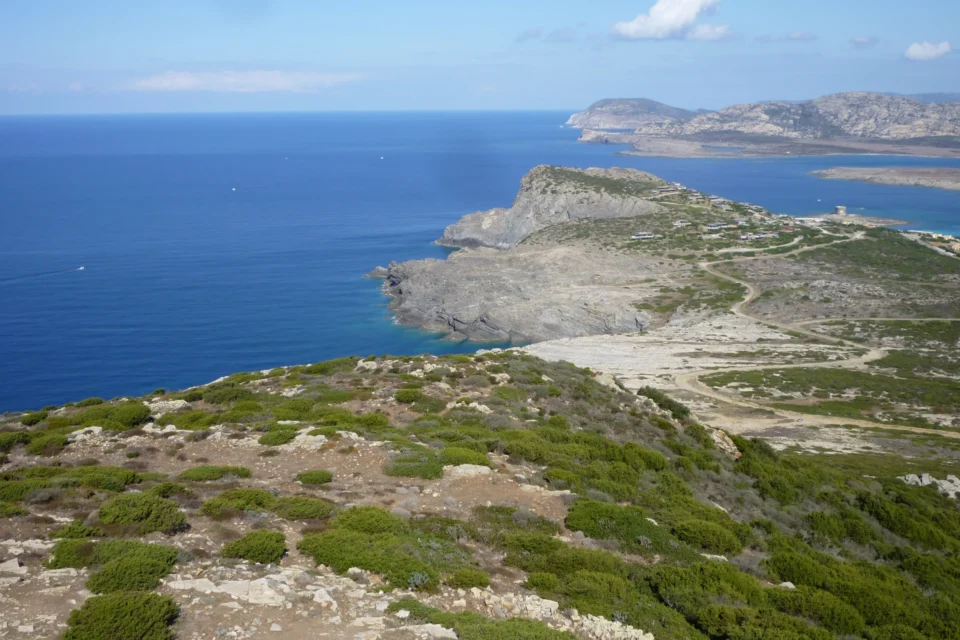
At Sardinia’s north-western tip, this fifty-square-kilometre island spent more than a century as a place people were sent rather than chose. Quarantine station, penal colony, maximum-security prison — its very isolation preserved an interior of macchia, granite and white-sand coves that now forms one of the Mediterranean’s most moving national parks.
Why visit
Asinara condenses two journeys into one day trip: a voyage into an extraordinary natural refuge and a voyage into Italy’s recent past. Decades in which ordinary access was forbidden allowed wildlife to flourish undisturbed, and today mouflon, peregrine falcons and the island’s celebrated white donkeys wander tracks where prison convoys once rolled. Few places in Europe let you swim in water this clear in the morning and stand before a haunting stone ossuary after lunch. Photographers come for the contrast between turquoise coves and austere prison architecture; walkers come for the sense that every path carries a story. Children, meanwhile, tend to remember one thing above all: the albino donkeys that approach the roadside without a flicker of fear.
Character and history
Sardinia’s second-largest island has been inhabited since Neolithic times, but its modern fate was sealed in 1885, when the Italian government expropriated the island to build a lazaretto and an agricultural penal colony. The small farming community was forced to leave; many families resettled on the coast, where they founded the village of Stintino. From 1915 the island held thousands of Austro-Hungarian prisoners of war, many of whom died and were buried at the Campu Perdu ossuary built two decades later. In the 1970s the prison became a high-security facility that held mafia bosses and Red Brigade militants; judges Giovanni Falcone and Paolo Borsellino were briefly held here in 1985. After the prison closed, the Parco Nazionale dell’Asinara was established in 1997, followed by a marine protected area, both managed by the park authority.
What to see
Arriving by boat, most visitors begin at Cala Reale, a late nineteenth-century hamlet of whitewashed buildings where the House of Savoy once moored and which later served as a quarantine lazaretto; today it houses park services. Further along the sheltered east coast lies Cala d’Oliva, the former prison-staff village of low white houses and stone-paved lanes, now the island’s main visitor hub with a botanical observatory and memory trail. Beyond these two centres, the park’s waymarked routes thread past a domus de janas rock-cut tomb, abandoned penal-colony buildings and viewpoints over the untouched western cliffs — note that the coves of Cala Sant’Andrea and Cala d’Arena are strictly protected no-entry zones.
How to experience
Come by one of the ferries that run in season from Stintino and Porto Torres, and plan a full day. First-time visitors do well with the park’s small train, jeep tours or shuttle bus; confident cyclists can rent mountain bikes or e-bikes on the island and follow the old service roads at their own pace. Swim from the eastern beaches, walk the themed trails that start near Fornelli, and save time for the memory route that explains the prison years. Guided visits led by park staff add context you would otherwise miss, particularly around the high-security compound. Spring, when the island’s hundreds of flowering species are at their best and the light is soft, is widely considered the finest season; summer days are hot and shade is scarce, so set out early. Check timings and sailings on the park’s site, parcoasinara.org, before you travel.
Practical planning
The island has no hotels in the conventional sense and very limited services, so carry water, food, sun protection and sturdy shoes; there is nowhere to buy supplies once the boat lands. Access to the national park itself is free, but boat tickets, island transport and guided tours are paid separately and schedules vary by season. Overnight options are deliberately scarce, so most travellers base themselves in Stintino, Porto Torres or Alghero and cross over in the morning, returning on an afternoon sailing. Drones, free-roaming dogs and collecting anything natural are prohibited under park rules, and the strictest coves are closed to landing altogether. Seas can be choppy on windy days, so if you are prone to motion sickness take precautions before boarding.
Nearby places
Though the island sits apart, its gateway towns make easy companions. Porto Torres combines Roman remains with the port from which many boats depart; Stintino pairs the famous sand of La Pelosa with a fishing-village centre built by Asinara’s exiled families; Sassari, the island’s second city, lies inland with Gothic churches and lively cafés; and Alghero adds a Catalan-old-town evening to any north-west itinerary. (Neighbours chosen from the same region, as the province field was blank in the canonical record.)
Worth building a day around.
Cala d'Oliva
SardegnaTurismo identifies Cala d'Oliva as one settlement and harbour on Asinara and describes arrival by authorized boats from Stintino and Porto Torres. The Asinara…
Cala Reale
SardegnaTurismo identifies Cala Reale as a harbour and settlement on Asinara and describes arrivals from Porto Torres and Stintino. The Asinara Park authority identifies…
Journeys in Asinara.
Demo — Asinara Private Highlights Tour
Let a local expert design your Asinara day.
Tell us your dates and pace. A travel designer replies within one working day.