Apricale
High on a sunlit spur above the Nervia valley, Apricale stacks its dark stone houses against a castle-crowned rock and calls itself, with some justice, a village where the Middle Ages and contemporary art share the same alleys. Murals bloom on thirteenth-century walls, a bicycle flies from the bell tower, and Taggiasca olive oil scents everything.
Why visit
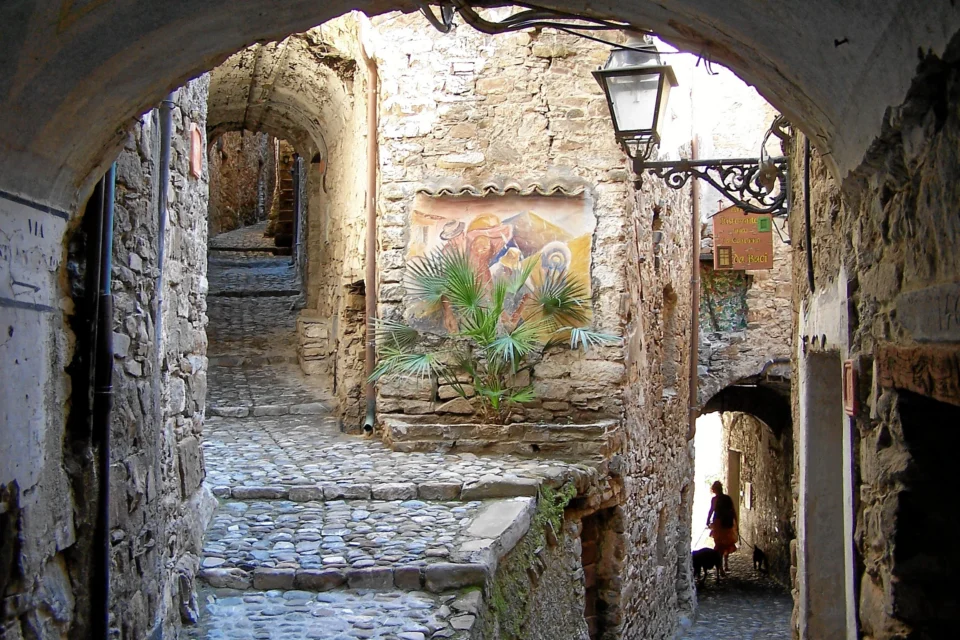
Apricale rewards travellers who slow down. This is a village for wandering: three medieval gates, steep caruggi worn smooth by centuries of feet, and a central square where the church and castle face each other like old neighbours. Photographers come for the texture of stacked stone and the sudden framings of the valley; art lovers come for the murals and the castle’s exhibition programme; food travellers come for one of Liguria’s great olive-oil traditions, honoured with the Città dell’Olio label. Because the village sits inland from the Riviera crowds, it makes a serene half-day or overnight contrast with the coast, and its handful of trattorie and rooms let you experience a borgo after the day visitors leave.
Character and history
The name comes from the Latin apricus — sunny — and the village lives up to it, terraced among olive woods below the Maritime Alps. A Celtic-Ligurian settlement existed here by the late Bronze Age; the castle on the rocky outcrop was founded around the year 1000 by the Counts of Ventimiglia, and around 1270 the village passed into the Doria fiefdom of nearby Dolceacqua, under whose rule it remained for some five centuries. The steep lanes and dark stone houses preserve a thirteenth-century atmosphere, and Apricale’s rural Statutes of 1267 — a blend of Roman and Germanic law — count among the oldest of their kind in Liguria. In recent decades the village has cultivated a second identity as a place of artists: murals have appeared along the alley walls, sculptural jokes punctuate the rooftops, and the restored castle now runs exhibitions in collaboration with the Fondazione Maeght of Saint-Paul-de-Vence, giving the borgo a cultural pulse far larger than its few hundred residents.
What to see
The Castello della Lucertola — the Lizard Castle, named for the emblem of the region’s ancient Celtic-Ligurian inhabitants — rises over the village at the head of the square. Restored and opened to culture, it holds the medieval Statutes, a Risorgimento room and a hanging garden, with exhibitions through the year. Across the way, the Church of the Purification of the Virgin Mary has stood on this spot since the thirteenth century; later baroque remodelling, a 1935 neo-Romanesque facade, portals by Giovanni Viale and a mosaic rose window telling the Presentation at the Temple reward a slow look, and its bell tower rises from the castle’s old square tower — crowned by the sky-pointing bicycle of Sergio Bianco’s 2000 installation, “La forza della non gravità”. Wandering between them, pass through the medieval arched gates that still guard the caruggi and look for the village’s murals along the way. Don’t miss the playful Monument to the Book, a steel sculpture by Enzo Pazzagli and Claudio Nobbio that sums up the village’s art-meets-history spirit.
How to experience
Take the village on foot and without a schedule. Enter through the gates, climb to the castle for the valley view, then settle on the little square for coffee or a glass of Rossese. Eat the way the valley eats: stuffed vegetable antipasti, ravioli, rabbit braised in Rossese wine, and the pansarola — a sweet fried fritter celebrated every September at the village’s long-running sagra, paired traditionally with zabaglione. The surrounding olive terraces are the point of much of the landscape, and tastings of the local Taggiasca extra-virgin oil are easy to arrange. Time a visit for the patronal feast on 8 September, for August’s itinerant theatre, or for the Valentine’s gastronomic-musical itinerary in February if you want to see the borgo in festive mode; otherwise any quiet weekday delivers the village at its most atmospheric, with light sliding across the stone.
Practical planning
Apricale lies in the Province of Imperia, about a twenty-minute drive north of the coast at Ventimiglia or Bordighera up the Nervia valley roads. There is no railway; arrive by car, parking below the village and walking up — the lanes are stepped and steep, so pack accordingly, and note that luggage on wheels and Apricale’s cobbles negotiate poorly. Days trips pair naturally with the coast and with neighbouring villages. A small tourist tax applies to overnight stays, contributing to the village’s upkeep. Opening times for the castle and its exhibitions vary with the season and programme, so check the municipal site (comune.apricale.im.it) or the Borghi più belli d’Italia page before travelling; the church is open to the public with mass times posted locally.
Nearby places
The Nervia valley and the nearby Riviera give plenty of range. Dolceacqua, the Doria stronghold whose bridge Monet painted, is the classic companion visit, and the coastal pleasures of Bordighera, Sanremo and Imperia all lie within a short drive — each pairing hill-village silence with seafront energy.
Worth building a day around.
Castello della Lucertola
Castello comunale visitabile a pagamento; ospita il Museo della Storia di Apricale con sette sale tematiche (Statuti del 1267, sala Risorgimentale, giardino pensile con…
Chiesa della Purificazione di Maria Vergine
The current Comune di Apricale place page labels the church's access mode "Aperta al pubblico" and gives Piazzetta 11 febbraio as its location. The…
Monumento al libro
Opera in acciaio a pagine di libro di Enzo Pazzagli e Claudio Nobbio, nello spazio pubblico del borgo. Borgo medievale in pendio con vicoli…
Porte ad arco medievali del borgo
Tre porte ad arco medievali dell'antico cinto di mura, liberamente visitabili nel centro storico. Borgo medievale in pendio con vicoli e scalinate; accessibilita ridotta…
Journeys in Apricale.
Demo — Apricale Private Highlights Tour
Let a local expert design your Apricale day.
Tell us your dates and pace. A travel designer replies within one working day.