Aosta
Aosta calls itself the Rome of the Alps, and the title holds: Roman walls, a theatre, a triumphal arch and a vast city gate still frame a compact Alpine capital set where the roads to France and Switzerland converge. Medieval churches, cloisters and towers complete a city that reads like two millennia of European history in a single walk.
Why visit
Aosta offers something rare in the Alps: a genuine Roman city, preserved in situ at the heart of a modern regional capital. You can stand in a first-century theatre, walk a stretch of Augustan wall, descend into the forum’s cryptoporticus, and then, five minutes away, trace a megalithic sanctuary older than Rome itself. The city also works beautifully as a base — castles line the central valley in both directions, the Pila ski and hiking area lifts from the town’s edge, and the Gran Paradiso and Mont Blanc regions lie within easy reach. Compact and flat around the historic core, Aosta rewards unhurried exploring: arcaded streets, painted courtyards, the elegant main square named for statesman Émile Chanoux, and food culture that mixes Alpine heartiness with Italian finesse. For travelers crossing the Great St Bernard or Mont Blanc routes, it is the natural overnight — and often the unexpected highlight.
Character and history
Founded as Augusta Praetoria around 25 BC after Rome subdued the local Salassi, Aosta was laid out on the classic grid of a military colony, its walls enclosing a theatre, forum, baths and twin gates. The Porta Praetoria still stands as one of the finest Roman gates anywhere, and the Arch of Augustus raised in the same era greets arrivals from the east. After the empire, the town became a crossroads of medieval power and faith: bishops and canons built the cathedral complex and the collegiate church of Sant’Orso, whose Romanesque cloister of 1132 ranks among the masterpieces of religious sculpture in the Alps, while defensive towers rose against the reused Roman walls. The valley’s French-speaking identity — bilingual signs, Franco-Provençal place names, a cuisine of fontina and carbonade — gives the city a distinctly transalpine atmosphere. Modern Aosta balances administration and tourism with daily life, its market days and café terraces unfolding amid the ancient stones.
What to see
Begin with the Roman ensemble: the Roman Theatre of Aosta with its soaring southern facade, the nearby Porta Praetoria, the Arch of Augustus at the bridgehead, and the Roman Walls of Augusta Praetoria and Medieval Towers that still define the city’s rectangle. Descend into the Cryptoporticus of Aosta, the gallery supporting the forum, then continue to the Consolata Roman Villa and the Funerary Area outside the Porta Decumana, with the Roman Bridge over the Buthier (Pont de Pierre) beyond. The MAR – Regional Archaeological Museum provides the interpretive thread, and the MegaMuseum – Saint-Martin-de-Corléans Megalithic Area preserves in place a prehistoric cult site with standing stones and carvings of European importance. Sacred architecture competes: the Cathedral of Santa Maria Assunta and San Giovanni Battista with its mosaics and treasury — displayed in the Cathedral Treasury Museum and 11th-Century Frescoes — and the Collegiate Church of Saints Peter and Orso with the Cloister of Sant’Orso and its carved capitals. The Early Christian Basilica of San Lorenzo adds a paleochristian layer, while the Tour de Bramafam, the Manzetti Museum devoted to the local inventor, and the lively Piazza Émile Chanoux round out the picture.
How to experience
Do Aosta on foot and in layers. A single morning suffices for the Roman circuit — theatre, gate, walls, cryptoporticus — ideally with the cumulative archaeological ticket that links the main sites, and a combined visit to the MAR for context. Reserve the megalithic area for a separate slot; its multimedia presentation rewards time rather than a dash. Late afternoon belongs to Sant’Orso: the cloister’s capitals, the eleventh-century frescoes, then an aperitivo as the light leaves the peaks. Use the city as a castle-route hub — Fénis and Issogne lie west, Bard’s fortress south — or ride the cableway toward Pila for a high viewpoint over the valley. Seek out the food of the valley: fontina in every guise, carbonade, torcetti, and wines from the steep terraces above the Dora Baltea. Tuesday and Saturday mornings bring the market to the streets around the center, a lively glimpse of regional life.
Practical planning
Aosta is reached by the A5 motorway from Turin or via the Mont Blanc and Great St Bernard corridors, with rail links along the valley and buses to ski resorts and passes. The historic core is compact and walkable; car parks ring the center, and the railway station sits conveniently close with luggage storage available. A single cumulative ticket covers the main archaeological sites, with generous free-admission categories for young visitors, and guided tours of the city operate on a regular schedule — confirm times locally, as hours shift between winter and summer patterns. The Pila cableway departs from the town’s edge, making car-free mountain afternoons easy. Come in any season: winter for skiing and crisp light on Roman stones, summer for castle routes and alpine hiking, spring and autumn for quiet streets and harvest festivals in surrounding villages.
Nearby places
Fénis and Issogne anchor the castle route through the central valley, while Bard guards the narrows to the south and Courmayeur serves Mont Blanc. The Gran Paradiso National Park begins at the valley’s head, with the small vineyard town of Aymavilles on the road there.
Worth building a day around.
Arco di Augusto
Listed by the official regional tourism portal on its Aosta city page (opened 2026-08-31) among the monuments to visit; free-standing monument in public space.…
Area funeraria fuori Porta Decumana
Official regional heritage portal lists it among its archaeological sites (nav page opened 2026-08-31) with regional MidaTicket sales channel; detailed visit conditions not published…
Basilica paleocristiana di San Lorenzo
Listed on official regional heritage portal (valledaostaheritage.com, opened 2026-08-31) and included in the regional cumulative 'Aosta Archeologica' ticket per regione.vda.it theatre page opened same…
Cattedrale di Santa Maria Assunta e San Giovanni Battista
Official parish site cattedraleaosta.it opened 2026-08-31 (unit and museum pages); church interior open for visits/worship; treasure museum and 11th-century frescoes ticketed (see sub-attraction). Free…
Chiostro di Sant'Orso
Official regional tourism portal page opened 2026-08-31: free visit EUR 2 (reduced EUR 1); guided tour EUR 10 / reduced EUR 5 of cloister,…
Collegiata dei Santi Pietro e Orso
Official regional tourism portal page opened 2026-08-31: church free and open daily 9-18; crypt with ancient masonry, 15th-century choir stalls and 11th-century fresco cycle…
Criptoportico forense di Aosta
State-listed archaeological site (cultura.gov.it MiC page opened 2026-08-31), managed by Regione VdA; included in cumulative 'Aosta Archeologica' ticket per regione.vda.it theatre page. Semisubterranean double…
MAR – Museo Archeologico Regionale
MiC page opened 2026-08-31: daily 9-19 (Oct-Mar 10-13/14-17), EUR 10 / reduced EUR 8, cumulative 'Aosta romana' ticket; built over the visitable remains of…
MegaMuseo – Sito megalitico di Saint-Martin-de-Corléans
Official regional heritage portal page opened 2026-08-31: 12,000 sqm site, open Tue-Sun 10-18, closed Monday; accompanied guided tours at 11:00 and 15:30; ticketing via…
Mura romane di Augusta Praetoria e torri medievali
Walls listed by official regional tourism portal (opened 2026-08-31); towers (Tour Fromage, Torre del Lebbroso, Torre di Sant'Anselmo) are in private/office use and viewable…
Museo del Tesoro della Cattedrale e affreschi dell'XI secolo
Official parish page opened 2026-08-31: EUR 4 (EUR 5 with frescoes), free under 18; Sat-Sun 15-17:30 with 'Chiese Aperte' volunteers; daily 15-17:30 in summer…
Museo Manzetti
Official regional tourism portal page opened 2026-08-31: Tue-Sun 10-13 and 14-18, closed Monday; free entry when no paid exhibition is running (then included in…
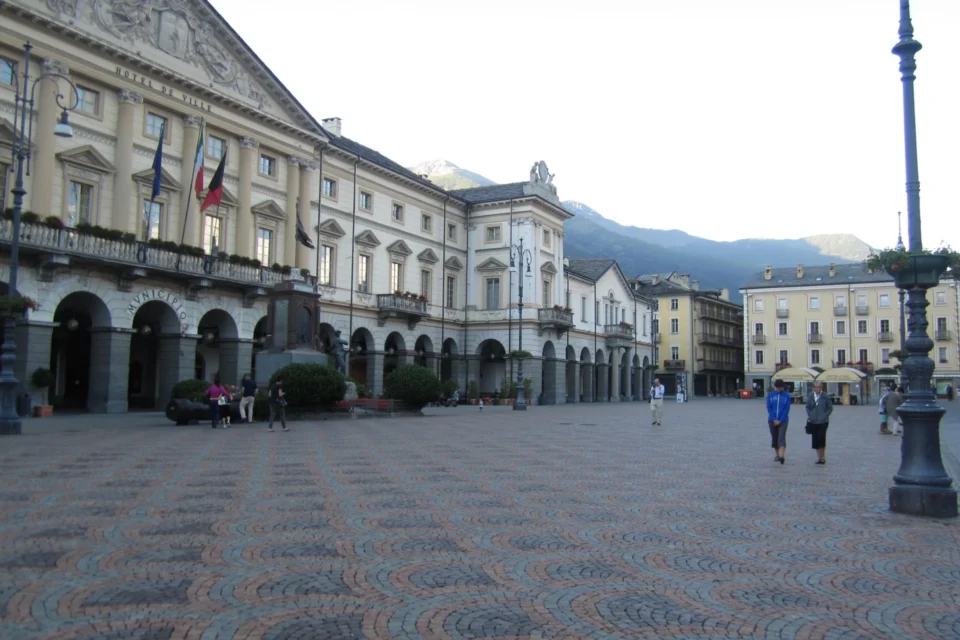
Piazza Émile Chanoux
Listed by the official regional tourism portal on its Aosta city page (opened 2026-08-31) as 'Piazza Chanoux e il Municipio (Hôtel de Ville)'; historic…
Ponte Romano sul Buthier (Pont de Pierre)
Listed by the official regional tourism portal on its Aosta city page (opened 2026-08-31) as 'Ponte Romano sul Buthier'; Augustan-era bridge in public space.…
Porta Praetoria
Listed by the official regional tourism portal on its Aosta city page (opened 2026-08-31); best-preserved Roman gate of its type, in public space. Street-level,…
Teatro Romano di Aosta
Ticketed site managed by Regione Autonoma Valle d'Aosta; cumulative ticket 'Aosta Archeologica' (EUR 10) includes theatre, cryptoporticus, San Lorenzo, MAR and Megalithic Area. Hours…
Torre del Bramafam
Official regional tourism portal page opened 2026-08-31 explicitly states 'non visitabile': exterior viewing only at any time, on the walls walking circuit. Exterior viewing…
Villa romana della Consolata
Official regional heritage portal page opened 2026-08-31: visitable by reservation with the 'Aosta Archeologica' cumulative ticket on Saturdays and Sundays 9-13; tel. 0165 275911.…
Journeys in Aosta.
Demo — Aosta Private Highlights Tour
Let a local expert design your Aosta day.
Tell us your dates and pace. A travel designer replies within one working day.